NYYS Jazz: Lineage
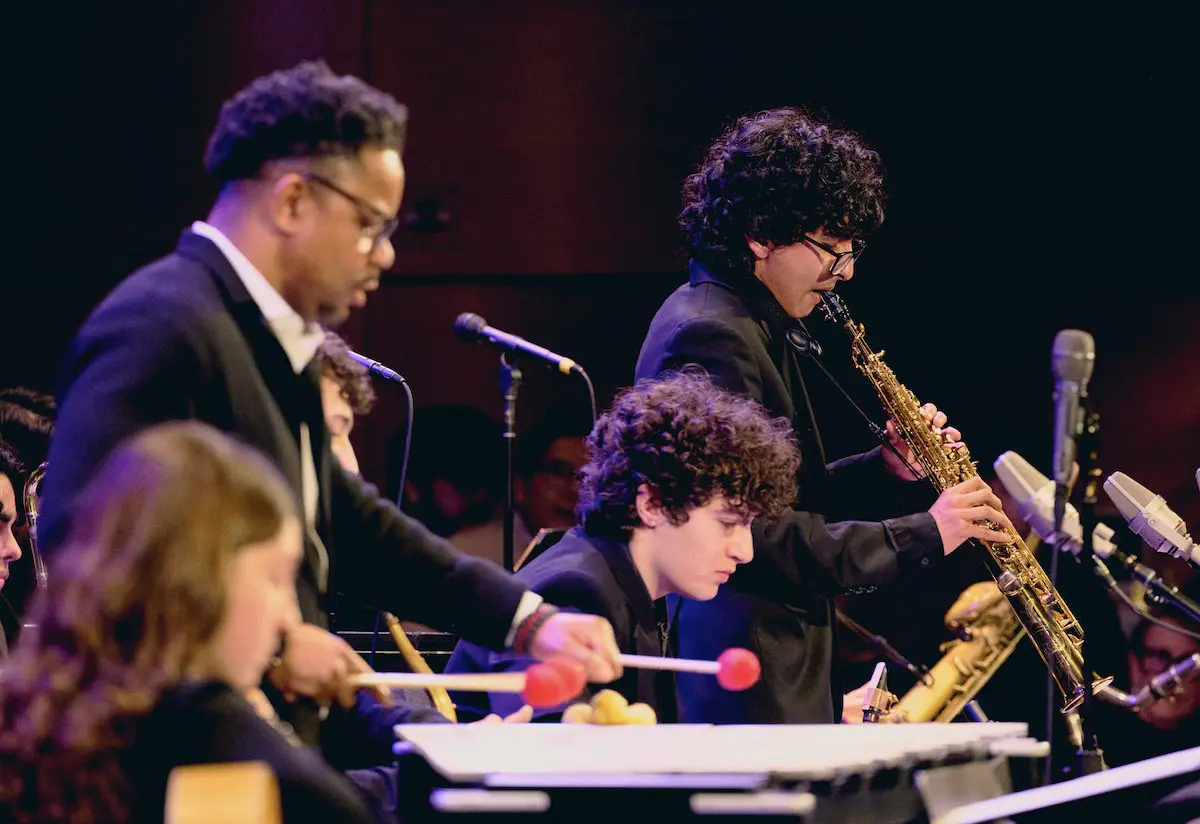
This is the second album by The New York Youth Symphony aka NYYS which is an ensemble of 17 remarkably mature musicians aged between 15 and 22 years. Their Grammy Award debut release in 2022 was an orchestral album featuring works by Florence Price, Valerie Coleman and Jessie Montgomery. Here they concentrate on the jazz repertoire, interpreting classics of the genre by Alan Ferber, Thad Jones, Wayne Shorter, Duke Ellington, Neil Hefti, Joe Henderson and some others.
Thad Jones’ Tiptoe, better known as Tip Toe, comes from his 1960 album The Best Of Birdland Vol 2. He often returned to it over the years and it eventually became part of the Thad Jones-Mel Lewis Jazz Orchestra’s book. A Rhythm chart, it has a swaggering soli from the trombone section along with some fine writing for the woodwinds. Trumpeter Emma Kelner in a cup mute and Levi Gingsburg’s ethereal Lee Konitz-like alto are pretty impressive here. The moody Infant Eyes has a fine contribution from Basil Moore on trombone and NYYS generate a relaxed Kansas City groove on a foot-tapping Splanky before really letting their hair down on that famous shout-chorus.
Alex Stewart’s definitive book Making The Scene listed no less than 60 bands active in New York City back in 1998. That was at least 50 years after the big-band scene had pretty well ended and although 1998 is a long time ago, things probably haven’t changed very much in the city today. The young musicians of NYYS and their band director Michael Thomas are to be thanked and congratulated for keeping the flame of big-band music alive and burning very brightly. As an introduction to this vinyl double album, Delay and Cottontail have been released as singles.
Discography
The Compass; Delay; Tiptoe; Infant Eyes; Cottontail; Ebony; Wildwood; Splanky; A Shade Of Jade (61.28)
Selected personnel: Emma Kelner, Edward Shen (t); Basil Moore, Thomas Leenhouts (tb); Connor Sobieri (ts); Giancarlo Crapanzano (bar); Scott Robert (p); Lucas Giordano (b); Zev Vestel (d). New York, June 2025
Outside In Music
Karsten Vogel: Late Night Ballads
Multi-instrumentalist Karsen Vogel’s eclectic list of influences include Albert Ayler, John Coltrane, Eric Dolphy, Charlie Parker, Paul Desmond and Stan Getz. The one that is most apparent here is Paul Desmond. Over the years Vogel has organised two popular jazz-rock groups – Burnin’ Red Ivanhoe and Secret Oyster. He has recorded over 70 albums, 39 of them as a leader and Late Night Ballads is his first release to concentrate almost entirely on evergreen torch-songs from the songbook repertoire. The exceptions are his own Open 24 Hrs and Bud Powell’s I’ll Keep Loving You from the composer’s first date as a leader in 1949 with Ray Brown and Max Roach.
Vogel negotiates this well-chosen material with a fragile, almost flute-like alto sound with each note carefully crafted to reflect the album title. Selections like Laura, You Go To My Head, I Remember You and Don’t Explain are perfect vehicles for his melodic variations. The provenance of Laura (a tune used extensively in the film of the same name) is particularly interesting. Its complicated melodic structure really needed Johnny Mercer’s distinguished lyric to turn it into a hit for Frank Sinatra, Dick Haymes and (surprisingly) Woody Herman. The latter’s 1945 vocal revealed another side to his musicality on a recording that apparently sold over a million copies. The last word on David Raksin’s classic can be found in Ted Gioia’s definitive book The Jazz Standards. The author quotes Cole Porter no less, claiming that Laura was the one song he most wished he had written.
Discography
Laura; You Go to My Head; I Remember You; Don’t Explain; I’ll Keep Loving You; Sweet Lorraine; Open 24 Hrs; In Your Own Sweet Way (42.13)
Vogel (as); Mads Sondergaard (p); Peter Hansen (b); Klaus Menzer (d). Copenhagen, 1 October 2024.
Storyville 1014370 CD
Sonny Criss: Selection d’Alain Gerber 1947-1958
The sleeve note claims that this is a “tribute to one of the 20th century’s greatest forgotten masters of jazz” and nobody could really argue with that. Jazz Journal used to have a popular feature called The Forgotten Ones and sadly there was never a shortage of candidates for that particular column. Buddy Collette, who was something of a mentor to Criss, points out in his autobiography that “Sonny was almost as good as Bird… but by the time he was 50 years old he was still not making any money and became very bitter.” He worked almost exclusively in Los Angeles (sometimes in strip clubs) but time spent in New York might have improved his career prospects. Charlie Parker, of course, was his primary influence, along with Benny Carter and Eddie Cleanhead Vinson.
CD1 concentrates on some of his earliest recordings although it does not include his work with Norman Granz’s JATP which included Parker in the line-up. Hot House is a remarkably mature performance for a 20-year-old. There is some fine Wardell Gray here too. Out Of Nowhere, one of the boppers’ favourite standards, has Criss at his most lyrical. Tornado, from Sonny’s first date as a leader, is credited here to Criss but it is actually Denzil Best’s Allen’s Alley aka Wee. His three choruses find him at his most inventive, accompanied by his long-time collaborator and friend Hampton Hawes. He shares the stage with Parker on The Squirrel and it is very difficult to tell them apart.
CD2 features his work from the 50s, when he was really in his pomp, playing with passion, invention and flair. With Barney Kessel he takes a fresh look at Alabamy Bound, which had been a big hit for Al Jolson in 1939. He was a master of the 12-bar form, as he demonstrates on Sonny And Sweets and especially his own themeless West Coast Blues. Caution is thrown to the winds on the outstanding Sweet Georgia Brown, which storms along fluently despite a tempo of 75 bars per minute. Another double album worth tracking down is Sonny Criss – The Complete Imperial Sessions (Blue Note CD24564).
Discography
CD1: Hot House; Sonny’s Bop; Out Of Nowhere; Flip’s Idea; Put That Back; The First One; Calidad; Blues For Boppers; Tornado; Irresistible You; The Squirrel; Broadway; A Smooth One (73.51)
CD2: The Two Mothers; Sonny And Sweets; Alabamy Bound; West Coast Blues; Sweet Georgia Brown; The Man I Love; After You’ve Gone; Ornithology; Night And Day; What Is This Thing Called Love; In The Still Of The Night; Easy Living; Willow Weep For Me; Wailin’ For Joe; I Got It Bad; Sylvia; Butt’s Delight (71.31)
Criss (as) with personnel including Harry Edison, Howard McGhee (t); Charlie Parker (as); Wardell Gray (ts); Jimmy Rowles, Hampton Hawes (p); Barney Kessel (elg); Leroy Vinnegar (b); Buddy Rich (d). Los Angeles, 1947-1958.
Frémeaux & Associés FA5913