
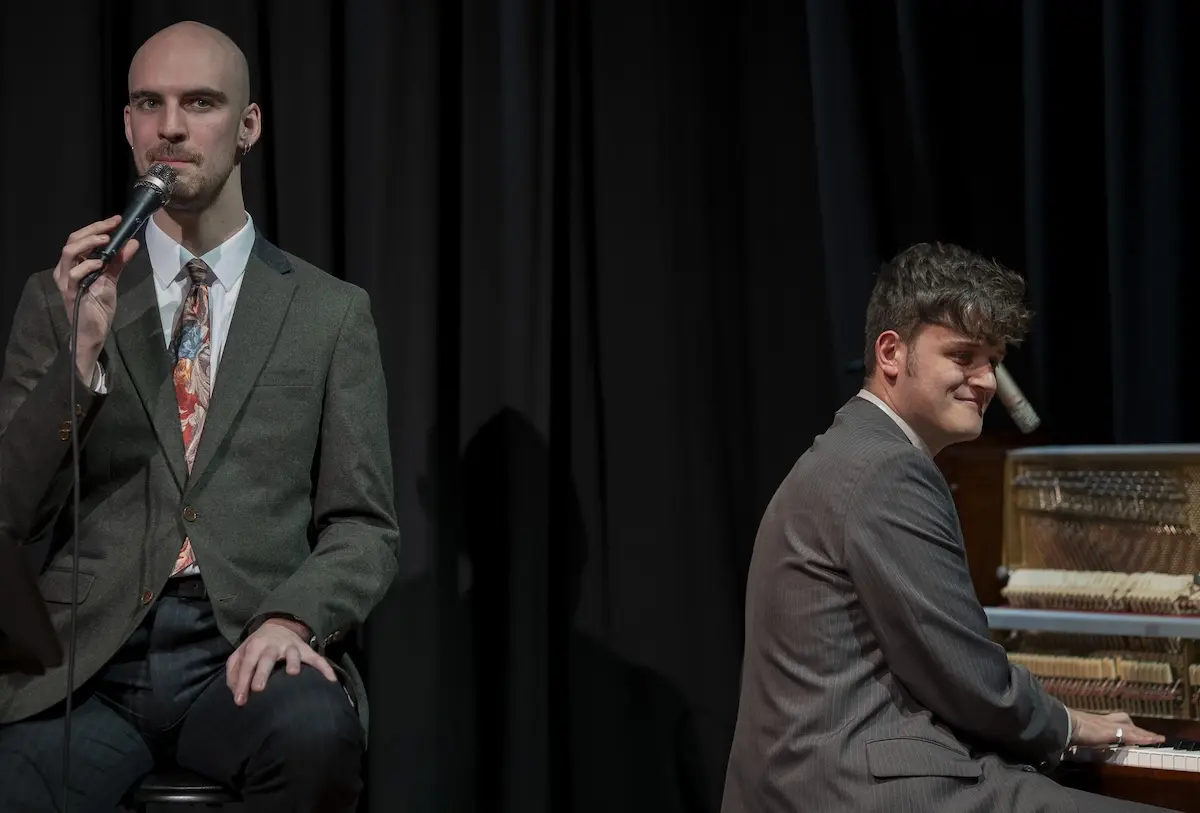
Some might feel a musical duo offers a third of the entertainment provided by a sextet or an eighth of that available in a 16-piece band; but music is not a numbers game. Being exposed, however, a twosome has to stack joint resources in order to provide something equivalent to its reduced status. Singer Elijah Jeffery and pianist Eddie Gripper also illustrate the sometimes forgotten observation that new male jazz singers neither arrive on the jazz scene in droves nor immediately connect with a sympathetic pianist; still less do the pair strike up a golden songwriting partnership.
The two Britons are promoting their eponymous first album, including at one pub venue where a noisy punter kept asking for a Buddy Holly tune. The more singer and pianist insisted that Holly was beyond their interest and repertory, the louder came the demands.
At this Black Mountain Jazz gig, in Abergavenny, they performed charts from the album alongside selections from the ubiquitous Great American Songbook as well as a few items not that far distant from Holly and his ilk. And they aren’t afraid to confront issues in their songs – matters of politics and of the heart – and pay respects to other piano-vocal duos whose achievements are historically significant, in particular the collaboration of Tony Bennett and Bill Evans.
From the second (1976) Bennett-Evans album Together Again, they chose Bernstein’s Lucky To Be Me and from the first, Evans’s Waltz For Debby, incorporating lyrics by Gene Lees. The words here, as with other selections – not least in the songs Jeffery and Gripper wrote in a self-imposed eight-week crammer before their album was recorded – depended heavily on, for want of a better term, sincerity. They were not carriers of facile sentiment but heart-warming stories that made the listener – well, listen.
That applied especially to James Taylor’s The Frozen Man, written for performance with Larry Goldings and depicting a voyager lost in pack ice during attempts to open up the Northwest Passage. Contrast that with another song of gravitas, the Jeffery-Gripper chart Good Honest Men, which elicited a knowing hum from the audience before a note was sounded, the title alone clearly echoing the current widespread absence of political principle.
Jeffery is a trained actor, and his theatrical experience was an aid to negotiating unhesitatingly the ramifications of love unrequited in Close Your Eyes. Maybe the two knew full well that there was already a synonymous chart in existence with different resonances.
Jeffery-Gripper is not a combination meant as a straightforward coming together for performance: it already displays the telepathy that makes songs speak with variety of tone and temperament, and not just with the eloquence and clear enunciation necessary for the listener to (a) understand what’s being sung/said and (b) assess the emotional claims being made.
Their inspiration is widely located – in folk music for the original True Love Never Dies (a grisly ballad) and I Live Not Where I Love (as in the version by Steeleye Span and Maddy Prior), in the GAS and jazz standard repertory for the charming pastiche of Because Of You (another original) and in pop/rock for the impetus of inspired reinterpretation (Joe Jackson’s It’s Different For Girls).
As a classically-trained pianist moulded to jazz by Huw Warren, Gripper doesn’t create an uneasy amalgam of two genres but a relatively unadulterated jazz style feeding off rich resources; Jeffery’s expressive range in the storytelling aspect of song feeds off it constantly in the manner – for this reviewer at least – of Kurt Elling. That both have the ability to discover the potential of nuance in what they write and perform augurs well and will continue to stifle the pub-audience bore who demands what isn’t intended to be in their gift.
Elijah Jeffery (vocals) and Eddie Gripper (piano) at Black Mountain Jazz, Abergavenny, 25 January 2026