Martin Speake Big Band: Hidden Vision
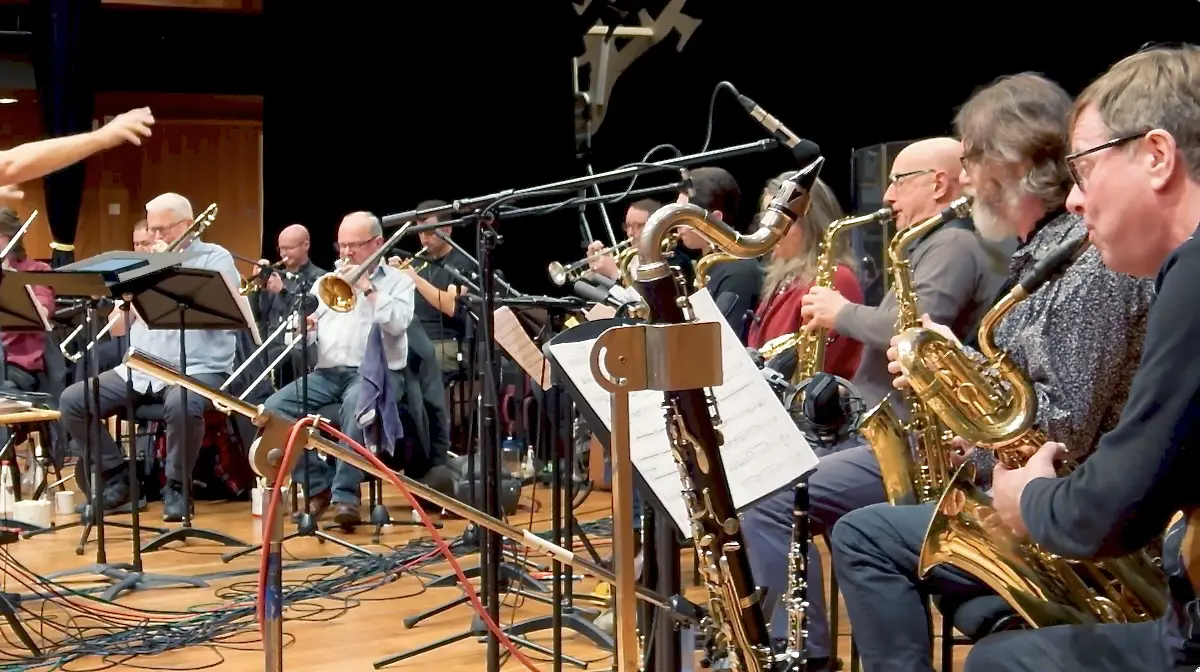
Altoist Martin Speake’s specially assembled big band fully justifies its reason for existence as the vehicle to transport the arrangements of his former student Charlie Rees, who has enhanced Speake’s original charts to the point of glowing revelation. Rees, still in his 20s and also a saxophonist, had previously got to grips with his mentor’s compositions in scores he wrote for the London Jazz Orchestra and performed at The Vortex in Stoke Newington and at Morley College.
So much is Speake history. There is, of course, more that might be called extra-musical. In the jazz world, only a head-in-the-sand recluse would not know that Speake the educator had become embroiled unwittingly in the Cancel Wars, where you can be written off as a professional if you say something with which an active cohort disagrees. In his case, it was the view that the British jazz scene was not racist; his opponents thought it was and “excluded” him, effectively denying him the right to work and earn wages at the place where he had hitherto done so with distinction.
Enough said; or maybe not enough. The album Hidden Vision – seven Speake charts orchestrated by Rees along with Jimmy McHugh’s Where Are You? – might be read as exuding a confidence that’s essentially Rees’s and a defiance that’s all Speake’s, the poise and assurance and support of band members being taken as read.
Rees’s approach is forearmed with knowledge of the modern arrangers of tradition but displays a knack for rummaging in its rattle-bag of nuance to subvert the limitations of the cliché-prone 17-piece – well, 17 plus the Guildhall’s wonderful Scott Stroman as conductor.
Everything is all of a thoughtful and thrilling piece.
Discography
Bill Wrathall; Always A First Time; Keith Jarrett; Tom; Keep In Touch; Twister; Where Are You?; Hidden Vision (58.05)
Speake (as); Charlie Rees (ts, ss, arr); Martin Hathaway (as, f), Alyson Cawley (ts, f), Duncan Lamont (bar, bcl); Louis Dowdeswell, Andy Greenwood, Tom Dennis, Steven Nichols (t, flh); Mark Nightingale, Jeremy Price, Martin Gladdish (tb), Simon Minshall (btb); Mike Outram (g); Emil Viklický (p); Matt Ridley (b); Tom Hooper (d); Scott Stroman (cond). London, 30 October 2025.
Pumpkin Records 016
Charles Lloyd: Sangam & Friends
Charles Lloyd’s new album of old recordings with his Sangam trio (tabla player and percussionist Zakir Hussain and drummer Eric Harland) offers seven tracks combining three trio performances recorded in America with three tracks of the trio plus Indian friends, and one with Lloyd alone on tenor saxophone with the friends but without Harland and Hussain. The extra-trio numbers were recorded in Mumbai.
The melding of musical cultures represented on all seven Lloyd charts, one an arrangement, furnish a clear example of how jazz may be considered a roughly circumscribed art whose boundary is pushed outwards at various places to the point where something new and remote from its jazz origins might be created. This is especially true where one of the admixed cultures is in thrall to the other.
Lloyd seemed to insist, however, on equanimity weighted slightly in jazz’s favour: “Sangam” is the name for where three Indian rivers meet, but he saw the musical confluence geographically as that of the Ganges (common to both), the Rio Grande and the Mississippi.
The trio charts find Lloyd in conventionally modal form – tertiary on Jai Ganga while playing tenor sax and flute with breaks between, playing flute only on Tagore and alto sax only on Bharati’s Dance, Tempo Divine. Harland and Hussain simply supply an exotic-sounding rhythmic support to an inspiringly meandering jazz trio; Lloyd, especially in the flying arabesques of the last, is spellbinding. He’s elsewhere willingly subsumed by the sub-continent: in the chant-like extemporised counterpoint of The Blessing, for example. But he whips the musical fusion into something funky on Sam On The Ganges (a redux of Sombrero Sam).
Discography
Clear The Dust; The Blessing; Jai Ganga; Tagore; Bharati’s Dance, Tempo Divine; Eternal Dreamer; Sam On The Ganges (45.25)
Lloyd (ts, as, f); Zakir Hussain (tab, pc); Eric Harland (d, pc); Vijay Prakash (v); Sabir Khan (sarangi); Rakesh Chaurasia (bansuri); Niladri Kumar (sit, elsit); Ranjit Barot (kyb). India, 2009. Trio-only sides from undated Sangam archives.
Blue Note 00199957662239
Eric Dolphy: The Quintessence
Among post-Parker saxophonists, Eric Dolphy would stand out even if posterity had not been robbed of a rising stature by his death at 36. He accepted 1961 dates in Europe accompanied by local musicians, but plans back home to build on his collaboration with Booker Little were to collapse when the 23-year-old trumpeter died. Three years after his Continental sojourn and while on another, Dolphy failed to emerge from a diabetic coma. Parker had died in 1955, aged 34.
This two-CD selection from Frémeaux by definition covers a truncated period in recording terms, beginning with a 1949 chart, Gassin’ The Wig, by Roy Porter and his 17 Beboppers and ending with some of the 1961 Dolphy quartet sides in Europe. The only gap is the 10 years from 1949 to 1959, at the end of which he recorded as a member of the Chico Hamilton Quintet. But during that time, he was refining and expanding his style.
These early days were on the West Coast, where Dolphy was born in 1928. West Coast bop was, well, West Coast jazz, a breezier, less stiletto-sharp version of the East Coast’s. But a year after the Hamilton sides, Dolphy was in New Jersey, recording with his own quintet (Freddie Hubbard, Jaki Byard, George Tucker, Roy Haynes) and contributing to the evolving modernism of Easterners with his Los Angeles credentials. Thereafter, all the activity bar the European (Denmark) is in New York, with, among others, the Oliver Nelson Sextet, the Ken McIntyre/Dolphy Quintet and his own quartet (the fabulous Out There album, on which the leader plays his three instruments of choice and Ron Carter plays cello). Other Dolphy appearances are with bands led by George Russell, Carter, and Mal Waldron.
Discography
CD1: (1) Gassin’ The Wig; Miss Movement; Lady E; GW; 245; Les; April Fool; Alto-itis; Curtsy; Lautir; Out There; Serene; The Baron; 17 West; Feathers (70.14)
CD2: Far Cry; Miss Ann; Tenderly; ’Round Midnight; Rally; Saucer Eyes; Warm Canto; Warp And Woof; God Bless The Child; Fire Waltz; In The Blues; Don’t Blame Me (73.27)
(1) Dolphy (as, f); with Roy Porter & His 17 Beboppers, Chico Hamilton Quintet, Oliver Nelson Sextet, and others. Los Angeles and New York, 1949-1960.
(2) Dolphy (as, cl, bcl); with the George Russell Sextet, the Ron Carter / Dolphy Quintet, the Mal Waldron / Dolphy / Booker Ervin Quintet, and others. New York and Copenhagen, 1960-1961.
Frémeaux & Associés FA 3074