What a pleasure to host a festival gig alongside jazz broadcaster John Hellings (BBC, commercial radio passim, Serenade Radio), at which music and reminiscence co-mingled. As it was the renowned Abergavenny Food Festival – a two-day annual event – we’d had to devise a format that combined the music and the comestibles, so we rummaged with AI in the history of tunes with food or drink in their titles. There turned out to be a lot more than Tangerine and Watermelon Man, but we included them anyway. How could we not?
John presently hosts an hour-long programme of jazz on Serenade, one of the UK’s internet radio stations, not the least attraction of which is the absence of news bulletins, adverts and other interruptions. It’s music – and comment – all the way. I’m happy to plug Serenade at a time when jazz on the BBC resembles a quarry to be hunted down, though obviously one that provides a meal rather than a bloody scalp after its moveable hiding-place has been discovered.
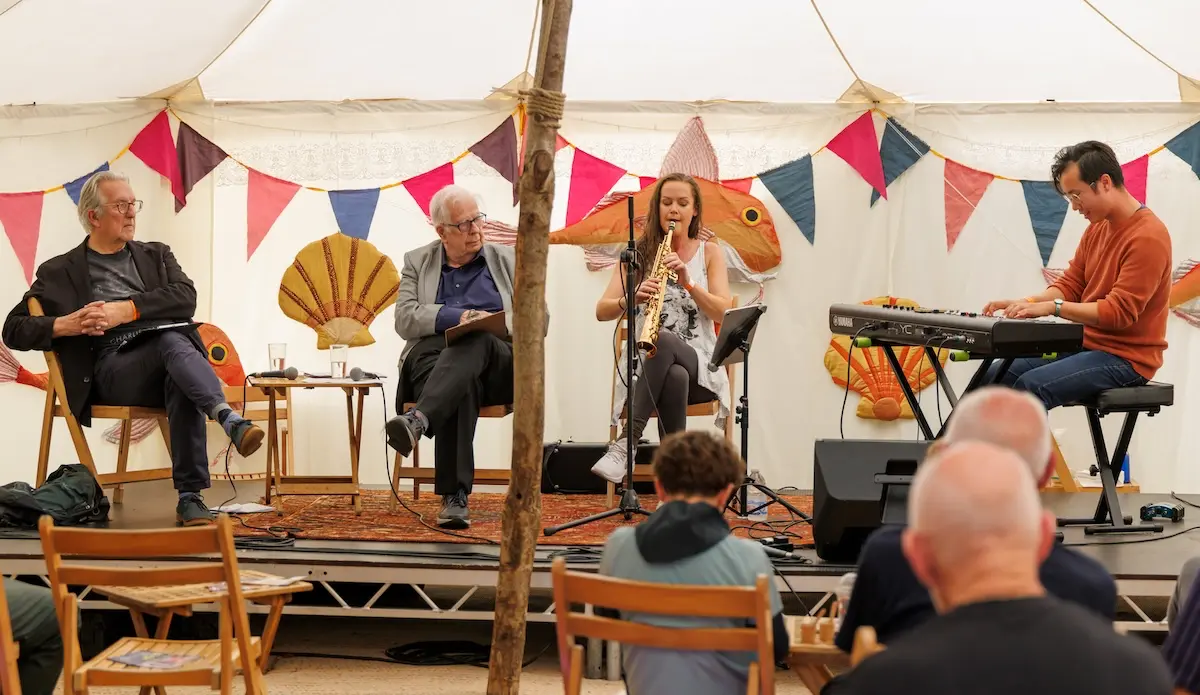
Our gig was called From Barbecue To Black Coffee, and joining us on the podium in our tent were the talented Martha Skilton on soprano sax and Newman Tai on keys. The event that preceded ours – every year the festival’s zillion attractions seem to fall over each other in pursuit of its zillion wrist-banded punters – was The Kids’ Restaurant, a worthy attempt to “re-imagine our food future”, ie., the eco-friendly future of healthy food production and presentation. It involved the youngsters themselves no less than seriously pontificating adults, and at the end they made little tubs of salted caramel ice cream for everyone, including us.
Events in tents, or mini-marquees, are always interesting for the passers-by whose curiosity gets the better of them and tempts them to linger at the entrance. This time they included those who’d come to see us and had turned up just when the Kids & Co. had reached a pitch of ecstasy in their enthusiasm for reimagining our food future. Among them were Ian Mann (of The Jazz Mann blog) and his wife, Pam. The kindly Ian was sitting at the front when the show began. I imagined we were performers indoors who had espied a less kindly critic in the audience and were under pressure. Then I realised that, having been MC at a few gigs with the spotlight on the stage and the premises in darkness, the audience would have been invisible. But this was a tent in the afternoon and they weren’t. It was just as well, because the house was full. There’s no sight more welcome to performers than a full house, especially when you can see it, and even when there’s a critic in the audience and its not a full house but a full tent.
This being a food festival, our musical take on things was strictly defined. We couldn’t have decided to reimagine our jazz future, as the curious would probably have departed prestissimo, as fast as Anita O’Day’s performance of Tea For Two at the 1959 Newport Jazz Festival. John mentioned that. I knew he would. He also reminded me in the planning that many tunes beloved of jazz musicians were double entendres, which in turn reminded both of us that dodgy innuendo wouldn’t go down well today. It didn’t stop us noting the fact or me, a lapsed Methodist, realising that when Bessie Smith sang I Need A Little Sugar In My Bowl she wasn’t referring to breakfast or cornflakes.
Chatting with Newman Tai before the gig, we noted how many male musicians had been nicknamed Fats: Waller (naturally), Navarro, Domino (we’ll let him in), Heard (Eugene, not J.C., though both had been a drummer in the Erroll Garner Trio); and when we’d run out of examples, there was also the realisation that, today, to be called Fats would be like being called Snotty – not very nice. In the old days they obviously didn’t mind, nor could they deny knowledge of why they were called Fats. I mean, they were fat, or of euphemistically ample proportion, or portly. As were Jimmy Rushing, King Oliver, Oscar Peterson, the young Louis Armstrong, Joe Turner, Bessie, Mahalia Jackson, Dave Bowman (trombonist in Bud Freeman’s Summa Cum Laude Orchestra), Cannonball Adderley, Ella Fitzgerald, Ma Rainey and the 21-year-old Sidney Bechet. Charlie Parker in decline, of course, was not so much fat as bloated. Today, they’d all be described as larger-bodied, and not necessarily because they couldn’t keep their paws off the cakes and sausages; also today, they’re generally much thinner and drink mineral water at gigs. It seemed, as our show progressed, that obesity, as much as smutty insinuation, belonged in the past. A bit like the six charts we hit upon: Struttin’ With Some Barbecue (Lil Hardin), Tangerine (Victor Schertzinger), Tea For Two (Vincent Youmans), Watermelon Man (Herbie Hancock), Salt Peanuts (Dizzy Gillespie & Kenny Clarke), and Black Coffee (Sonny Burke). We held Goodbye, Pork-pie Hat (Charles Mingus) and The Frim Fram Sauce (Evans-Ricardel) in reserve.
Maybe it’s not strange that the innuendo was sexual and that women bore the brunt of it, if that’s the appropriate expression. John had noted, though we didn’t include it in the show, that when Diana Krall was asked what “chafafa” meant in the words to The Frim Fram Sauce (“I want the frim fram sauce with the Ausen fay / With chafafa on the side”) she said “It’s all about sex.” Isn’t it – wasn’t it – always? Goodness knows what “the Ausen fay” was. Just don’t ask.
It behoved us to explain why jazz musicians were attracted to foody tunes. My theory was that they often lead such crazy lives that their attitude to sustenance, or food, was not so much a consequence of hunger as ravenous want. I adduced a few examples. For another, turn to the social media pages of former Jazz Journal contributor and tenor-man Simon Spillett and news of his recent travels while gigging in the West Country. But the titles weren’t always about food directly. Tangerine was written by film director Schertzinger for his 1942 movie The Fleet’s In, and was not a fruit but an alluring South American maiden, who commanded the attention of both men and women. This was wartime, and South America was subject-matter for escapism. Just as well, because the film’s plot was endearingly barmy. But Johnny Mercer’s words to the songs were a sort of poetry: his Tangerine had “eyes of night / and lips as bright as flame”. The film also included I Remember You, another jazz standard in waiting. We didn’t have anyone at our gig to sing those tunes that had words. John and I volunteered but we failed the audition, even for the two-word lyric of Salt Peanuts.
Seeking information about those six charts led to deeper levels that offered information surplus to our needs – the knowledge, for instance, that Black Coffee was plagiarised from Mary Lou Williams’s What’s Your Story, Morning Glory? via the dab hand of sometime Jimmie Lunceford arranger Billy Moore; and that Herbie Hancock, who wrote Watermelon Man as a commercial chart to help promote his first album as leader, earned enough royalties from Mongo Santamaria’s version (words by Jon Hendricks) to pay his domestic bills for five years. Apocryphal tale or not, our audience liked it. And we liked the salted caramel ice cream.