
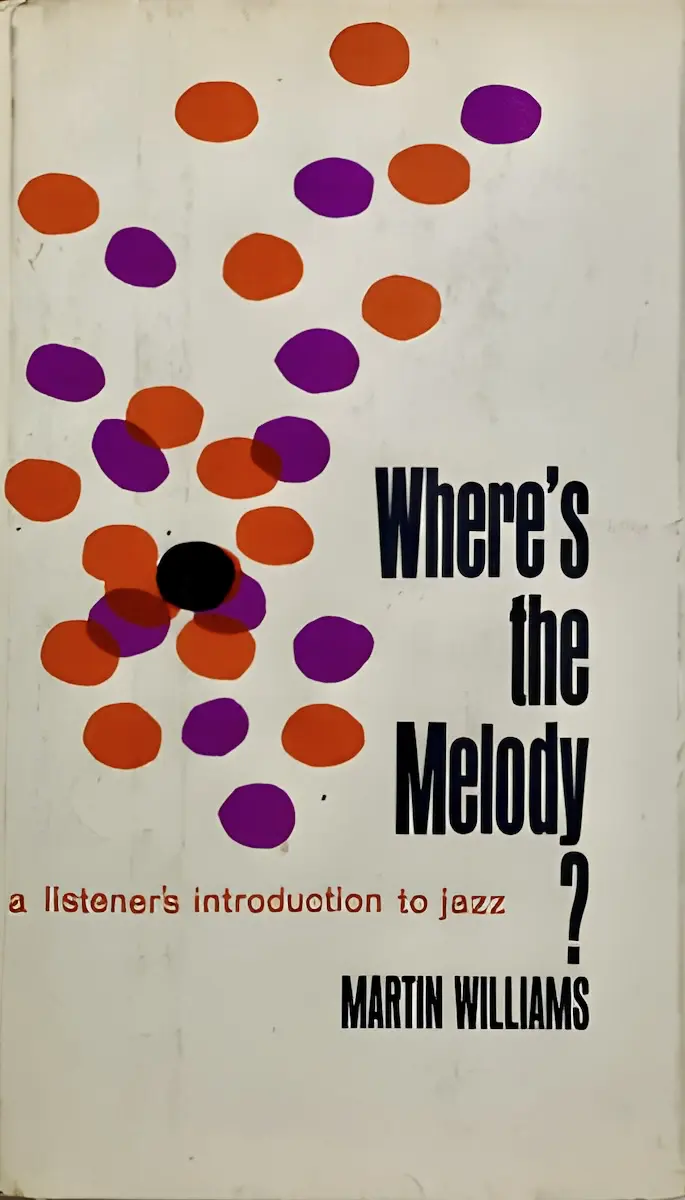
There have been many books written to introduce the novice to the exciting world of jazz but this was undoubtedly one of the most disappointing I have read. It is extremely disjointed and my impression (I hope a wrong one) is that Mr. Williams had on his files a miscellaneous assortment of left-over articles, which he decided to amalgamate as an introduction to jazz. The contents are divided into three sections. The first ‘On the music’ consists of a brief outline of what jazz is; a short look at the blues (which by the by uses some well-chosen recorded examples); an analysis of eight recorded solos; an explicit chapter on jazz composition; a very brief history of the stylistic changes in jazz; and a chapter giving selections for a basic jazz library. The latter I am afraid makes the assumption that every reader will approach the subject like a dedicated student rather than a bigoted fan.
The section ‘On the scene’ deals with four musicians at work, viz Monk, Milt Jackson, Big Joe Williams and Jimmy Giuffre. Pleasant enough reading for a warm summer’s night but surely mere sweetmeats when a good main course should have been served. I also found the writing, particularly in the Giuffre section, to be a bit ‘precious’ – take for example ‘. . . The room holds a pause for a couple of beats after which Giuffre speaks for the three of them, “Let’s do some more.” Peacock wiggles his eyebrows in assent. Friedman moves to the piano. …” Less pretty prose and more solid substance would have made this section less dispensable. The third part comprises short studies of Horace Silver and Billie Holiday; four and a half pages of nothing devoted to Gene Krupa which inexplicably end in eulogising Roy Eldridge; some easy knocks at Shearing, Peterson. Jamal and Brubeck (sitting targets and hardly worthy of Martin Williams) and finishes with a few pointers on Ornette Coleman entitled ‘The new thing in jazz’.
The basic conception of this book is a good one, to present the story of jazz through its music and musicians without recourse to stylistic divisions. But it fails to carry through this praiseworthy ambition, the choice of material being, as I pointed out, so fragmentary that the theme quickly gets lost.
Martin Williams has written far better work than he displays in this book and I am only too sorry not to be able to recommend it to readers of this journal but unless they be absolute beginners, I doubt if they will find much of value here and if they are just starting out there are far better books than this to point them along the way.
Where’s the Melody? by Martin Williams (Pantheon Books, price $4.95)