Doug MacDonald Trio: Live In Beverly Hills
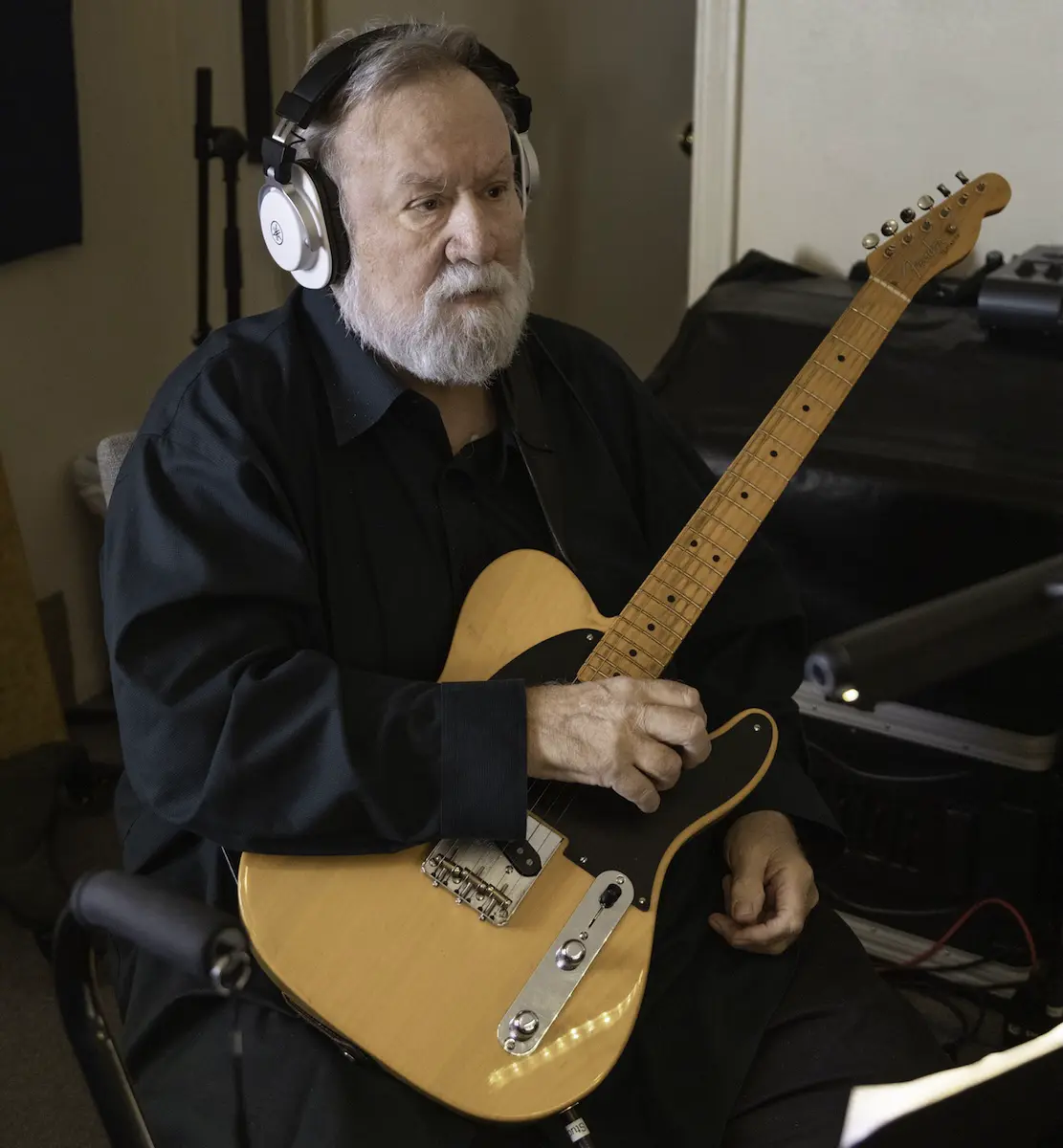
Fourteen years is a long time for a recorded jazz gig to become available, especially when its instigator confesses that his drummer on the date “just happened” to tape it. Even by jazz standards, it seems hyper-casual. But here it is: a rough-cut live session in 2012 by guitarist Doug MacDonald and his trio. The prescient drummer was Billy Paul and the bassist and singer Lou Shoch, who has since died. If these names seem unfamiliar, it only serves to emphasise how self-sufficient some regions of America are in jazz. MacDonald refers to “LA area musicians”, suggesting that they don’t travel far unless they make a record, which does the travelling for them.
Originally from Philadelphia, MacDonald began his career in Hawaii, where he played with Trummy Young and Gabe Balthazar, and with Del Courtney at the Royal Hawaiian Hotel. Relocating to Las Vegas, he began playing in lounges and showrooms with such as Joe Williams, Carl Fontana, Jack Montrose and Carson Smith. On to Los Angeles, he played in the bands of Bill Holman, Ray Anthony and John Clayton and performed and recorded with Jake Hanna, Rosemary Clooney, Jack Sheldon, Bob Cooper, Ross Tompkins, Ray Brown, Buddy Rich and Ray Charles.
Here, vigorous chords slice through the charts in MacDonald’s sinewy guitar style, and his solos trade much with Paul’s rat-a-tatting ones and the attenuated efforts of Shoch – so much so that The Night Has A Thousand Eyes extends to an overlong eight minutes. MacDonald might have employed some calmer tempos; instead, it’s an up-and-at-‘em session which starts well, with the leader and the bassist sharing the head on Luis Bonfa’s Samba De Orfeo. Shoch is a natural as the singer on Louis Jordan’s Early In The Morning.
Discography
Samba De Orfeo; Unimpressed; Mail Blues; The Night Has A Thousand Eyes; Early In The Morning; Baubles, Bangles And Beads; Yesterdays (37.51)
MacDonald (g); Lou Shoch (b, v); Billy Paul (d). Los Angeles, 19 May 2012.
DMac Music DM28
Sylvie + Ursula: New Eve
After winning the BBC Young Jazz Musician 2024 title, bassist Ursula Harrison told me that she usually avoided calling herself a jazz musician. This was not from any antipathy towards the music or any misgiving she might have felt about subjecting herself to mild interrogation by a jazz magazine. Nor did it appear to stem from any possibility that one day she might cease to avoid calling herself one. Singer Sylvie Noble, Harrison’s duo partner on this refreshing and eloquent début album, would doubtless say much the same thing about her own genre status.
But, in both cases, what they perform together is not so much jazz by strict definition as jazz by core value, which makes Harrison’s admission to me more a sign of the times than paradoxical disclosure. Compositional credits are shared, and the way the charts are sung and played is jazz by any other name. The lyrics are “written by hand”, Harrison told me, meaning that they were not all, at the time of the album’s release, available in formally printed shape. I obtained a few pdfs of words and scores, one with its tempo marked unambiguously “rubato as hell” (very jazz-like).
There’s a sense in which every performance of these songs will be different, for the duo’s secret lies in Harrison’s personification of the bass and Noble’s skill in encouraging its almost human responses. The bass solo on Distant Haze, for instance, is a wordless reiteration of what’s just been sung; elsewhere, there’s scat ’n’ bass playfulness, cheeky accelerations of tempo (Country Song), a hymn to the unsung (Nameless Folk), processional solemnity (Arizona), and touching poetry (Days Go By). The lyrics represent sentiments unravelling along a line or in a circle rather than in strophic blocks, and Harrison’s bass is part of the process, offering inventive argument, commentary and chivvying support to existential vocals often moulded Betty Carter-like by Noble. An adventurous first album, giving the tale-telling voice an edge and the bass a narrative equivalence.
Discography
Country Song; Who Knew I’d Miss The Rainfall; Distant Haze; New Eve; Dance; Nameless Folk; Arizona; Days Go By; I Was Alone (31.06)
Noble (v); Harrison (b). Pembrokeshire, August 2025.
Flaming Sword Records FSR 0001
Yetii: Inner Worlds
A piano trio is called such only because the piano harbours the most comprehensive sonic armoury. That said, attempts to make it first among equals have been going on since Bill Evans and the early outings with bassist Scott LaFaro almost made the piano trio, so-called, sound like a bass trio. It would never have been a drum trio. All that didn’t last long, but things wouldn’t be the same again for the vamping keyboard, the chugging bass and the bomb-dropping, cymbal-riding drum kit.
Enter pianist Alex Veitch, whose piano trio is not called a piano trio, though it is and it isn’t. The Bristolian’s threesome, Yetii, nominally subsumes Veitch, bassist Ashley John Long and drummer Alex Goodyear.
The inner worlds of Inner Worlds are established by the pianist as composer of 10 of the 11 charts – the 11th is by Abdullah Ibrahim – and are mostly reflective or impressionistic, with the mood likely to be changed by the bass and drums as sometimes arch modifiers, rather like substantial revisions on a calm surface. The opening May The Wind processes as limpidly as the figures on a Greek vase until the bass decides to move off at pace, and there’s a final intoning ostinato that carries over into Lost And Found, whose three-note motif is onomatopoeic against that pedal note. Again, bass and drums subvert the fugitive mood with a scurrying increase in tempo.
Enough wants to be a waltz, but everyone has other ideas in playing with time and tempo, and the following Resemblance includes some mischievous arco tremolos by Long; Goodyear is ever ready to spring subtle surprises, always with brushes except for the Ibrahim chart, on which he switches to hand-drumming. Summer Part 1 is left to Long’s provocative pizzicati, which slip over into the ballad-like Summer Part 2, in which the album’s distinction between more or less uniform mood and shifting temperament comes into focus. Afar is more conventionally piano-led, with busy goings-on elsewhere. But even on Spring, where piano defers to bass, giving way to a chase episode, the coda is one of total calm. Ibrahim’s Chisa, a township dance, begs the exploration of the group’s – or Veitch’s – outer worlds. They’ll doubtless be essayed with world-class, if less ruminative, music-making.
Discography
May The Wind; Lost And Found; Enough; Resemblance; Afar; Spring; Rolling; Summer Part 1; Summer Part 2; Hymn; Chisa (54.51)
Alex Veitch (p); Ashley John Long (b); Alex Goodyear (d). Cardiff, 2025.
Yetii 002