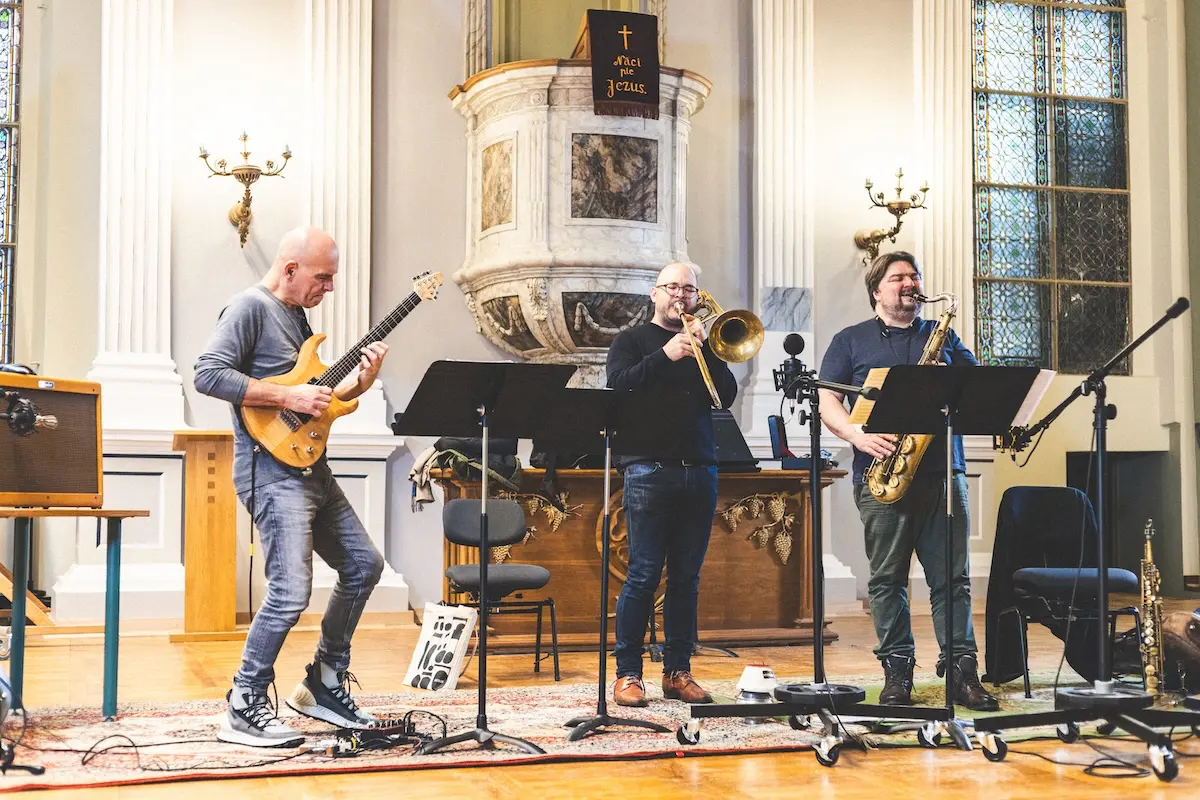
Liudas Mockūnas with Samuel Blaser & Marc Ducret: Twisted Summer
Swiss trombonist Samuel Blaser‘s Spring Rain (Whirlwind, 2015), a homage to Jimmy Giuffre’s short-lived trio with Paul Bley and Steve Swallow, revealed the depth of his admiration for the great American reedman. While it would tempting to view Twisted Summer as a celebration of Giuffre’s earlier trio with Brookmeyer and Hall, Blaser confirmed by e-mail that it was never the intention to use their music as a conscious blueprint. Instead what we get is something altogether more personal, music infused with Giuffre’s spirit yet avowedly contemporary in its approach.
Recorded direct to analogue tape with no edits or overdubs, each musician contributes one short chamber-jazz composition and one longer piece where ideas can play out at greater length. Just as with Giuffre’s seminal trio, the three share harmonic, melodic and rhythmic duties, and no matter how far their improvised dialogues stray there’s always a strong sense of underlying structure. The variety of moods and modes explored keeps the programme consistently engaging, and from the moment I pressed play I felt as if I’d been sucked into an irresistible vortex.
Mockūnas’s short chamber-piece Drop It introduces a session where a constant sense of danger and menace lurks in the shadows. Ducret’s 15-minute title track is a genuine tour de force, with some tantalising hints of Giuffre. The criminally under-appreciated Mockūnas has a wild solo that combines traditional phrasing with a unique approach to sound, and at the five-minute mark a tight rhythmic passage nods to The Train And The River, Blaser using it as a springboard into some earthy blues. Mockūnas’s Air features a masterful solo from the trombonist, moving from scarcely audible lower-case timbres to explosive rasps. On Blaser’s How Lovely Ducret’s ethereal delay joins the dots between Giuffre’s Americana and Bill Frisell’s chamber vignettes, while the spiky polyphony of his closing Think Of 3 is constantly thrown off course by the ebullient collective improvisation. Venturing to places scarcely imaginable even to a visionary like Giuffre in the late 50s, Twisted Summer is nevertheless the perfect accidental homage by these three modern masters.
Discography
Drop It; Twisted Summer; Dama; Air; How Lovely; Think Of 3 (48.27)
Mockūnas (ts, bs, ss, cl); Blaser (tb); Ducret (elg). Riga Recording Studio, Latvia, 2-3 December 2023.
Jersika Records JRA025
Conic Rose: Wedding
While some musicians choose to play in an international style that is not rooted in any particular location, Conic Rose’s dreamy fusion of jazz, indie-rock and electronica could only emanate from Berlin. Living and working in the city’s culturally diverse Wedding district – hence the title – they sound qualitatively different to their Scandinavian, Belgian or US electro-jazz counterparts. It surely helps that the group’s studio is located in the middle of the neighbourhood, and even though I’ve only ever passed through the area briefly I can nevertheless detect a strong sense of authenticity and place.
This is the group’s second full-length studio album, and their evolution since 2020’s Babyghosts EP has been one of constant refinement. The group is built around the trumpet and flugelhorn of Konstantin Döben and the keyboards of Johannes Arzberger, both of whom could easily hold their own in the world of straight-ahead jazz. Similarly, bassist Franzi Aller is as comfortable playing post-bop with saxophonist Tony Lakatos as writing for a classical string-ensemble, while guitarist Bertram Burkert cut his teeth with Michael Wollny, Frank Möbus and Richie Beirach. Yet the point of Conic Rose is not to mine one particular idiom. The band is as likely to lean into Radiohead and Bonobo as Miles or Coltrane, glitch techno or Krautrock, and each is a part of their natural musical reflexes.
While recognisably cut from the same cloth as 2023’s Heller Tag, the record feels ever so slightly more relaxed and polished. Several of the keyboard-driven pieces, including the title track and the haunting Less Lonely, have an appealing post-Stereolab retro-pop sensibility. The relaxed groove and melodic melancholia of Too Many Flowers carries echoes of Wolfgang Haffner’s millennial NuJazz, while the fractured beats of Patterns nod to experimental electronica. Elsewhere, Döben is at his lyrical best on ambient-jazz ballad Never Ending Story, and Burkert’s guitar colours the otherwise breezy Twist with a harsh industrial edge. Short, punchy and full of memorable hooks, this set finds Conic Rose bringing new twists to NuJazz. They are surely destined for greater things.
Discography
Future Has Got You; Less Lonely; Twist; You Gonna Help Me; Too Many Flowers; Wedding; Loving Parents; Never Ending Story; Patterns; Walking Memories; Kids; Prophet Spring (45.11)
Konstantin Döben (flh); Johannes Arzberger (p, kyb); Bertram Burkert (elg, elb); Franzi Aller (elb); Nicholas Stampf (d); Silvan Strauss (additional d). Berlin, No dates.
Conic Rose LP03
Terje Evensen: Reclusive Mountain
Nothing like as well known as Bugge Wesseltoft, Eivind Aarset or Nils Petter Molvær, drummer and sound artist Terje Evensen is nevertheless a respected second generation figure in the new Scandinavian electro-jazz. Among his past achievements are the 2010 album Still You, You Still Here (Fonorum), widely believed to be one of the first web-only releases, and his collaborations with Molvær in the late Martin France’s band Spin Marvel. He has released numerous solo ambient-jazz projects from his studio, and this new five-track EP bears favourable comparison with the very best that this exciting sub-genre can offer.
Describing each piece as having its own dramaturgy, Evensen and his handpicked group of collaborators set about bringing each imagined scene to life. Both Molvær and UK ambient-guitar maestro Leo Abrahams appeared on Evensen’s wonderful 2019 double album Music For Paintings, while Julian Argüelles and Michel Godard are each deployed to great effect as guest soloists. Spin Marvel bassist Tim Harries brings his muscle to the groove-based pieces, and cellist Natalie Rozario provides a skein of grainy textural detail. Evensen’s mixing strikes the perfect balance between electronic and acoustic timbres, and with studio mastering from the renowned Ed Woods the music’s cinematic ambitions are equally matched by the impeccable production values.
On the the title track Molvær is in imperious form, his sweeping lyricism framed by Evensen’s tactile ambient backdrop. As the vista widens Harries locks in with Evensen’s chattering percussion, and Rozario emerges from the music’s deepest layers to negotiate some scarcely perceptible harmonic shifts. Leap Year is dedicated to Martin France and is a joyous assemblage of densely intertwined rhythms, while the constantly shifting spaces of the atmospheric Moody Zoo gain direction as Argüelles’ laser-like tenor cuts through a heavy dub-style groove. Harries is more fleet-fingered on Red Dot, shadow-boxing with Evensen’s unpredictable pulses, and the closing Glimpse Of Closeness very much belongs to Godard, his tender, emotive serpent commanding complete attention as it moves through Evensen’s beautifully barren landscape. Music to savour, again and again.
Discography
Reclusive Mountain; Leap Year; Moody Zoo; Red Dot; Glimpse Of Closeness (27.21)
Evensen (d, elec) with Nils Petter Molvær (t); Julian Argüelles (ts); Michel Godard (serpent); Leo Abrahams (elg); Natalie Rozario (clo); Tim Harries (b, elb); Studio Abstract Goat (location and date unknown).
Records Abstract Goat RAG 011