Bill Nelson’s Orchestra Futura: Live At Nelsonica & Clothworkers Hall
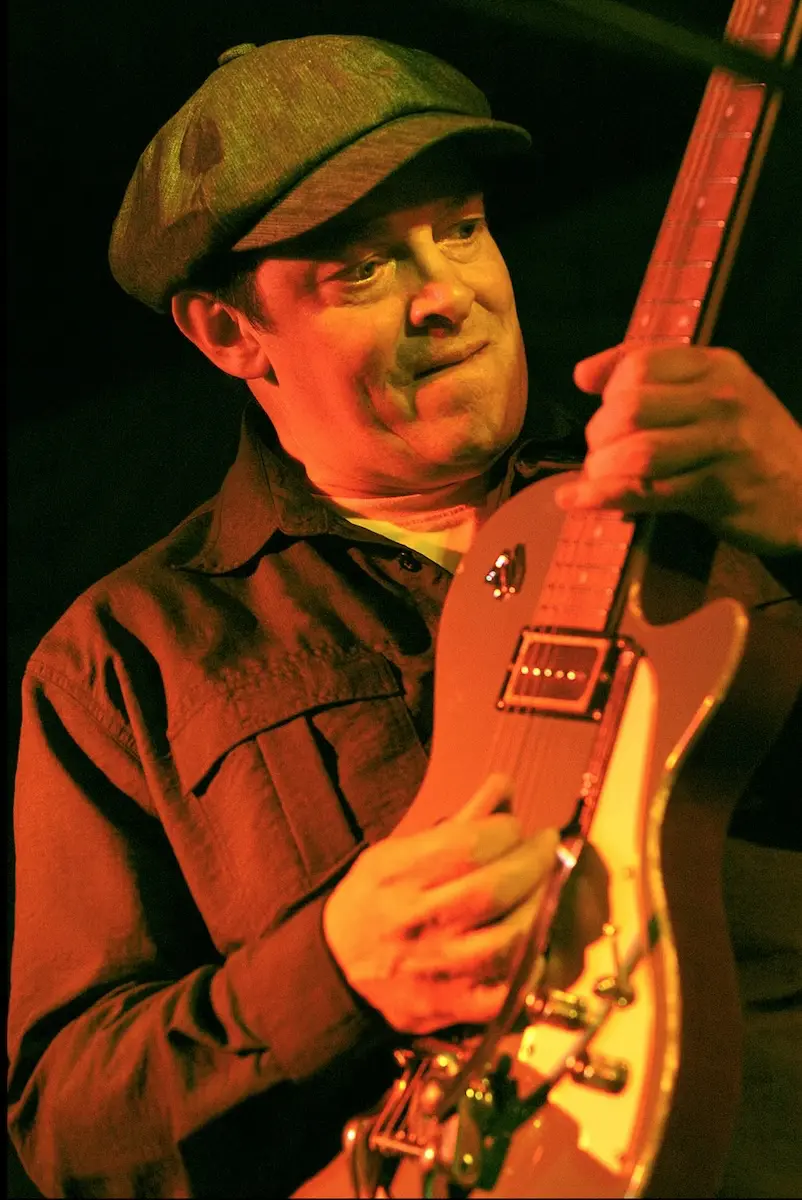
Guitarist, singer and composer Bill Nelson’s career began with Be Bop Deluxe, the rock group he led in the 1970s. The band scored a modest chart success with the memorable Ships In The Night from their album Sunburst Finish (Harvest, 1976) – ironically Nelson’s least favourite track on the album. Gradually tiring of the band he formed his own vehicle, Bill Nelson’s Red Noise, spawning a sole, more experimental album, Sound-On-Sound (Harvest, 1979).
Since then, Nelson has released over a dozen solo albums and collaborated with the likes of Harold Budd. Gleaned from live concerts performed between 2009 and 2019, his latest recording moves on considerably from the pop/rock world. Orchestra Futura comprises Nelson plus saxophonist and flautist Theo Travis (ex-Gong, Travis & Fripp and Steve Wilson and currently a member of the revivified Soft Machine). The trio is completed by bassist Dave Sturt (ex-Gong and Jade Warrior) and this is the record debut of this line-up.
The subtle opening of A Marble Solace, with repeated glockenspiel-sounding effects, affords a backdrop for Travis’s plangent flute and Nelson’s echoey, legato guitar lines all underpinned by Sturt’s sparse sustained bass-guitar notes. Pixels By Moonlight introduces a smorgasbord of sounds and backing tracks including Nelson’s heavy guitar chords. The album, a whole world apart from Be Bop Deluxe, is more comparable to the ambient soundscapes created by Robert Fripp and Brian Eno but with a richer, more diverse palette. On Starlight Men Travis’s flute shimmers over Nelson’s jangly guitar, the instruments interweaving seamlessly. The tremolo guitar opening to For The Sake Of Trains is soon joined by Travis’s soprano saxophone in reverberating counterpoint to Sturt’s bass anchoring the melodic instruments.
Whilst there is much improvisation within each track there is also a preordained structure which renders these performances far more satisfying than mere noodling. The closer Perfect Cloud, at just over 13 minutes duration, is presented as an atmospheric dreamscape involving lush guitar lines, wistful soprano saxophone and busy bass guitar runs. Interestingly, only at its conclusion with audible audience applause is the listener reminded that this is a live album and not a heavily multi-tracked studio one.
Discography
A Marble Solace; Pixels By Moonlight; Starlight Men; For The Sake Of Trains; Perfect Cloud (45.29)
Nelson (elg, hca, elec); Theo Travis (f, ss ts); Dave Sturt (elb, elec). Leeds & York, 2011-2012, 2018.
Ethersounds ESCD012
Julian Lage: Scenes From Above
Here’s virtuoso guitarist Julian Lage’s fifth album for Blue Note and 17th album to date. This quartet date features two new recruits to Lage’s line-up. John Medeski on organ and piano is a founder member of the renowned Medeski, Martin and Wood trio and has contributed to albums by John Zorn and others. Drummer Kenny Wollesen has a long professional career recording with the likes of Bill Frisell, John Zorn and Sex Mob. The group is completed by the inclusion of a long-time Lage collaborator, Peruvian bass player Jorge Roeder, who has recorded with the guitarist since his debut album Sounding Point (EmArcy, 2009).
The anthemic opener Opal sets the pace, subtly underpinned by Medeski’s sultry organ. Roeder’s bass line leads on Red Elm, which gradually builds in pace affording confident soloing by Lage and swirling interspersions from Medeski. Talking Drum opens with a bluesy lick transitioning into a country feel punctuated by three ascending organ chords and seven slurred descending ones. This pattern repeats, allowing Lage space for freewheeling soloing, the piece concluding with a satisfying coda of descending organ and guitar chords. The relatively restrained opening to Havens, with hand drumming, a repeated organ riff and Lage now playing acoustic guitar, concludes with a plangent chordal ending. The prayer-like Night Shade, opening with Lage’s delicate acoustic guitar notes, is characterised by Medeski’s soulful organ and its enchantingly haunting hook. On Storyville Roeder gives a tour-de-force pizzicato bass solo that’s swiftly followed by a swirling mêlée of guitar, bass and piano, resolved neatly by an ensemble coda. The laid-back Something More is guitar-led Americana played over sultry piano punctuated by stentorian piano chords.
Scenes From Above must rank as one of Lage’s best album to date. His recruitment of Medeski is ideal since the two musicians gel perfectly, the keyboardist subtly complementing Lage’s playing. With the addition of the virtuosic Roeder and Wollesen the line-up now resembles something of a super group. This is a very focused and cleverly crafted record which on repeated plays (something this wholly accessible album will surely invite) sears into the memory bank of the listener.
Discography
Opal; Red Elm; Talking Drum; Havens; Night Shade; Solid Air; Ocala; Storyville; Something More (42.28)
Lage (elg, g); John Medeski (org, p); Jorge Roeder (b); Kenny Wollesen (d, pc). New York, 22 May, 2025.
Blue Note 7893202
Dave Stryker: Blue Fire – The Van Gelder Session
Guitarist Dave Stryker’s homage to the great Rudy Van Gelder, who died 25 August 2016 aged 91, was recorded at the late recording maestro’s studio in New Jersey. Stryker’s trusty Gibson ES-347 is put to good use on this session comprising originals, non-originals and standards. Organist Jared Gold has played on Stryker’s records since The Chaser (Mel Bay, 2005) and McClenty Hunter has been Stryker’s regular drummer since Blue To The Bone IV (SteepleChase, 2011).
Explaining the album’s subtitle, Stryker says “This recording was a long-time dream for me. I had always wanted to record at Rudy Van Gelder’s studio but I never got the chance when he was alive. Thankfully, Rudy’s assistant Maureen Sickler and her husband Don have taken over the operation to keep it preserved.”
The opener, Van Gelder’s Place, is an irresistibly breezy 12-bar blues whilst the title track’s head is characterised by a torrent of ascending and descending notes before resolving into fast-paced solos by Stryker and Gold. The mood changes with a Latin-esque take on Lennon and McCartney’s The Fool On The Hill and once again with Charlie Parker’s Dexterity, where Stryker carves out crystalline guitar lines. On this tune and most of the others, Gold’s Hammond B3 forays invoke the feel of Larry Young, which is surely explained by the fact that he’s playing the original instrument that Young (and Jimmy Smith) used in Van Gelder’s studio. The tune ends with a snappy drum break from Hunter. The ballads Waiting For Ruby and Jerome Kern’s The Folks Who Live On The Hill amply prove that Stryker is more than capable of turning down the volume and velocity and playing with sensitivity and finesse. Once again Stryker has produced an album of high quality with the aid of two outstanding accompanists.
Discography
Van Gelder’s Place; Blue Fire; The Fool On The Hill; Dexterity; Waiting For Ruby; Back And Forth; The Folks Who Live On The Hill; Every Dark St.; Summer Night (56.10)
Stryker (elg); Jared Gold (org); McClenty Hunter (d). New Jersey, 14 July 2025.
Strike Zone 8828