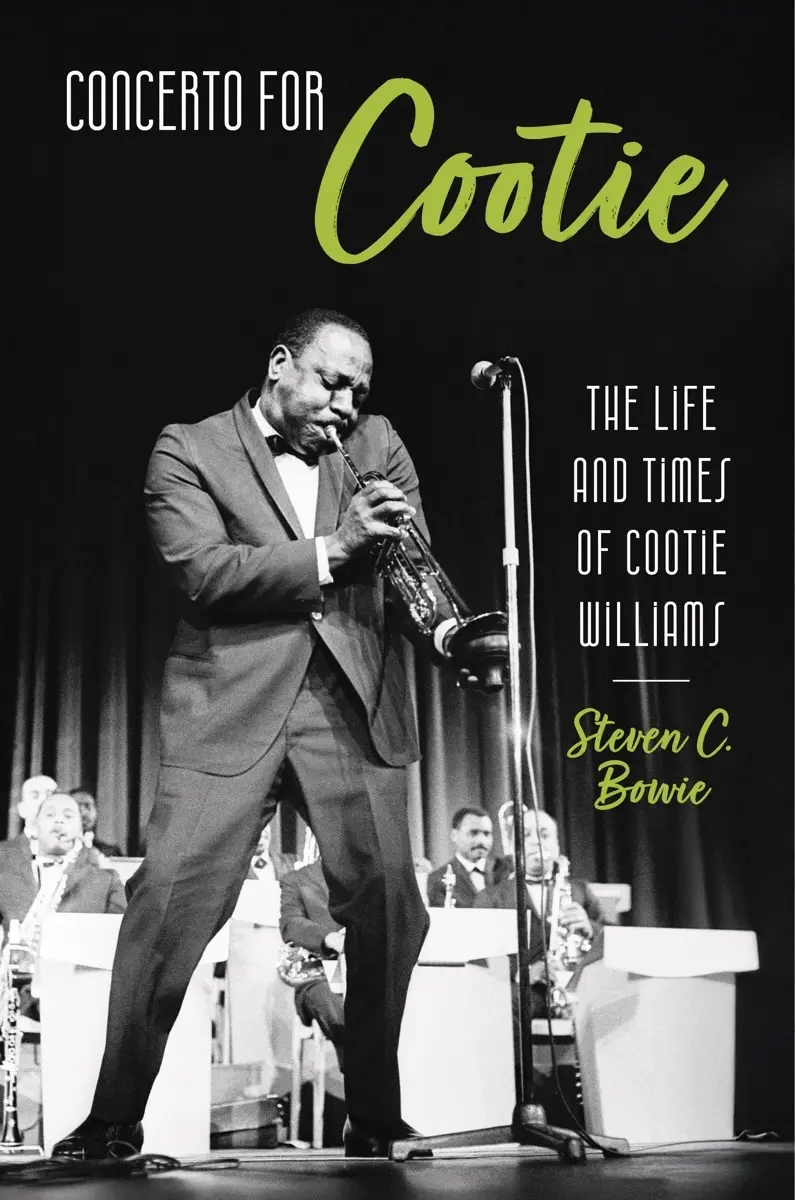
The genesis of this book provides a striking beginning to author Steven Bowie’s introduction. Way back in 2010 he dreamed he was standing by a bookstand and beside him was Cootie Williams, leafing through a book. Bowie asked him what he was reading and Cootie said “It’s a biography of me.” Then Bowie asked who had written it and Cootie replied “You did!” Fifteen years later the book in the dream has become reality and that time period gives some idea of the amount of research undertaken to make the book as thorough as possible.
Although the author is a musician he’s not over-concerned with analysis of Cootie’s hundreds of recordings, though he does comment helpfully on some of them from time to time. What’s really valuable for a reader familiar with those recordings is the revelation of so many details of the life and character of the man who made them. We learn much about Cootie’s family and childhood, his music lessons, his playing alongside Lester Young (in Lester’s father’s band) and his missing through illness the 1927 recording session by the Ross De Luxe Syncopators. Then he’s off to New York with Ed Hall to work briefly with Chick Webb and Henderson before the crucial move to Ellington. The coverage of the following dozen years includes many nuggets of information new to me and I’ll give one example. Buck Clayton was overwhelmed by Cootie before becoming aware of Armstrong, and he learned to play many of Cootie’s solos from the Ellington records (though he couldn’t manage the growling). And Buck even managed to get Cootie and Joe Nanton to growl the Wedding March for him when he was married in 1934.
The move to Benny Goodman and Cootie’s experiences with him are covered, again with many interesting details, before the story of what is surely the least known and least discussed part of Cootie’s career – half-a-dozen years in charge of his own big band. Here the author’s research proves invaluable and he’s able to quote Cootie himself (from contemporary articles and interviews which include a six-hour session in 1976) to bring this period to life. When the big band is no longer viable (like almost all others at the time) Cootie’s reputation finds him work (though no recordings) through the early 50s until his career is relaunched by the revival of interest in swing-era musicians. He makes several impressive LP recordings with fellow veterans and, in 1962, rejoins Duke Ellington. Like many others, I had the impression in the subsequent years that Cootie and Cat Anderson were not the best of friends. but the author has unearthed a comment from Cat on Cootie’s return which says “Cootie sounds as great as ever now … he just knocks us out when he starts playing … we’re so happy that he’s doing these things with as much talent as he ever had.”
So, of course, Cootie went on doing those things until the death of the leader and he recorded a magnificent Jeep’s Blues soon after that sad event, as the band carried on under Mercer’s leadership. Until now I hadn’t realised the extent of Cootie’s sporadic involvement with Mercer’s “heritage” band, but that apparently continued until 1980, when he signed off by giving his trumpet to a much younger member of the band – Barry Lee Hall. And I shall sign off by saying that this book reaches the standard of the finest biographies of jazz musicians and should certainly be read by anyone who’s been touched by the music of Cootie Williams.
Concerto For Cootie – The Life And Times Of Cootie Williams, by Steven C. Bowie. University Press Of Mississippi, 329pp and 114pp notes, partial discography and index. ISBN 978-1-4968=5944-0