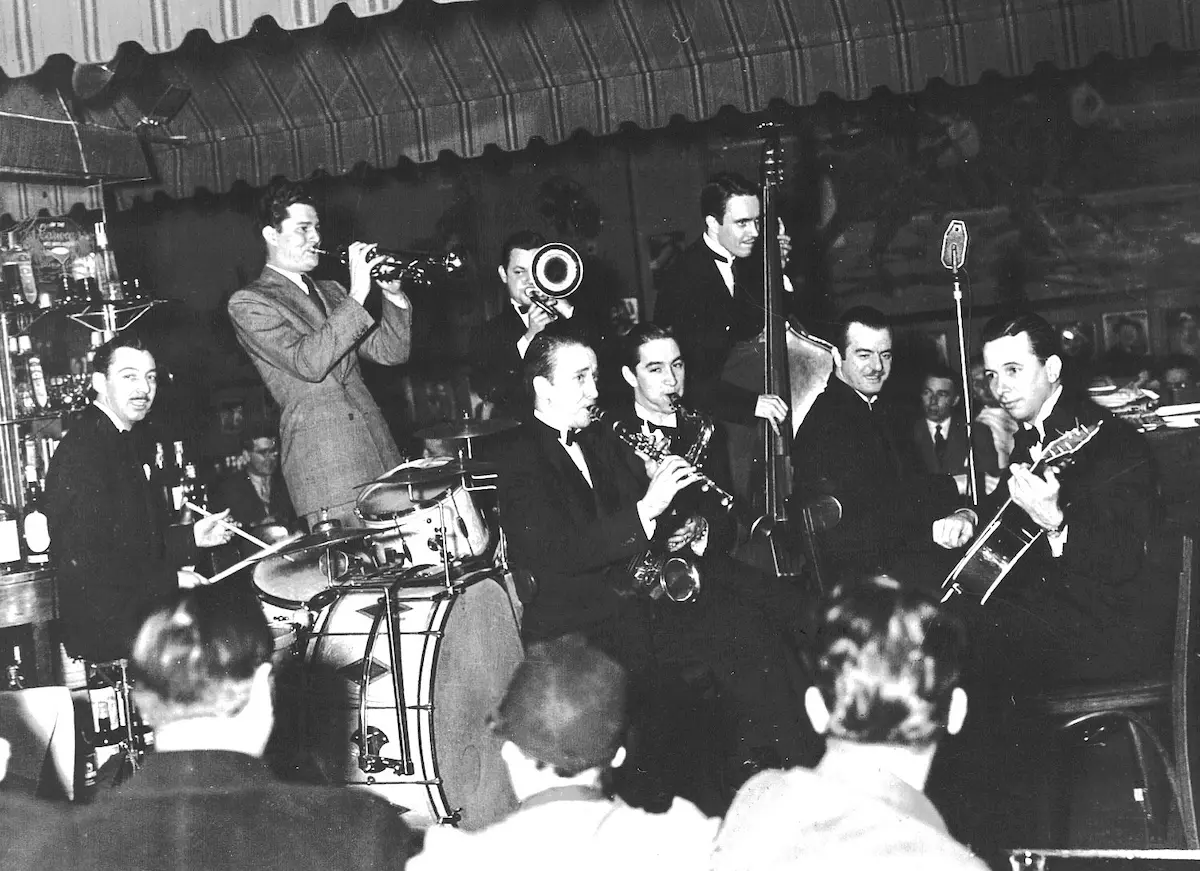
Bob Crosby: Classic Decca Recordings Of Bob Crosby And His Orchestra & The Bob Cats (1936-42)
I’ve reviewed some superb Mosaic sets – and that includes most of them. But their latest archival release is pure joy, and reminds us of the high quality of the Bob Crosby Orchestra, and its small-group spin-off The Bob Cats. The band originated when Ben Pollack’s musicians quit en masse over the leader’s infatuation with an unimpressive singer, Doris Robbins. In 1934, Bing Crosby was a star, and his younger brother Bob seemed a possible leader for the Pollack renegades.
The leader had to talk to dancers and diners, and sing a bit. Bob Crosby (1913-93) was personable enough, and sang with bands led by Anson Weeks and the Dorsey Brothers (1934–5). But Tommy Dorsey told Bob acerbically that he was “the wrong Crosby”, which according to Michael Steinman in his liner notes was “unkind but accurate”. Bob Crosby himself joked that “I’m the one with no hope” – referring to older brother Bing’s films with Bob Hope.
For Steinman, “His pitch and diction were good, but … Jess Stacy … said his style was ‘a cross between bleating and mumbling’.” Stacy heard him sing a thousand times more than I have, but on the limited evidence here, the putdown is unkind. For New Grove, “An unpredictable vibrato marred much of Crosby’s singing, but his rhythmic phrasing did much to compensate.” That seems a more just verdict. For my money, he’s the best of a variable selection of vocalists on these mainly non-vocal sides.
The Bob Crosby Orchestra made its début in June 1935. It proved highly popular, and was critically rated. For Ellington, they had “an amazing amount of colour … a truly gut-bucket band” and he ranked them with the Dorsey, Goodman and Whiteman orchestras. Steinman says that these comments were code for “White band that has succeeded in sounding Black”. Gunther Schuller described “a blending of the new big-band sound of swing with the freedom and loose-textured spontaneity of small-group Dixieland”. Bob Haggart commented that “We tried … to swing like a small band. So there wasn’t a lot of ensemble written … We did it in sections, like the Ellington band.”
The liner notes by Michael Steinman begin with some excellent quotes, notably “We had a great band … We played Bob Crosby-style Dixieland very well” (Czech writer Josef Škvorecký) and “I am not at heart a two-beat man, but there was a gutsy and musical feel to everything done by this two-beat band” (pianist Jess Stacey). As Steinman reminds us, the band’s music was made for dancing. Many compositions and arrangements were by band members.
Their style was described as Dixieland, which Matty Matlock and others bridled at – it seemed to imply inferiority to black New Orleans models. “Dixieland” is the post-1940 revival of New Orleans music, also known as traditional jazz. There were white bands in New Orleans such as the ODJB and Papa Jack Laine’s, but as J. Bradford Robinson writes in New Grove, “White musicians were slower to grasp the rhythmic swing and blues inflections essential to jazz, though … they made important contributions to its repertory and harmonic and melodic vocabulary.” He adds that as later white jazz groups such as NORK became more adept, there was less need to distinguish New Orleans and Dixieland.
The collection features outstanding soloists. Two of my favourites are pianist Jess Stacy and clarinettist Irving Fazola, but the release made me listen to pianist Bob Zurke (1912-44), whose pellucid work is prominent on Meade Lux Lewis’s Honky Tonk Train. Trumpeters are Billy Butterfield with a huge sound, Yank Lawson with his Southwest “wide beat”, and the pugilistic Muggsy Spanier. The clarinettists are a joy. Matty Matlock plays with New Orleans fluidity, while eccentric Irving Fazola’s sound is woody and dark. New Orleanian Eddie Miller was as urbane as his tenor- and clarinet-playing. Bob Haggart was the first white bassist to slap strings like Wellman Braud and walk like Walter Page. Drummer Ray Bauduc drew on Baby Dodds and Zutty Singleton.
The original band broke up in 1942. Bob Crosby went on to appear in many films, and served with distinction in WW2 with the US Marines, leading a service band in the Pacific area. After the war he was active mainly as compère and singer on radio and TV shows, occasionally organising reunions of the Bob Cats. After Crosby’s tenure, members of the ensemble performed as The World’s Greatest Jazz Band, a moniker with some justification.
There are many gems here. Classics of what I’d call “swing modernism” include Stumbling, arranged by Bob Haggart – for Steinman, a “magnificent perpetual motion machine”. Haggart’s less-known composition My Inspiration rivals his classic What’s New. There are atmospheric interpretations of Summertime and Embraceable You, and a gorgeous Skaters Waltz, one of the most beautiful examples of jazzing the classics. It is based on Les Patineurs (“The Ice Skaters”) by Émile Waldteufel, composed in 1882. Jess Stacy’s eventful, engaging Burnin’ The Candle At Both Ends is another perpetual motion machine. But the highlight for me is The World Is Waiting For The Sunrise, with wonderful Irving Fazola – it’s good to have the alternative (presumably first) take. The title rings true now, as it did then.
Discography
(62:12) + (69:06) + (70:41) + (79:48) + (70:15) + (74:14)
Musicians include: Billy Butterfield, Yank Lawson, Muggsy Spanier (t); Eddie Miller (ts, cl); Matty Matlock, Irving Fazola (cl); Jess Stacy, Bob Zurke (p); Bob Haggart (b); Ray Bauduc (d). New York City, 1936-42. A full discography and more information on the set is at mosaicrecords.com/product/decca-recordings-of-bob-crosby-and-his-orchestra
Mosaic Records MCD6-283(6XCD)
Tord Gustavsen: Changing Places
Changing Places, released by ECM in 2003, was Gustavsen’s first album as leader, and became an instant classic. Like Keith Jarrett, after his first album for ECM he’s never recorded for another label. Also like Jarrett, the Norwegian pianist has an immediately recognisable signature style – one that that draws on a range of influences including gospel and chorales, with a lyrical cantabile that comes ultimately from Bill Evans.
Gustavsen has made 10 albums for the label in the traditional piano-trio format, and also two quartet albums, plus Restored, Returned with the Tord Gustavsen Ensemble. His latest release is Seeing from 2024. Changing Places is a double album, now reissued on vinyl for the first time, in ECM’s gatefold Luminessence series. It features a programme of Gustavsen’s delicate, intense original compositions.
The album opens with Deep As Love, a gorgeous, haunting ballad – one of the highlights of the album. At A Glance is a plangent mid-tempo composition, while Song Of Yearning wears its heart on its sleeve. Graceful Touch is reprised with a variation towards the end of the album, and the album concludes with a solo piano version of Song Of Yearning. The playing is very distilled – Gustavsen doesn’t waste any notes. There is an elegiac beauty about proceedings that make the album totally compelling. It could serve the purpose of background music, but more important, also more exalted purposes.
Discography
Deep As Love; Graceful Touch; Ign; Melted Matter; At A Glance; Song Of Yearning; Turning Point; Interlude; Where Breathing Starts; Going Places; Your Eyes; Graceful Touch, Variation; Song Of Yearning (Solo) (65.55)
Gustavsen (p); Harald Johnsen (b); Jarle Vespestad (d). Oslo, December 2001 – June 2002.
ECM 1834/759 8119