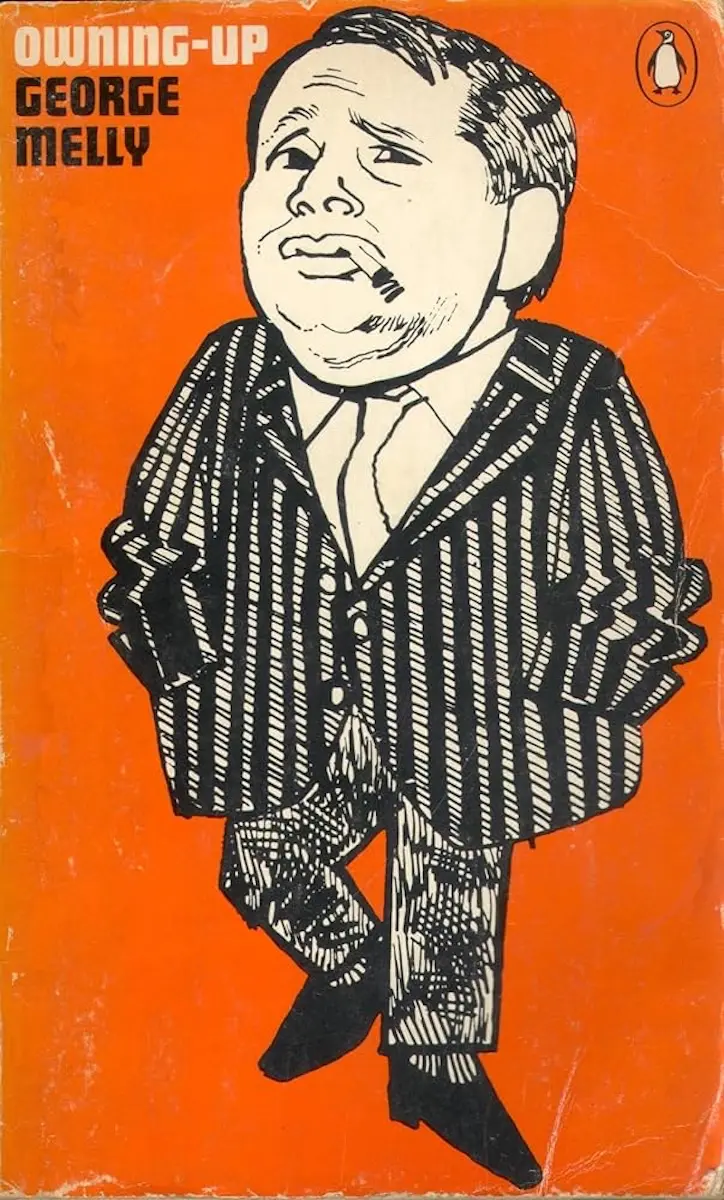
This book confirms that, of all Melly’s undoubted talents, his ability as a writer is supreme. His powers of observation, sensitivity and, above all, his unfailing selection of the right words to get his meaning over, have a Thurberian professionalism, and there is little doubt in my mind that this is a masterpiece of humour. Certainly Owning Up is the funniest book I can ever remember reading and on at least three occasions while reading it I was made speechless with laughter and resulting tears.
On the other hand, the book is also a rough diamond because George has probably decided that, if it was worth writing, he had to be completely frank. It is frank to the point that it will undoubtedly shock and horrify many people. The words which we all use but which are proscribed by our social mores flock thick on practically every page, at the same rate, in fact, that they occur in the world of the professional jazz musician. In this respect, I feel that it will be a shame if the book becomes notorious for its bad language rather than acclaimed for the brilliant use of the rest of the language.
The book chronicles George’s association with Mick Mulligan and follows the birth of the Mulligan band until its final disintegration in unbelievable respectability. It is not until near the end of the book that one is formally told of the crux of George’s philosophy. Calling one morning at the hotel room of an American blues singer, he finds him with a young lady who is a mutual acquaintance of both George’s and mine.
‘She radiated contentment and reaffirmed me in my belief that what you really want to do, provided it respects the identities of other people, is the basis of a workable morality.’ A theory which we would all like to be true but which, in this book, smacks of an attempt at self-convincing. It is in fact impossible to opt out of all responsibility, and the total pointlessness and at times bleak horror of the manner of life described in the book merely confirm the empty nature of the theory. Further emphasis is laid by the last chapter, What Has Happened To The Chaps? wherein we learn that all the wild living has been left behind and that the heroes have acquired the urbane potentiality of living happily ever after.
But the extended adolescence of the Mulligan boys makes wonderful reading, and I can guarantee that anyone who coughs up his thirty bob is not going to be disappointed. It is a fact that the musicians who surrounded Mulligan were chosen more for their conviviality than for their musical ability and in people like Frank Parr, Ian Christie and Mulligan himself there is an off-beat but above average intelligence which produces a humour that is much more deep and satisfying than any of the currently fashionable cynics of our time. This aspect far outshone the musical qualities of the people involved, and for this alone, this book is to be welcomed as a permanent record of the most painful and the most hilarious period in British jazz.
George has a magnificent way of phrasing his anecdotes and at times one becomes intoxicated with what seems like literal involvement with his characters. The stories are too numerous and too brilliant as they stand for me to plunder and edit any of them for this review. Despite the fact that much of the material is cruel by circumstance, most of the possible unhappiness which might have resulted has been obviated by George writing to no less than 40 people to gain their permission to print these chapters, and out of that number, only the fortieth person to be asked withheld permission. I must quibble with George’s account of Sinclair Traill’s ‘reluctance to stand a round’, and not because I work for Jazz Journal. In consultation with Mark Murphy, the members of the Merseysippi Jazz hand, Jack Swinnerton and others, I can report that, after calculation, we all owe rounds to Mr. Traill – if George is correct, then I can only say that our reluctance must be greater than Sinclair’s (I hope Sinclair does not assume this acknowledgment in writing to mean that he is going to collect). To read this book is a satisfying and exhilarating experience. I only wish that I had half of George’s talent.
Owning Up, by George Melly (Weidenfeld and Nicolson, 204 pp. 30s.)