Rich Brown: Nyaeba
Gone surely are the days when the “success” of a solo instrumental album was measured by how the musician managed to cover the conventional bases, as if the music was little more than an exercise in box ticking. In that era notions of abstraction were by and large disregarded as somehow unmusical. Brown’s take is in that respect entirely of the modern world. He employs overdubbing and a form of sampling and he brings virtuosity to bear in ways which transcend the purely demonstrative, while his view of the wider world is reflected by the inclusion of sampled speech extracts from Alice Coltrane.
The spiritual implications of Coltrane’s presence are unsurprisingly most obvious on Turiyasangitananda – The Transcendental Lord’s Highest Song Of Bliss (Meditation For Alice Coltrane) where the balance between music and speech is finely struck. A quiet sense of wonder is provoked by the sparse yet uncharacteristic sounds Brown extracts from his bass and worldliness seems to diminish.
Heart Of A Lonely Woman is driven by a nominally percussive rhythm track and incorporates the Ornette Coleman composition denoted in the last two words of its title. Brown makes the case for that being one of the most enigmatic melodies ever to grace the jazz world, and in so doing highlights how reimagining need not necessarily be merely a grandiose claim.
For me Kalagala Ebwembe embodies the depth of Brown’s relationship with his instrument. The piece is entirely rhythmically driven and minimal – and thus quite devoid of soloistic flights of fancy. That absence of showiness highlights his appreciation for the idea that virtuosity is neither an end in itself nor enough to engage the listener.
Discography
Ukudlala; The Sum Of Our Tears; Heart Of A Lonely Woman; Nyaeba (The Griot); Kalagala Ebwembe; Sowetoiera; Turiyasangitananda – The Transcendental Lord’s Highest Song Of Bliss (Meditation For Alice Coltrane); The Kingdom Of Heaven Is Within (35.34)
Rich Brown (6-string elb; 4-string semi-acoustic fretless b; E-bowed bass). The Escape Corner, Toronto, Ontario, Canada, 30 May 2024.
Whirlwind Recordings WR4838
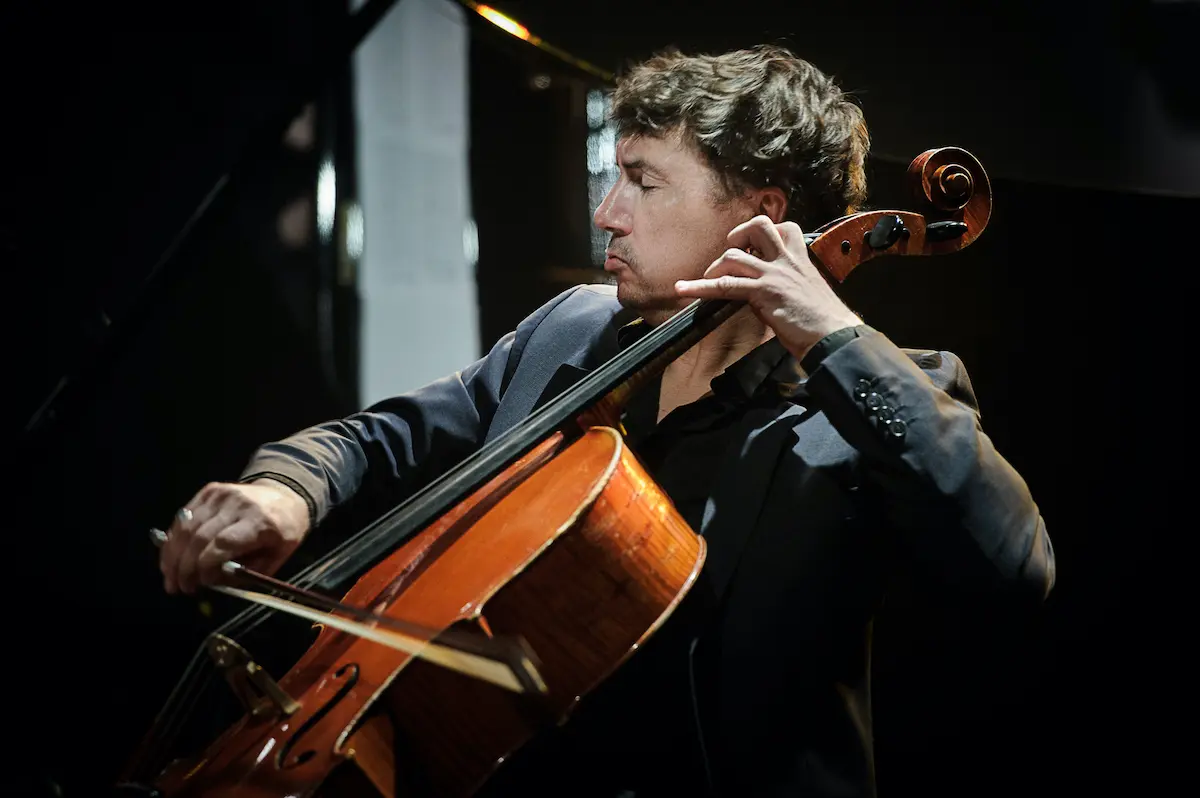
Vincent Courtois: Lines For Lions
A line-up of cello and two tenor saxophones (with clarinet for additional colour) surely qualifies for the chamber jazz label. Putting such trifling matters as labelling to one side, this trio puts out music of a rare order, defying many of the widely acknowledged notions of jazz without taking matters as far out as Jimmy Giuffre, Paul Bley and Steve Swallow did many moons ago. It brings the receptive listener a fresh menu nevertheless.
Courtois composed the whole programme, and his appreciation for the group’s restrictive sonic palette is coupled with a knack for notably cryptic titles. Seven Lines For Old Mediums is a case in point, the essentially dark implicatory nature of the piece being maximised by the group’s restraint. Lion’s Den flirts covertly with something more conventional, not least through a tenor solo and Courtois “walking” a bass line that seems to provoke a highly Tristanoesque response from the tenors, the tightness of the duality suggesting the understanding Lee Konitz and Warne Marsh had.
The relationship between this music and Tristano is both playful and full of respect, as exemplified by Fincker’s clarinet on There And Then, where he pulls off the considerable feat of not adding anything inessential to a sparse setting that’s weighty enough to sustain itself. He evokes Giuffre’s spirit without falling into the trap of imitation in the hope that it comes over as homage. By way of leavening, Erdmann takes a comparatively rowdy approach and in so doing reminds us of how there’s always been (or at least ought to have been) more to this strain of highly nuanced jazz than polite sterility.
Discography
Alone In Fast Lane; Mulholland Coffee Break; There And Then; Finally Giovanni; Seven Lines For Old Mediums; Lion’s Den; Adios Body (Hello Soul); Hobo Clown (42.28)
Daniel Erdmann (ts); Robin Fincker (ts, cl); Courtois (clo). La Buissonne Studios, Pernes les Fontaines, France, 25 and 26 November 2024.
La Buissone RJAL 397051
Rahsaan Roland Kirk: Seek & Listen. Live At The Penthouse
It’s some kind of truism that atmosphere cannot be aurally recorded but by way of bucking the notion here we have two previously unreleased 1967 sets which capture the barrelling spontaneity of Kirk’s quartet going in no uncertain terms about the business of, as liner note writer John Kruth so pertinently puts it, levitating a Seattle night club audience.
Considering these sets, I was repeatedly struck by the sheer joy of life in Kirk’s work. It’s akin to Zoot Sims’s ability to convey the impression that there’s nothing in the world he’d rather be doing than playing a wind instrument “in the moment”. Note Kirk’s ability to set up a call-and-response with himself by alternating fours on different instruments in the same mouth at the same time. Add to this his clear appreciation of his instruments’ differing characters – as exemplified by his manzello and tenor sax work on Mingus Gruff-Song – and you have a musician who for all of his supposed eccentricities had ability and ideas in abundance.
Burton, Novosel and Hopps made up Kirk’s working band and this shows throughout both sets. Not a foot is put wrong and the business of lifting an audience out of the everyday world for a while and buoying their spirits is taken care of. Passing time has done nothing to dilute the potency of Kirk’s message.
Discography
CD1: The Jump Thing; Alfie; Mingus Gruff-Song; Medley: Ev’ry Time We Say Goodbye, I’ve Got It Bad (And That Ain’t Good), Sophisticated Lady, Satin Doll; Medley: Blues For C. & T., Happy Days Are Here Again, Down By The Riverside (41.41)
CD2: Ode To Billie Joe; Prelude To A Kiss; Funk Underneath; Lovellelliloqui; Now Please Don’t You Cry, Beautiful Edith; Making Love After Hours (44.53)
Kirk (ts, f, stritch, manzello; flexatone; siren, whistle, v); Rahn Burton (p); Steve Novosel (b); Jimmy Hopps (d). Penthouse Jazz Club, Seattle, Washington, 8 and 15 September 1967.
Resonance Records HCD-2080