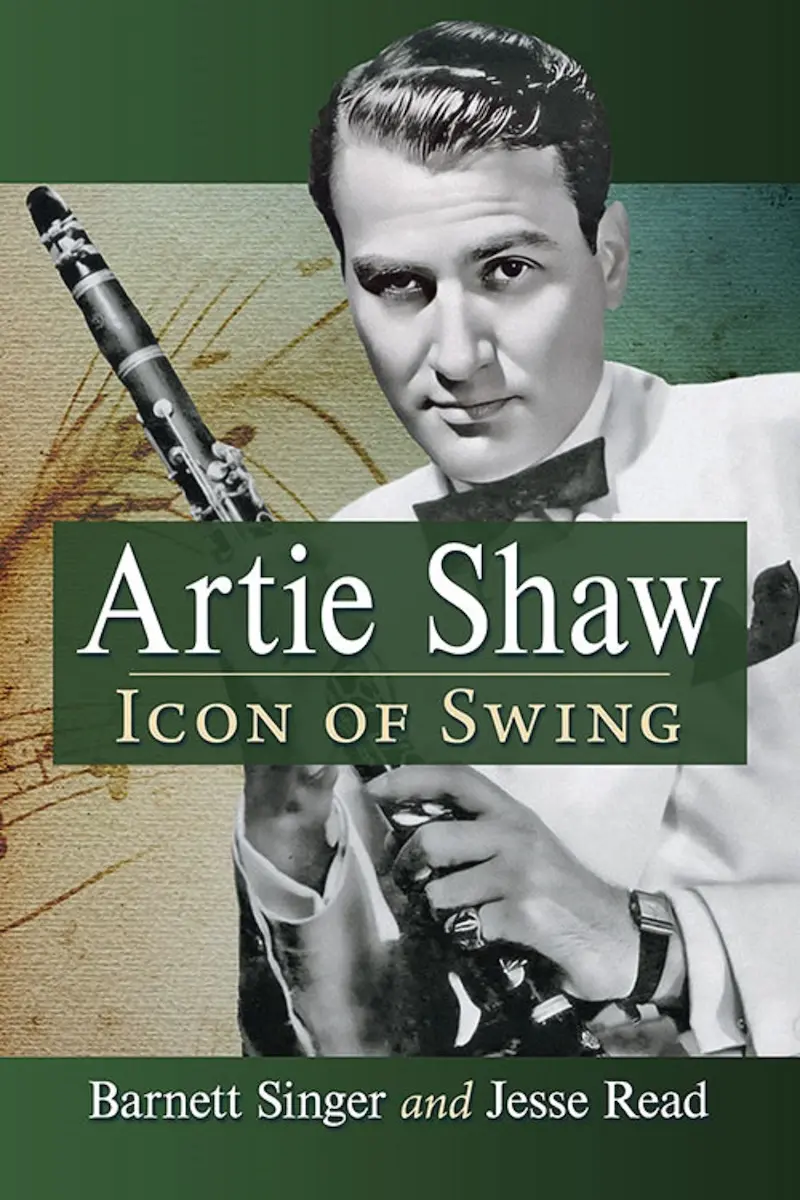
Co-authors Barnett Singer (professor emeritus of history at Brock University, Ontario) and Jesse Read (professor emeritus and former director of the School of Music at the University of British Columbia are ardent Shavians. Unfortunately, they get off to a tangled and confusing start. Singer acknowledges the help of Read but states that “all references to ‘I’ or ’me’ are to Singer; references to ‘we’ or’ us’ are to Singer & Read”.
Singer’s “primary sources” are his memories of phone conversations over seven years with Shaw (not recorded) and he asserts that he takes “majority responsibility for all infelicities here”. Also off-putting are his irritating and primitive prose style, and limited vocabulary. Seemingly every other sentence ends with an exclamation mark (I lost count), the clarinet is also called a “licorice stick”, and the text is riddled with critical comments on Benny Goodman. Early on, Singer asks rhetorically “Why do we need another book on Shaw?” before commending Vladimir Simosko’s Artie Shaw: A Musical Biography And Discography (2000), Tom Nolan’s Artie Shaw, King Of The Clarinet: His Life And Times (2011), and (briefly) my own Artie Shaw: His Life And Music (1998, 2004), judged “too slim and full of long quotations”. (It was, however, revised and extended in the second edition).
Singer, one quickly learns, discovered Shaw (on disc) at an early age, and has yet to recover from the shock. His and Reid’s central focus is the early parts of his career, starting with Begin The Beguine (1938) and concluding with his large and small post-WWII groups. Singer praises Shaw’s playing with overly detailed, repetitive and florid appreciations. Every recorded or live session is stamped, dated and eulogised. As for Shaw’s service and problems during WWII, Singer’s sparse account should be supplemented by Michael Doyle’s recent Nightmare In The Pacific: The World War Saga Of Artie Shaw And His Navy Band (2024, reviewed here).
In the remainder of the sprawling text, Singer recognises the talents of such Shaw men as Buddy Rich, Roy Eldridge, Hot Lips Page, Cootie Williams and Dodo Marmarosa. Three of Artie’s eight wives – Lana Turner, Ava Gardner and Doris Dowling make brief appearances – to the reader as well as they did with the unblushing groom. Singer makes nods to the Jewish influences on American jazz and to Shaw’s conflicted childhood.
There are nine pages of succinct chapter notes – which could have been better incorporated in the prolix text. An extensive bibliography partly redeems the text, but E.D. Blandford’s excellent Artie Shaw: The Man & His Music, privately published, Hastings, Sussex (1974) is absent. Curious readers who might want to listen to any of the studio or live recordings painstakingly analysed in the text are directed to YouTube rather than to specific LPs or CDs. In conclusion, the authors caution (clumsily) that “this is more than an essay cum memoir elements than a scholarly tome” and express the hope that that “were he still alive, Mr. Shaw wouldn’t have been too put off by the interpretations we’ve offered”. But they add parenthetically “Not that he ever really needed them!” To which an appropriate response could be “Really!!!!”
Artie Shaw: Icon Of Swing, by Barnett Singer and Jesse Read. McFarland & Company, Jefferson, North Carolina; pb; 195pp. ISBN 978-1-4766-8970-8