Atzmon, Bulatkin, Volos, Černák: Praying For More Songs To Come (HLAVA XXll)
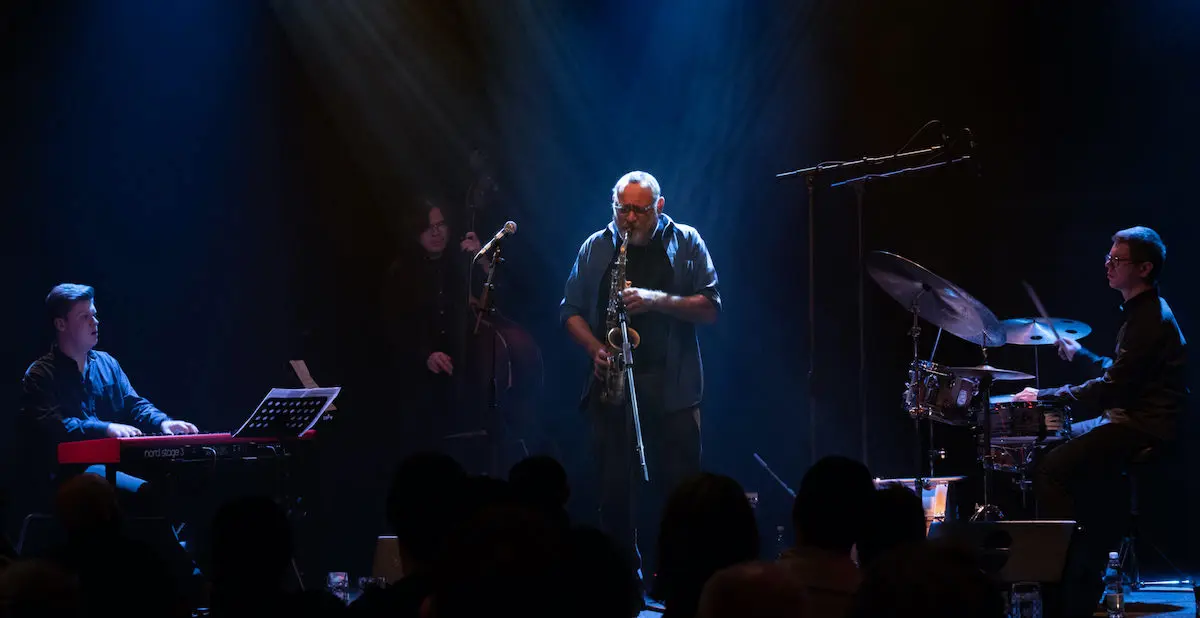
Well known for his amalgamation of Middle-Eastern music and jazz, Gilad Atzmon steps into a more straightforward jazz setting. Apparently recorded acoustically in one room, without editing, in half a day, it has the immediacy of a live performance rather than a studio session.
Each track is balanced with an identifiable theme from which it departs or abruptly changes mood. The opener, The First Day Of The Year, an original by Atzmon, is closely related to Wayne Shorter’s Footprints and is played warmly by him and with lightness of touch by pianist Daniel Bulatkin. As they open up, Atzmon lets rip, unleashing a volley of notes, before returning to the attractive theme at the close.
His other composition, Autumn In Baghdad, a slow, slightly wistful ballad, at times hints at a tango; solos by Atzmon and Bulatkin are played with intense feeling and expression.
Bulatkin contributes Early Blues (I Listen To), Coltrane’s Spiritual clearly a model, from its introductory build-up to subsequent straight blues. He keeps the momentum going with bassist Taras Volos and drummer Dušan Černák, whilst slipping in full-noted runs over block chords. Atzmon dons his Trane hat as Černák throws in a battery of cymbal and snare.
The title track, written by bassist Volos, has a Middle Eastern introduction, Atzmon on soprano, reminding us of Orient House Ensemble days, before it becomes a full-blown workout of uptempo hard bop.
In the middle of these is Arthur Johnston’s 1934 My Old Flame, which Charlie Parker recorded in 1947 with Miles Davis – a straight rendition, indicating and consolidating their respect for early influences. A consistently satisfying album.
Eric Dolphy Quintet: Outward Bound (20th Century Masterworks 350285)
During the 50s Eric Dolphy developed his style whilst a member of several bands – including those of Chico Hamilton, Mingus, Coltrane, Max Roach, Oliver Nelson and Gunther Schuller – and having a close association with Ornette Coleman; each setting was highly productive and addressed the different facets of his playing.
By 1960, the time of this his first recording as leader, he had established himself as bridging the gap between hard bop and free jazz. It’s almost as if he’s showing his detractors how the new style can be embedded in the modern jazz idiom, here represented by trumpeter Freddie Hubbard and the rhythm section of Jaki Byard, George Tucker and Roy Haynes.
It was an opportunity for Dolphy to show his versatility: his explosive, angular alto on GW (a tribute to Gerald Wiggins), Les and the slow blues 245; bass clarinet with its dramatic leaps from upper to lower register on Miss Toni; flute on Glad To Be Unhappy, and clarinet for On Green Dolphin Street. Hubbard plays well – comparatively straight, a fitting contrast, although when he briefly strays into freer territory on Les, it’s slightly unconvincing.
Two extra tracks appear – April Fool (flute) and a slightly longer take of 245. On both takes of this, Hubbard and pianist Byard are at the height of their soulful inventiveness, whilst Dolphy’s solos are commanding and utterly compelling, worth the price of the album on their own.
Aruán Ortiz: Créole Renaissance (Intakt CD441)
This impressive solo album by New York-based Cuban pianist Aruán Ortiz is his way of drawing on and connecting threads associated with Négritude, the cultural, political and literary movement that originated in the 1930s.
Using the full keyboard, heavily bass-dominated, he explores Cuban, Creole and Afro-American music with an intense mixture of improvisation, overriding formal considerations. Ortiz occasionally introduces thematic direction, but isn’t restricted by it.
Some are fragmented and free – L’Etudiant Noir, referencing a short-lived Parisian journal, and Legitime Defense, in which deep chasms open up, parallel runs flashing out. Others are more impressionistic: Seven Aprils In Paris incorporates Sophisticated Lady, slow walking notes fleetingly interspersed with Duke’s classic, snippets hanging in the air, tantalisingly, but not sufficient to divert him or deflect his intent.
The Haberdasher has notes played apart, isolated, like a transcription of a Monk piano part
whilst The Great Camouflage has darkly sombre single notes that draw a right-hand response in equal parts pensive and haunting. Première Miniature (Créole Renaissance) and Deuxième Miniature (Dancing) are two contrasting excerpts – one a brief excursion scampering across the keys, the other with heightened multi-layered chords.
We Belong To These Who Say No To Darkness uses bent, plucked and strummed strings, then tiptoeing up as if to demonstrate/elaborate upon the recitation of “isms” in From The Distance Of My Freedom, where he contrasts primitivism with modernism.
The album finishes with Lo Que Yo Quiero Es Chan Chan, a slower, brooding and fractured version of the Compay Segundo song from the Buena Vista Social Club.
The Counterfictionals: An Incomplete Encyclopedia Of Gentle Emotions
The Counterfictionals are a group of Danish musicians who produce original music inspired by cinema. The intention is to create a mood or emotional collage that sits within the general context of the film, or from a specific sequence. In this respect it’s successful, with music that is attractive and atmospheric, at moments slightly unnerving. Tension is built through implication rather than anything obvious.
The opener, Poems And Rain, is the theme for a hypothetical film never made. It’s simple at first, initially featuring bassist Tove Sørensen and the clarinet of Jeppe Zacho; then layers of texture are gradually built as other instruments are introduced. The barely discernible narration by David Kerns is taken from James Joyce’s Ulysses, a description of early morning Paris, as “Belluomo rises from the bed of his wife’s lover’s wife.”
The Coen Brothers’ Fargo is the inspiration for Norm Gunderson’s 3-Cent Stamp, the touching scene concerning Norm’s painting of a mallard used on a stamp. Of course, there’s a metaphor involved here regarding relativity and the importance of small things. The music draws on several stylistic strands, from the African feel of rhythmic guitar and kalimba, to the central section of Henriette Groth’s piano and Zacho’s schmaltzy tenor, ending with the clarinet taking it into klezmer territory. All very effective.
Beatrix And Bill are presumably the protagonists in Tarantino’s Kill Bill; Beatrix the main character, “The Bride”. A Morricone atmosphere is created by the guitar, twangy with resonant low bass notes thrown in. Melodica, vibes and theramin alternate, and again clarinet, although it’s the tenor that gives more definition and depth, as it does elsewhere, grounding the metaphysical elements, nailing it down.
This segues into Puppet, about loss of control in Being John Malkovich. Groth’s piano sets a repetitive theme supported by the theramin, its eerie echo reminiscent of Angelo Badalamenti’s music for Twin Peaks. Zacho’s more expansive and aggressive contribution appears towards the end. Similarly, the TV series is the inspiration for The White Lodge, as is H.P. Lovecraft’s Cthulhu – the haunting music reflecting mystery, the supernatural and even paranoia.
Some might regard the references to cult movies and obscure literary passages as esoteric and even pretentious, but I found it engaging and fascinating.