
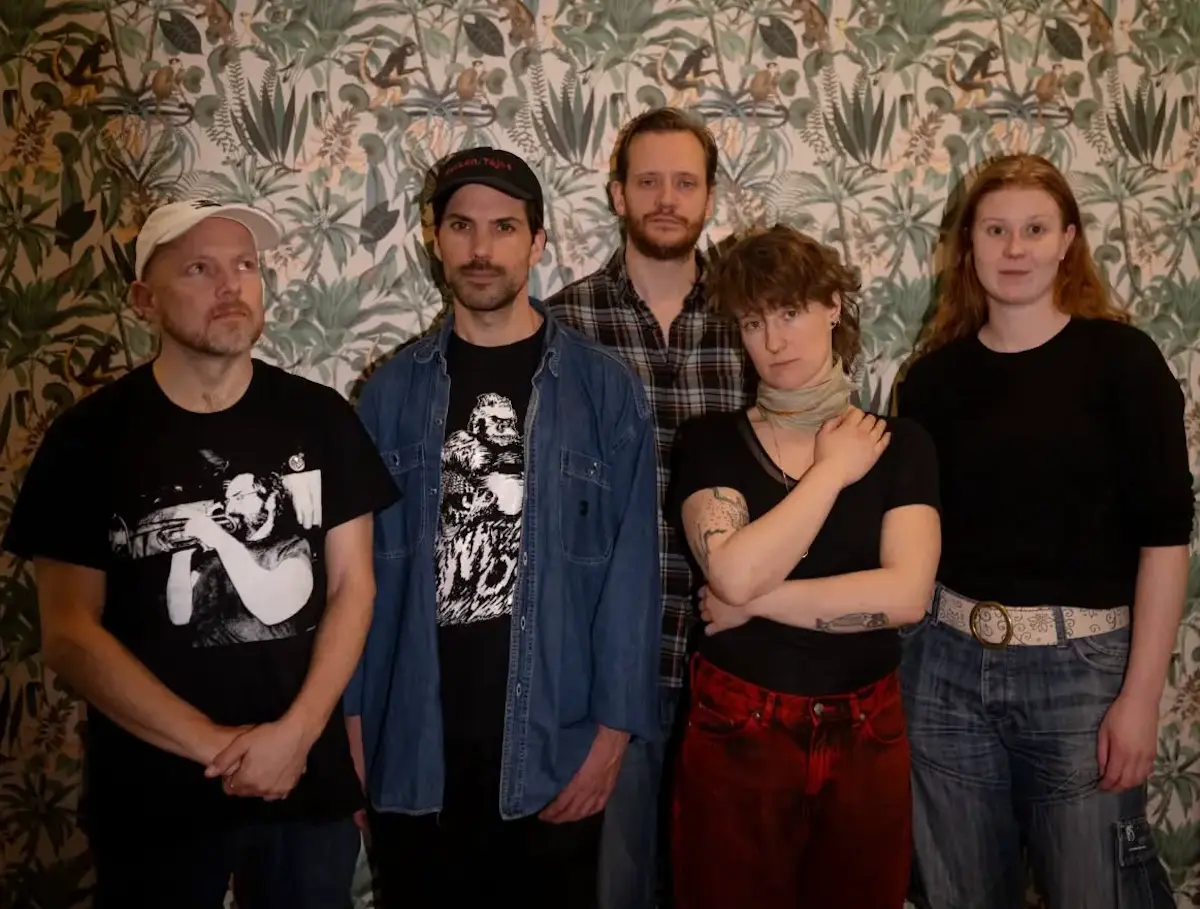
Malcolm Braff with Petter Eldh & Lukas König: Outside
Swiss pianist Malcolm Braff was born to missionary parents in Brazil in 1970. His unconventional upbringing goes some way towards accounting for his very individual style. After taking classical piano lessons from age six he returned with his family to Europe in the early 80s, stopping off in Cape Verde and Senegal on the way. He then studied classical music at Neuchâtel and Geneva, finally experiencing a jazz epiphany at Montreux in 1989. Going on to study with François Lindemann, Jacques Demierre and Franco D’Andrea, he has developed a percussive style and is particularly open to African and Indian influences. He’s often compared to Don Pullen, and interestingly both recorded for Blue Note during the Bruce Lundvall era.
The music on this four-track EP dates back to August 2020, and I’m not sure why it has sat in the vaults for so long. Braff was joined by a dream team of Swedish bassist Petter Eldh and Austrian drummer Lukas König, the four tracks experimenting with intricate compositional structures and complex rhythmic sub-divisions. The most obvious parallel is Eldh’s work with Kit Downes’ Enemy, but those with longer memories may also make a connection to Braff’s 2011 album Inside (Enja), which featured König and bassist Reggie Washington. While this set is certainly more abstract, both are firmly rooted in Braff’s fascination with rhythm.
In Vienese Grøt À La Berlinaise (loosely translating as “Viennese Porridge In The Berlin Style”), stiff formality collides with rhythmic chaos as an attractive theme is stretched in all directions. 3TOES leans into the contemporary Berlin sound which is so familiar to Eldh, its cascading off-kilter rhythms perfectly suiting Braff’s percussive style, while Cycle sees a broadly similar approach applied to a slower tempo, the pianist’s lyricism given ample space to breathe. The set closes all too quickly with Crémines, which includes some of the set’s fieriest playing. I’m not sure whether this trio is still active, but I for one would love to hear more.
Discography
Vienese Grøt À La Berlinaise; 3TOES; Cycle; Crémines (22.37)
Braff (p); Eldh (b); König (d). Crémines, Switzerland, 5–11 August 2020.
Unit Records UTR 5296
Jonas Cambien’s Maca Canu: Popular Misconceptions
This is the second occasion in recent months that I’ve reviewed Belgian-born and Oslo-based piano and keyboard player Jonas Cambien, and if his quirky solo album Man Eating Tree suggested a strong individualist with a keen sense of fun, this second album from his group Maca Canu does nothing to dispel that impression. The publicity for the group’s eponymous 2024 debut memorably described it as “an exploding kunstkammer of curiosities”, and with the group’s eclectic signature sound encompassing everything from Ethio-jazz and modern chamber music to blistering free jazz, the description seemed entirely apt. Cartoonish flights and unexpected juxtapositions came as standard, and the effects were often as disorienting as a fairground hall of mirrors.
The group’s expanded to a quintet with the addition of trombonist Kvåle, who guested on two tracks on the group’s debut, and the all-female frontline is perfectly complementary. Opener Tree Frog explores the same Reichian minimalism as Tre from the solo set, though the well-drilled kinetic counterpoint here sounds very different to Cambien’s prepared-piano mayhem. Macao Nu (“naked ape”) relies on repetition too, though this time the forms are more groove-based, Cambien’s Ace Tone organ riding a wave of rising energy. Cosmic Vacuum Cleaner evokes the free jazz of the late 60s, its blocky structures shattering as Emmeluth unleashes a powerful tenor solo, and she’s pushed her all the way by the explosive Wildhagen. Hunting Mosquitos is a nocturnal fantasia of small gestures and sounds, while Everything Looks Like A Nail moves from shapeless improv to groovy breakbeats in the blink of an eye. Elsewhere, Factoids is a short but colourful interlude based on a minimalist drone, and the groovy organ lines and firecracker backbeats of Desert Rat burst with unbridled joy. It’s a perfect finale to a highly spirited and imaginative set. In the best possible sense Cambien is truly one of a kind.
Discography
Tree Frog; Macaco Nu; Cosmic Vacuum Cleaner; Hunting Mosquitos In The Dark; Everything Looks Like A Nail; Factoids; Desert Rat (36.15)
Cambien (p, org) with Signe Emmeluth (as, ts); Guro Kvåle (tb); Ingebrigt Håker Flaten (b); Andreas Wilhdagen (d). Amper Tone, Oslo, 9-11 January 2026.
Sonic Transmissions Records 2026
Phil Haynes’ 2 Horns & What?: AvAnt MODerN & JAzZ nOW
Haynes has been an almost ever-present part of my listening habits of the last 40 years. My review of his recent autobiography should give some sense of why I continue to find his music so appealing. Against medical odds Haynes continues to record some of the most adventurous and far-reaching music of his career, and this new double-disc set, which takes a fresh perspective on his unconventional piano and bass-less quintet 4 Horns And What?, is no exception.
Whereas the original quintets of the late 80s, documented in a superb 2024 anthology, paired Haynes’ thunderous drumming with a cast of soloists including Ellery Eskelin, John Tchicai, Paul Smoker and the low-end brass of Joe Daley and Herb Robertson, the two groups heard on this release are very much reduced in size. The more skeletal resources necessitate a few changes in approach, and for the most part the music is more chamberish in complexion than the playful free jazz cum New Orleans polyphony of old.
The freewheeling live set with Pleninger and Wooley is perhaps the most outré of the two, as suggested by its title. With a recitation of texts by Shakespeare, the opening track channels the feel of a hip early 70s loft-jazz happening. The classic free-bop foment of Out Of The Bowels finds Haynes in his natural habitat, and the extrovert Wooley slots into Smoker’s shoes as if it was always meant to be. Both horns solo head-to-head with Haynes on Blue Jungles, while the striking For Hawk, Doc & Dee recalls some of Anthony Braxton’s more interesting tonal experiments.
JAzZ nOW, a studio session with Pleninger and Ragonese, walks more of a post-bop beat, though it’s certainly not short of surprises. The remarkably controlled abstractions of Steps could easily belong on the live session, and elsewhere there are new versions of Goofus’ Step and Iowa Get-Down to cherish. Rangonese and Pleninger are a contrasting but well-matched pair, with Together, Longer Shorter and Point-Period each thriving on their quick-witted interplay. The imperious Haynes digs into Elvin and swings like a demon at every turn. Taken together the two sets offer many worthwhile new perspectives on a group which was always conceptually interesting.
Discography
Disc 1: (1) Never Doubt I Love; Out Of The Bowels; The Code; Blue Jungles; For Hawk, Doc & Dee; Where Now; Smoke Rises; Chant (57.41)
Disc 2: (2) Together; Goofus’ Step; West Virginian Blues; Ragonese; Blu Dop; Last Dance; Longer Shorter; Steps; Point-Period; Pleninger; A Lil’ Iowa Get-Down (58.06)
(1) Haynes (d) with Nathan Wooley (t); Peyton Pleninger (ts). Bucknell University, 28 March 2026.
(2) Haynes and Pleninger with Jonathan Ragonese (ts, ss). Newfield, New York, 8-9 May 2026.
Corner Store Jazz 60 / 61