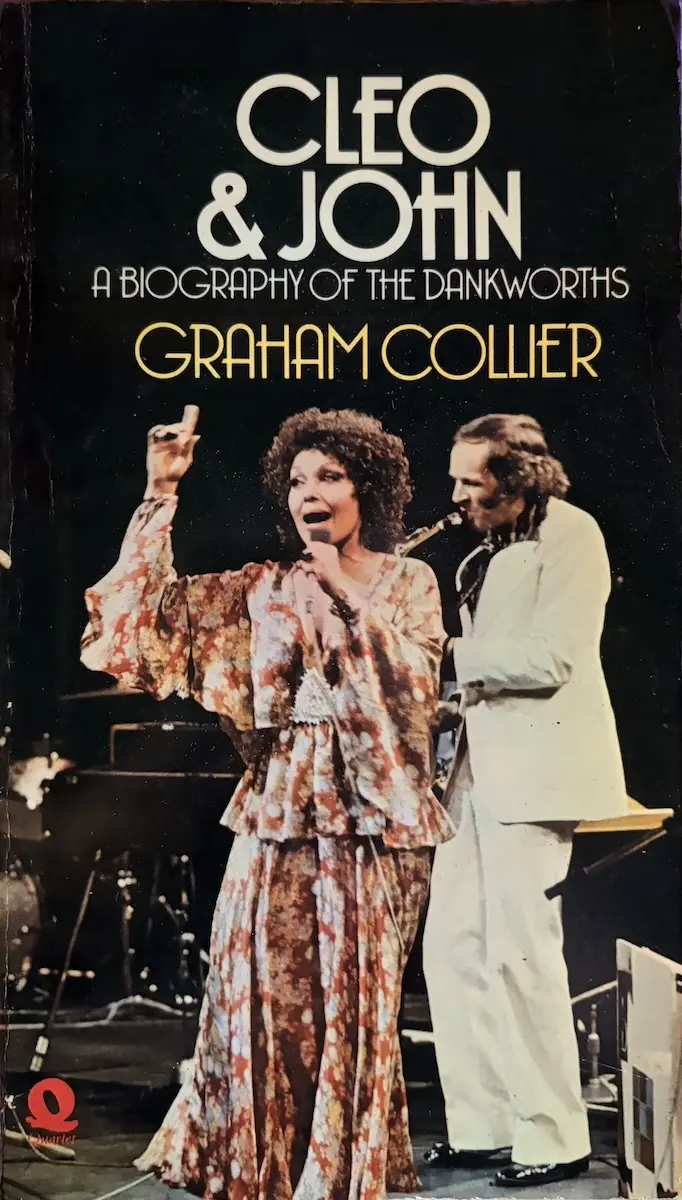
This is a surprisingly good book, and the surprise is occasioned by the fact that it is, by and large, a collection of press cuttings strung together with relevant quotations by the two subjects plus such associated figures as Don Rendell, Dudley Moore etc, and, of course, Graham Collier. What emerges is a factual biography which is at the same time objective and critical. Too many Johnny-come-latelys (sorry about that!) have fallen into the trap of the Dankworths-as-cult-figures and the ‘isn’t-Cleo-just-marvellous’ attitude. Collier is not above pulling the mat from under their feet, even if he has to use a quotation from someone else in order to do his hatchet work. But his own points are valid and as someone who has been writing about John and Cleo for a quarter of a century let me say that Collier’s early assessment of John’s honesty as a musician is something I have tried to hammer home myself. Dankworth is not an American negro from a Harlem tenement block and his music is a reflection of his own upbringing, not someone else’s. A pop singer from Dartford who affects a New York accept makes me reach for the off switch very quickly. Honesty in music is something which has always been very important to John.
The book covers his early influences, his work with the Seven, his big bands and the film business. Perhaps the most useful sections are those devoted to John’s own quotations; here you will find some very severe self-criticism as an instrumentalist and some amusing accounts of early brushes with the film-music scene. Collier makes the point that it was John who turned Cleo from a good band singer with a relatively limited range into the musical phenomenon she is today. The move up the social scale is documented too, complete with photos and descriptions of royal involvement, the CBE for John in 1974, even a chapter headed ‘Sir John and Lady Cleo . . .?’
But for most readers of this magazine the earlier parts of the book are the most interesting; rightly the importance of the Dankworth Seven is stressed (and eight of the original Seven recordings will soon be reissued as part of a new Esquire LP, incidentally) and some of the reminiscences by Don Rendell had me hooting with laughter, for I remember those days, and the Seven, very well. Somewhat surprisingly Collier has not turned to, or quoted from, Mike Butcher (one-time writer for this magazine), for Mike was the Seven’s manager. And on a purely factual note I suppose we are now sufficiently far removed from the event to reveal that ‘Dankworth At Newport’ (Top Rank 30 / 019), which Collier accepts as a transcription of the band’s Newport appearance in 1959, was actually taped at a Hammersmith concert when it was discovered that the Newport tapes were below par. And Ronnie Chamberlain was not ‘Ted Heath’s alto star’ in 1949; he was with Vic Lewis (page 16).
Graham’s style is sometimes a little sloppy (I wince when I read ‘I’ve’ and ‘they’ve’ in a book when it is not part of a quotation) but John and Cleo finally emerge as a couple of real people and the author must be given full credit for a tremendous amount of hard work in his researches.
Cleo And John – A Biography Of The Dankworths, by Graham Collier (Quartet Books, 27 Goodge Street, London W.1. £4.95. Hard covers. 187 pp, 45 photographs. Four page index)