
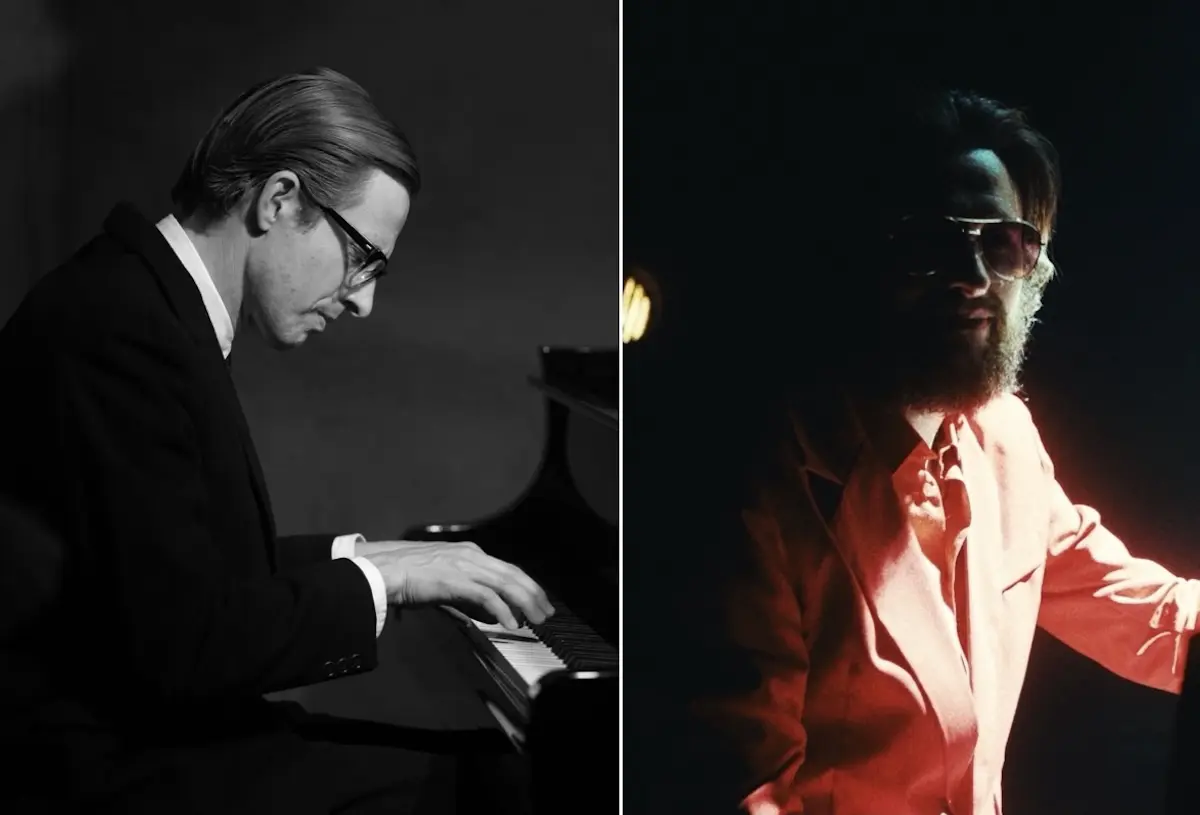
Everybody digs pianist Bill Evans in Grant Gee’s superb docudrama Everybody Digs Bill Evans. Or, rather, everybody dug Bill Evans. For Bill is spiralling downwards after the death in a car crash of his trio’s bassist Scott LaFaro. He sinks into non-creativity and recognition of tacit family friction. His loyal but envious schizophrenic brother Harry later shoots himself, and his father, Harry Sr., while cold-turkeying Bill in Florida, confesses having scrubbed his hands raw in order not to appear uncouth to his wife, Bill’s mother. Bill’s hands, apart from their owner’s sometime view that the fingers were too fat for playing the piano, were also too preciously soft for over-cleansing.
There’s a sense in which Bill was always an albeit modest golden boy, who outshone the two Harrys but whose glister faded in the joint heroin addiction with his long-term partner Ellaine Schultz. Even LaFaro didn’t like him: he didn’t like who Evans was, meaning the pianist’s appetites, his dependency on drugs, and the individual shaped by drug addiction. It’s a common story among addicts and those who try to help them or have to put up with their problematic self-absorption. One of the film’s obvious messages is that drugs turn creative individuals into non-creative wrecks. Its lack of Evans’s music, apart from the opening, and despite Roger Goula’s evocative score, is the best illustration of that. In one episode, when he’s recuperating with his parents in Florida, Evans is asked by a fan what he thought of Miles Davis (with whom he’d already played). Evans says only that Davis was a great musician, implying that anything he might add could detract from the trumpeter’s reputation, one also temporarily and seriously hampered by narcotics but grounded too in dodgy character traits.
Thus does Gee and writer Mark O’Halloran’s screenplay opt for the non-linear narrative of Intermission, the 2013 novel by Owen Martell on which the film is based. Apart from anything else, it reflects the paradoxical chaos of dormancy – Evans stopped playing the piano for a time after LaFaro’s death – and the need to put a broken life back together. Apart from the addiction, too, Evans knew he was on the cusp of a breakthrough in the jazz-piano trio format, and that the death of the person who was making it happen, illustrated vividly in the opening rapport sequence with LaFaro and drummer Paul Motian at the Village Vanguard in 1961, underlined the impossibility of starting the whole process again.
That recorded New York gig would result in the release of two seminal albums: Sunday At The Village Vanguard, and Waltz For Debby. The film’s scenes depicting Evans with Debby, his niece and Harry and sister-in-law Pat’s daughter, are particularly touching. There’s a lot in the story that’s touching, not least the evidence that to Evans’s modesty one could add a pacific, mild manner. The view that this, Miles-like, hid a less attractive side effaced or enhanced by drugs could be countered by the elegant melancholy that was Evans the musician at his most typical and trouble-free, exempt from the effects a drug-user assumed drug usage would promote. But with drugs and their use and abuse, one never knows. In any case, the film shows that Evans’s rise from the depths seemed hampered by the fault lines of close relationships. His brother Harry’s love and loyalty are countered by exasperation at Bill’s depression and drug habit, and a barely submerged feeling that Bill was gifted and he (Harry) wasn’t. Bill’s mother, also a pianist, refused to play because Harry Sr. couldn’t resist singing along with her. Harry Sr.’s singing is illustrated in a Florida scene with his mates as they drunkenly lurch through an a cappella version of the Londonderry Air. The depths are not only dark but mawkish.
Lengthy films about jazz and/or jazz musicians seem always to be risky, perhaps because there’s invariably some kind of notoriety and accompanying sensationalism involved. They’re also likely to attract viewers who enjoy jazz and deter those who don’t. Being a drug addict is notoriety. But Gee and O’Halloran have cinematographer Piers McGrail to tell a bleak universal story in sharp-contrast black and white, with garish colour employed for three flash-forward episodes. It’s also not overloaded with any background music, let alone by Evans. There are authentic performances from Anders Danielsen Lie as Bill Evans, Bill Pullman (Harry Sr.), Barry Ward (Harry Jr.), Mary Evans (Laurie Metcalf), Valene Kane (Ellaine), and Katie McGrath (Pat Evans).
At one point, Harry Sr. confesses to the recovering Bill how retirement in Florida was only made possible by an imprisoning – and implicitly non-creative – life of toil. Bill’s self-imposed drug incarceration is looking for musically sunnier climes. But they’re not to be found immediately when he returns to New York, despite the two album releases. The flash-forwards land in 1973 for his break with Ellaine and her suicide on the New York city subway; in 1979 for Harry Jr.’s suicide; and in 1980 for his own death. The film reminds us, however, that Evans formed a new trio after LaFaro’s passing and was prolific as a recording artist between 1962 and 1980. Considering the weight of grief and tragedy, it was a marvel that Evans ever functioned at all. One wonders what might have happened had LaFaro lived. Would that dislike of his colleague have led to estrangement and the death of Evans’s trio project? The project died anyway, though after those two albums, jazz piano trios would never be the same; and if the same, then a throwback.
In one of his drives out with his son in Florida, Evans Sr. moans “Look at Kennedy. The Irish are taking over. But never any Welsh. It’s because we’ve never suffered. It is our punishment.” For a film focused on one aspect of modern Americana, Everybody Digs Bill Evans is oddly Celtic: the principal filming was done in County Cork, the main distributor is Screen Ireland, Martell is a Welshman, and O’Halloran an Irishman. Evans Sr. was of Welsh ancestry. But the excuses of drug addiction quickly fall away.
Cause of death? Officially complications, including cirrhosis and hepatitis, resulting from protracted substance abuse; unofficially, perhaps, a malevolent spirit that touched Evans and those close to him.The only true innocent in the film is Debby herself, her uncle’s waltz dedicatee, played as a girl by Tallulagh Cavanaugh and as an adult by Isabelle Harriet. Everybody Digs Bill Evans is as close as one gets to a documentary drama that appears more documentary than drama. It deservedly won the Silver Bear award for best director at the Berlin International Film Festival earlier this year.
Everybody Digs Bill Evans, directed by Grant Gee, produced by Hot Property Films, Cowtown Pictures, Over The Fence Films and others. Supported by the BFI and Screen Ireland. One hour, 42 mins.