
Steven Bernstein & Scotty Hard: ResoNation Trio & Ultra Resonance
I remember seeing Sexmob at the Knitting Factory in the late 90s at the height of their fame, and it was clear that beneath the ribald humour the group’s de facto leader Steve Bernstein had a remarkable set of chops. They’re currently celebrating their 30th anniversary and have just released an album with doyenne of the Downtown avant-garde Laurie Anderson, but this statement release from Bernstein presents a very different side to his art, and one which might surprise a few people.
The set’s foundational disc, ResoNation, places Bernstein at the head of a chordless trio with Scott Colley and Nasheet Waits. He leaves behind his trademark slide-trumpet to focus on valve trumpet and flugelhorn and his trio show a real seriousness of intent as they pick their way through a variety of creative challenges. Whilst his expressive vocabulary owes a good deal to Lester Bowie and Don Cherry, I get a sense that the real Steven Bernstein is standing up to be counted. Amongst the many highlights are the Stańkoesque free ballad Two Shakes, Bernstein and Colley mining a rich seam of melancholy, Waits’ bouncy off-kilter grooves on Pettiford, the stop-start free-bop of South, and a surprisingly reverent reading of Vinson and Chatman’s classic blues Sitting On Top Of The World. File it alongside the great trumpet trios of Roy Campbell and Paul Smoker.
Conceptually at least, Ultra Resonance borrows from John Burns and Dick Cuthell’s Garvey’s Ghost, the dub counterpart to Burning Spear’s 1975 reggae classic Marcus Garvey. Bernstein hands over the reins to producer Scotty Hard, who chops and changes the original source material at will; what emerges is something genuinely fascinating in its own right. The music often recalls the ill-bient sounds of DJ Spooky and DJ Olive, post-hiphop beats colliding with subsonic bass-lines and queasily dystopian urban noise and Bernstein’s clarion cries holding the centre with a magnetic presence. I’d happily buy it as a standalone release, but thankfully both albums come as a set and they’re made to be enjoyed together.
Discography
CD1: (1) Turf; Pettiford; Two Shakes; Woodstock; August 3rd; West; Mammoth; Question; South; Sitting On Top Of The World (39.38)
CD2: (2) Argon; Erbium; Chromium; Vibranium; Rubidium; Titano; Radon; Niobium (37.54)
(1) Bernstein (t, flh) with Scott Colley (b); Nasheet Waits (d). Brooklyn Recording, NYC, 20-21 December 2023.
(2) as (1) add Jeremy Gustin (pc); Scotty Hard (org, kyb, lapsteel, elec). Duro of Brooklyn, NYC. No dates.
Royal Potato Family RPF2608
David Bowden: Unsong Songs
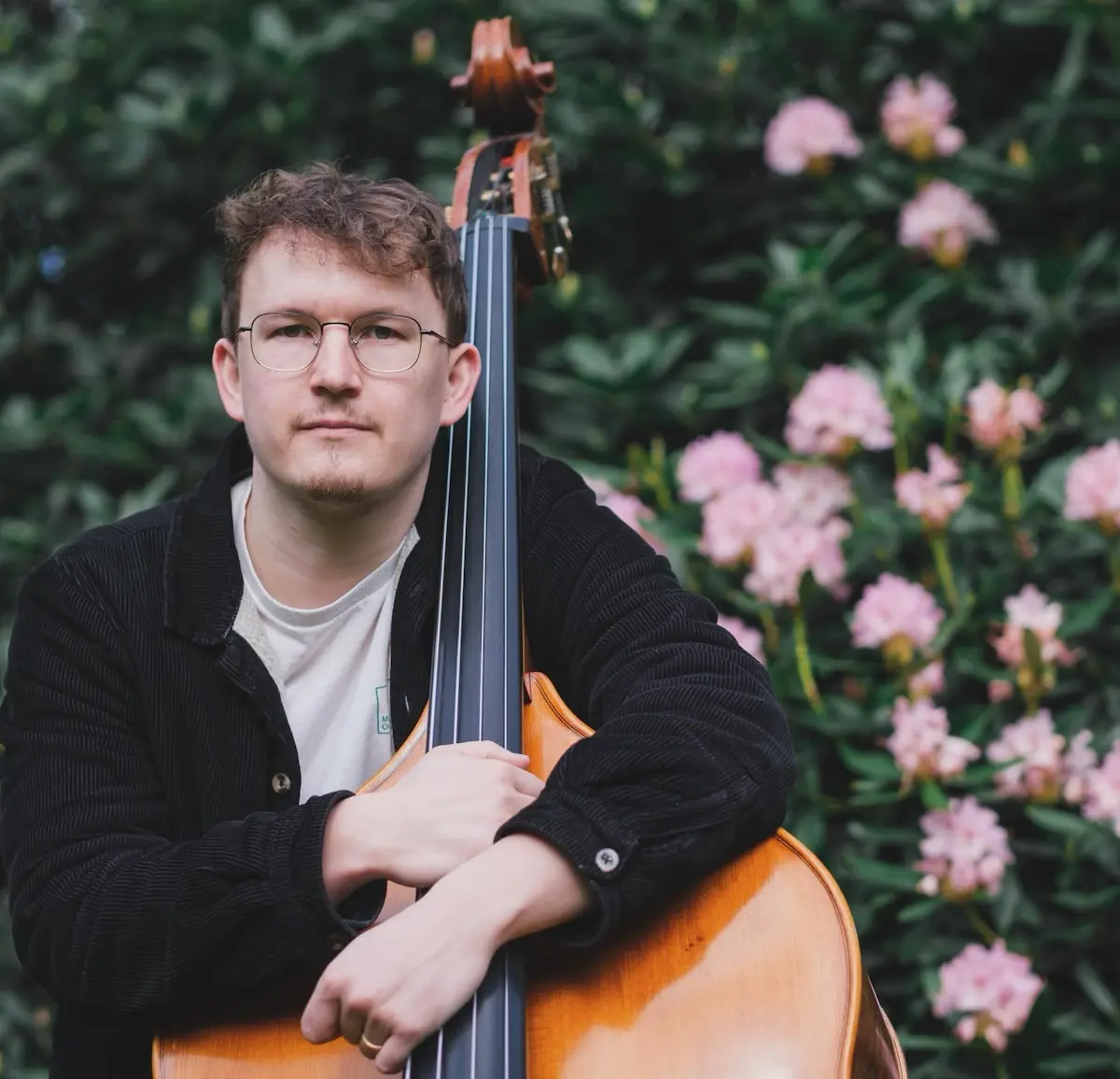
So synonymous is David Bowden with the sound of contemporary Scottish zazz that I had to check myself when visiting his biography. Actually born in London, Bowden moved north in 2011 to study at the Royal Conservatoire of Scotland in Glasgow. He is best known as the bassist in Fergus McCreadie’s award-winning trio, a group whose unique blend of contemporary jazz and Scottish folk music speaks as much of its place as the Nordic tone-poems of Jan Garbarek. Outside of McCreadie’s trio Bowden has shown a willingness to straddle genres in his collaborations with singer-songwriter Beth Malcolm, composer Finn Anderson and Glasgow-based fusion collective Mezcla, and he has also collaborated with another Mercury nominated artist, corto.alto.
Learning from his jazz-folk crossover projects, Bowden intended that these pieces for unaccompanied bass should emulate the phrasing of the human voice while capturing something of the intimacy of solo acoustic guitar music. Responsible for carrying the melody, harmony and rhythm, Bowden uses no loops or effects, and there’s little room for false starts or wayward choices. Save for Nick Drake’s From The Morning, Emilíana Torrini’s Snow and Chris Thile’s Jessamyn’s Reel, all of the compositions are Bowden’s, the relatively short programme maintaining a strong ebb and flow.
The busy polyrhythms and call-and-response lines of opener The Spider’s Talk have a West African feel, perhaps a hangover from Bowden’s studies in Ghana. On WGS Blues he taps into the guttural side of Mingus, while the folk-inflected Singing Sands is so persuasive in its lyricism it’s hard to believe that there’s no human voice at work. The intriguingly titled Hakken-Kraks is the most ambitious composition of the set, a roving piece which, like the shorter Chrysalis, builds its own rhythmic momentum. The closing Lullaby For Esmée, written for his young daughter, is as tender as it is charming, and it’s probably the most memorable of the originals. Bowden has conquered a notoriously unforgiving format with apparent ease, and this adventurous but highly accessible music stands frequent and repeated listening.
Discography
The Spider’s Talk; From The Morning; WGS Blues; Singing Sands; Hakken-Kraks; Snow; Jessamyn’s Reel; Chrysalis; Lullaby For Esmée (26.16)
Bowden (b). Solas Sound, Glasgow (no date).
David Bowden Music DBM001US
Jonas Cambien: Man Eating Tree
Founded by prolific Norwegian bassist Ingebrigt Håker Flaten in 2020 at the peak of the global pandemic, the Sonic Transmissions label continues to document both Flaten’s own work and that of a tight circle of like-minded creatives. While the majority of the label’s output leans towards free jazz and improvised music, this set from Belgian-born pianist Jonas Cambien (b. 1985) ventures further afield, incorporating elements of avant-garde composition, Ethio-jazz and minimalism into what can only be described as a defiantly idiosyncratic style.
Classically trained at the Conservatory of Brussels before relocating to Oslo in 2008, Cambien is now a central figure in the city’s experimental music scene. Amongst his four albums as leader is one from the group Maca Conu with Håker Flaten, and he can also be heard with Arabic-improv group The Handover. The prevailing influences on this new solo outing, however, are those early minimalists Terry Riley, Steve Reich and Philip Glass, and how listeners react to it will to a large extent depend on their predisposition towards the style.
Opener Tre is perhaps the most difficult of the album’s four contrasting pieces. Austere, machinelike and for a while verging on impenetrable, it has a repetitive motif that’s accompanied by dancing prepared piano rhythms moving in and out of phase. Across much of its 10-minute span only the smallest of shifts are perceptible, Cambien gradually drawing us in as he moves towards an explosive finale. The cascading melodies of Árbol briefly recall Jarrett’s free-ranging improvisations from the 70s before Cambien switches direction, deploying a panoply of preparations in a beguiling wall of sound. Silverware signals a shift into more of an electro-acoustic realm, wood and metal combining in a matte of overtones, while on the closing BOOM Cambien introduces the Ace Tone organ. The joy is inescapable as minimalist pulses blend with the hallowed sounds of Alice Coltrane and Sun Ra, and although Man Eating Tree could never be described as an easy listen, Cambien’s patiently developed solo crowns a boldly imaginative piece of work.
Discography
Tre; Árbol; Silverware Vibrating Inside Grand Piano; BOOM (37.02)
Cambien (p, org). Ugla Lyd Studio, Nesodden, Oslo (no date).
Sonic Transmissions STRLP39