Blazin’ Quartet: Cosmogonie
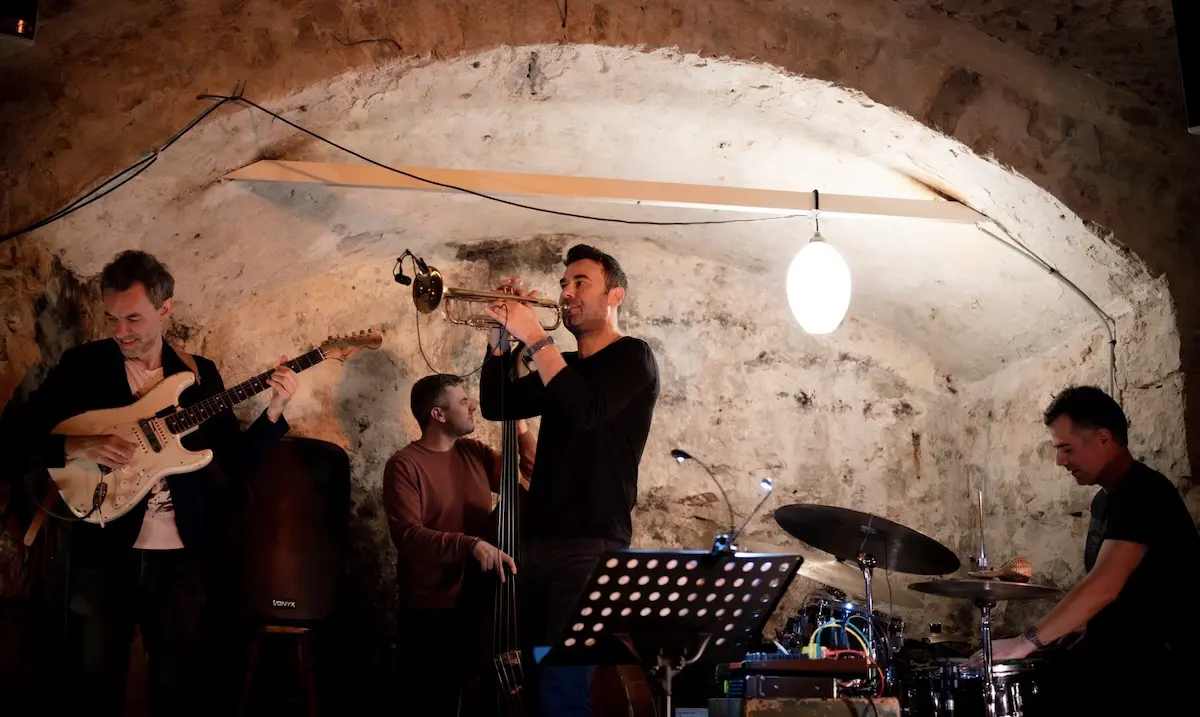
Cosmogonie is the musical portrayal of ancient Greek creation myths, of origin and existence, by the Blazin’ Quartet, led by Bosnian drummer Srdjan Ivanovic. Divided into three parts – Genesis, Metamorphosis and Clash – it starts with Chaos, a brief improvised passage reflecting the beginning of the world.
The journey unfolds through various stages, a mixture of intense, high-energy music, rock elements integrated with jazz and freer components. There’s a spaciness about Ourea and Pontos, whilst other tracks have hints of Balkan folk melodies, particularly Ether & Hemera, with its slightly mournful effect, and Cronos & Rea.
Frederico Casagrande varies his expressive guitar playing according to the interpretation of the stories. His slower blues-inflected lines and bent notes create a brooding atmosphere on Nyx & Erebe, and he uses distortion on Oceanos. His solo guitar feature, Tartaros, is played gently, a contrast to his wilder excesses on Cronos & Rea. The lead is alternated with trumpeter Andreas Polyzogopoulous, who at times is reminiscent of Tomasz Stanko or Ian Carr in the use of flattened tones. There are elements of quiet fragility, but he has the capacity for sudden explosive outbursts of expressive swing.
Ivanovic is the real leader, though, driving the music along, full of urgency in the uptempo numbers and constructing percussive patterns and textures on the slower ones, the middle section of Ether & Hemera a textural bed of percussive sound. There’s abstraction, but with underlying harmony and structure. On Hecatonchires, his solo is augmented with a kalimba (thumb piano). The solidity of Mihail Ivanov enables Ivanov greater exploration and the bassist is given an opportunity to solo on Mnemosyne (goddess of Memory), despite an abrupt ending, before leading into the forceful Ouranos, with Polyzogopoulous on a more open horn.
An absorbing album, and although its intention is to link to the mythological narrative, this isn’t essential, as the music stands up in its own.
Discography
The Genesis: Chaos; Gaia; Nyx & Erebe; Tartaros; Ether & Hemera. The Metamorphosis: Ourea; Pontos; Oceanos; Mnemosyne. The Clash: Ouranos; Hecatonchires; Cronos & Rea; Phoebe (48.04)
Andreas Polyzogopoulous (t); Federico Casagrande (g); Mihail Ivanov (b); Srdjan Ivanovic (d, pc). Athens, September-October, 2025.
Rue des Balkans RDB008
Art Farmer: Modern Art
The pairing of Art Farmer and Benny Golson has always been highly regarded, despite it having a lighter approach than other, more successful, contemporary bands of Blakey, Adderley or Silver. This album, recorded for United Artists in 1958 under Farmer’s name, preceded the Jazztet of the early 60s and included pianist Bill Evans, who had been playing with Miles Davis’s group from April of that year.
A good balance of originals, ballads and standards, it shows what an underrated player Farmer was, polished and unobtrusive as he thoughtfully constructs his solos. His composition Mox Nix shows this, as his controlled build-up prepares the way for Golson and Evans. Fair Weather is a typically attractive Golson number, recorded by Chet Baker a couple of months later on his Chet In New York album. Kenny Dorham was to add words to the music and some years after it found popularity on Herbie Hancock’s soundtrack for the Bernard Tavernier film Round Midnight.
Junior Mance’s gospellish composition Jubilation sees Golson in smooth and airy mood; of the ballads, the pick is Like Someone In Love, Golson’s lush tenor suggesting Don Byas or Ben Webster had just walked in the door. Farmer’s muted horn weaves patterns quietly in the background before his own solo. Farmer’s concise style, refined and often introspective, was once described by Val Wilmer as having “a loneliness, a feeling that squeezed through the horn with bitter poignancy.”
It’s an enjoyably relaxed session, played with quiet authority and sublety, good support coming from the rhythm section, among which Evans is given opportunity to solo, quite expansively, on I Love You. There are two extra tracks, both from earlier in 1958, with Hal McKusick instead of Golson up front, but I don’t feel they add very much. I found The End Of A Love Affair over-arranged (by George Russell) and likewise It Never Entered My Mind. A shame it never entered anyone’s mind to use as extras two numbers with Golson himself.
Discography
(1) Mox Nix; Fair Weather; Darn That Dream; The Touch Of Your Lips; (2) The End Of A Love Affair (23.53) – (1) Jubilation; Like Someone In Love; I Love You; Cold Breeze; (3) It Never Entered My Mind (24.53)
(1) Farmer (t); Benny Golson (ts); Bill Evans (p); Addison Farmer (b); Dave Bailey (d). NY, September 1958.
(2) Farmer (t); Hal McCusick (as, cl); Evans (p); Barry Galbraith (g); Milt Hinton (b); Charlie Persip (d); George Russell (arr). NY, 7 April 1958.
(3) Farmer (t); McCusick (as, bcl); Evans (p); Paul Chambers (b); Connie Kay (d); Jimmy Giuffre (arr). NY, 25 March 1958.
Waxtime 772378
Sun Ra: Jazz By Sun Ra
First issued as Sun Song on the Transition and Delmark labels, this was Sun Ra’s first album (although previously there were 78s and 45s) and the music is firmly rooted in earlier jazz forms and is a good example of how his music underwent a remarkable evolution between the mid 50s and 60s.
Unusually for Ra, he issued a booklet of explanatory notes to accompany the original album, and here they are included on the sleeve. The tracks are conventional and relaxed, although there are indications that something is afoot, which was to develop into the collective improvisations of later. The link to his swing years with Fletcher Henderson and the influence of Ellington are evident, shown by the amount of riffing and the arrangements that are followed (Brainville), but it also incorporates small-band swing (Fall Off The Log and Swing A Little Taste). Ra was no stranger to this, having played with the Dukes of Swing in the late 40s and with Coleman Hawkins and Stuff Smith. What is noticeable is the inclusion of elements of exotica and greater use of percussion.
It reflects little of contemporary fashions in jazz, although it has been described as hard bop for a more exotic ensemble. Certainly, the uptempo Future, with its piano introduction and hard-driving Gilmore solo, would fit that bill, as would Transition, all the front line given space to solo. New Horizons has a similar feel to some of the early 50s Debut material of that other stylistic maverick, Mingus, whilst the Richard Evans composition, Lullaby For Realville, could have come from Blues & Roots.
Sun Song is a prophetic piece, a portent, complete with other-worldly organ and layers of percussion (supplied by all members of the orchestra). So too, to some degree, is Call For All Demons. The odd title here is Possession, a comparatively straight big-band orchestration, arranged by Eutrice U. ”Prince” Shell.
Many of these players stayed with Ra for long periods, a steady personnel which understood the precepts of his music and how it was developing.
Discography
Brainville; Call For All Demons; Transition; Possession; Street Named Hell (21.59) – Lullaby For Realville; Future; New Horizons; Fall Off The Log; Sun Song; Swing A Little Taste (22.57)
Sun Ra (p, org); Art Hoyle, Dave Young (t); Julian Priester (tb); James Scales (as); John Golmore (ts); Pat Patrick (bs); Richard Evans (b); Wilburn Green (elb); Robert Barry (d); Jim Herndon (timp, pc). Chicago, 12 July 1956.
Jazz Wax JWR4645
Brian Landrus: Just When You Think You Know
According to the press release much of this album mirrors the unpredictability of life, and with a title that may well have a wider and pertinent context in the current political and social climate of the United States and its global relationships, you might expect something biting and cutting, but it’s a pretty laid-back album. The use of subdued piano and keyboard and quietly unobtrusive guitar is largely responsible for this.
Apparently the music is more reflective of personal aspects of musician and composer Brian Landrus’s life, and there’s a definite uniformity about it. A more distinctive sound is evident when Zaccai Curtis switches to an acoustic-sounding piano: on the easy swing and smooth thematic lines of One Year he deftly lays down the lead-in to Landrus’s agile baritone statement. He does likewise on the deeply felt El Perro Sigma, an elegy to Landrus’s dog, the leader’s bass flute in tandem with his other instruments.
Some of the tracks start promisingly, but all too soon blend in and become placid. From The Night augurs well, being expressively freer, with Lonnie Plaxico providing a bowed-bass texture, but it’s unfortunately all too brief. Beyond has a warm, attractive tenor solo from Landrus, and apparently has a vocal contribution from Violet Qiu, although this is presumably subsumed in the unison sections.
As skilful as the playing is, there are times when the track Trance aptly describes much of the music here, and I couldn’t help waiting for something with a bit of edge. Paroxysm is hardly a sudden outburst; “paradox” might be a more appropriate title. Whitney Balliett described jazz as the “sound of surprise” but I’m afraid that’s in short supply here. Having heard and thoroughly enjoyed Landrus’s earlier tribute to Ellington and Strayhorn, this is disappointing.
Discography
All In Time; Continuance; Untold Story; One Year; Dear Fred; Averse; El Perro Sigma; Beyond; Trance; From The Night; Just When You Think You Know; Under Dark; Something Special; Paroxysm (79.38)
Landrus (s, bcl, f); Zaccai Curtis (p, kyb); Dave Stryker (g); Lonnie Plaxico (b); Rudy Royston (d, pc); Violet Qiu (v). NY, August 2025.
BlueLand BLR2026