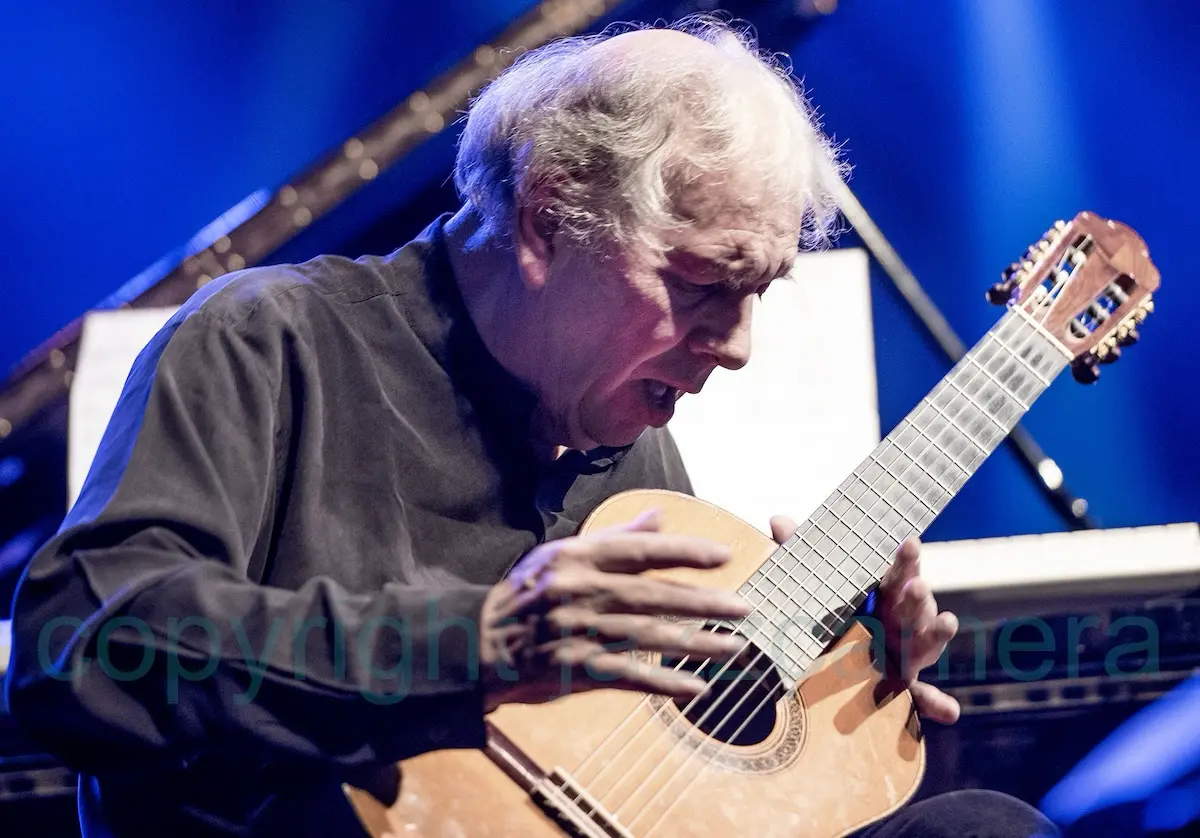
With the death of Ralph Towner (1940 – 2026) contemporary jazz lost one of its most prolific and distinctive voices. How many musicians can you think of whose work covers the range that Towner explored in the now rippling, now rapt and poised New Moon and Beneath An Evening Sky (from the 1979 Old Friends, New Friends) and the diversely swinging and bubbling Flutter Step and Burly Hello, Gary Peacock pieces which Towner helped bring to joyous life on the 1993 duo album Oracle, recently reissued in the ECM Luminessence series?
BBC Radio 3 marked Towner’s passing on 18 January by playing his beautifully measured interpretation of Danny Boy [Londonderry Air] from the 2023 ECM solo classical guitar recital At First Light, which I reviewed in 2023. Like many, I suspect, I was first drawn to Towner through the much earlier and strikingly different approach evident in his boldly fashioned 12-string solo introduction to The Moors on Weather Report’s early 1970s I Sing The Body Electric. But I would soon become aware of another, very different side to Towner’s musicality in his initial ECM albums Trios/Solos (1972) – with Glen Moore (bass), Paul McCandless (oboe) and Collin Walcott (tabla) – and the solo Diary (1973).
The full personnel of Trios/Solos made up the Oregon group which emerged from Paul Winter’s Consort Ensemble of the late 1960s. Oregon’s proto-world-music blend of jazz improvisation with folk feelings and forms, Asian-inflected structures and classically inflected tone poem was to prove influential. The band cut two albums for ECM, Oregon (1983) and Crossing (1984) before the tragic death of Collin Walcott in an on-tour road crash led to percussionist Trilok Gurtu joining the band and the eventual recording of a third and final album for ECM, Ecotopia (1987).
With further occasional changes in personnel, but with Towner and McCandless always present, Oregon would tour and record for several more decades. On their 30th recording, the excellent Lantern released by Kepach/CamJazz in 2017, a well-grooved and funky track like drummer Mark Walker’s Walk The Walk (featuring the multi-instrumentalist Towner on piano) underlines how much this border-crossing ensemble could respect and revivify fundamental jazz values.
The question then arises: how to characterise Towner, whether as player or composer? In the 2007 publication Horizons Touched: The Music Of ECM there is this suggestive indication: “Not a jazz guitarist in any conventional sense, but an improviser of eloquence and imagination, nor strictly a classical guitarist, Ralph Towner is a category unto himself.” Just so: but as Towner reveals in the sleeve note which he wrote for the aforementioned At First Light, his compositions have “trace elements of the many composers and musicians that have attracted me over the years. Musicians such as George Gershwin, John Coltrane, John Dowland, Bill Evans to name a few.”
In his sleeve note for the 1991 Sony/Columbia Jazz reissue of Weather Report’s I Sing The Body Electric, Lee Jeske spoke of “Ralph Towner’s flamenco-tinged 12-string guitar”. This is a projected association which, when I once spoke to him about it, Towner rejected firmly, albeit in typically smiling and good-natured spirit: “I’ve heard that connection suggested a few times. But really, my music has nothing to do with that particular tradition. It would be better to talk about my love of Renaissance and Baroque music, which I studied when young, or the impact on me of the Bill Evans Trio with Scott LaFaro and Paul Motian.”
Born into a musical family in Chehalis, Washington, Towner is said to have begun to improvise on the piano at the age of three and was playing trumpet at seven. In the Horizons Touched volume he speaks incisively about what for Towner was the crucial interplay of composition and improvisation, and vice-versa. From 1958 to 1963 he attended the University of Oregon where he studied classical composition before then studying classical guitar at the Vienna Academy of Music. He began his musical adventures as a conservatory-trained classical pianist, but from early on, improvising would seem to have been as natural as breathing to him, leading him into an initial career in New York as a jazz pianist.
The crucial impact of Bill Evans would be acknowledged specifically in two of Towner’s duo sessions for ECM, the 1985 Slide Show with Gary Burton (vibes, marimba) and the 2008 Chiaroscuro with Paolo Fresu (t, flh). Both contain wondrous readings of the Davis/Evans classic Blue In Green from Kind Of Blue, the 1985 session featuring the 12-string while the 2008 date has Towner on classical guitar, the instrument he called “my little travelling piano”. And the impact of the three-way interaction so characteristic of the Evans, LaFaro and Motian trio is no less evident in the richly diverse group interaction and consequent refiguring of factors of compositions and improvisation which so distinguish the totality of Towner’s work on ECM.
In the diverse company of such strong individual improvisers as, e.g., John Abercrombie, Gary Burton, Jon Christensen, David Darling, Jack DeJohnette, Paolo Fresu, Jan Garbarek, Eddie Gomez, Gary Peacock, Kenny Wheeler and Eberhard Weber, Towner conjured many a resonant, fresh yet deeply literate phrase, in both duo and small ensemble settings evincing equally the most subtle and potent interaction. He also made telling contributions to albums by, e.g., the Azimuth trio of John Taylor, Norma Winstone and Kenny Wheeler (Départ), Keith Jarrett (In The Light), Jan Garbarek (Dis), Arild Andersen (If You Look Far Enough) and Kenny Wheeler (Deer Wan). And on the 1982 Blue Sun, he brought an orchestral ambition to a solo album, playing 12-string and classical guitar, piano, synthesiser, French horn, cornet and percussion. Ironically, to my ears at least, this led to the kind of album where the titles of the tracks – e,g., Blue Sun, Shadow Fountain, Rumours Of Rain – stay in the mind somewhat longer than the impact of the at times overly textured music.
Titles (e.g., Oceanus, Visitation, Nimbus, Sand) and music were in especially fruitful accord on the two Solstice quartet albums on ECM which Towner led in the 1970s. In the notes for his 2004 ECM :rarum Selected Recordings release, Eberhard Weber spoke of the “stellar moment” in December 1974 when Towner and Garbarek, Weber and Christensen made the first of these recordings. “We all hit it off immediately and everybody contributed considerably to the success of the recording.” The music had a special impact on me, as did the February 1977 session which produced the quartet’s Sound And Shadows: so much so that in the summer of 1978 I drove up to Norway’s Molde Festival to hear the Solstice quartet give not one but three superb concerts.
I often wondered what it was in this music from Towner and his colleagues that had affected me so much. While researching my book Jan Garbarek: Deep Song (1998) I finally got my answer, in the shape of the analysis of the track Oceanus (composed by Towner and the opening piece on the first Solstice disc) which the composer, musician and writer Rod Paton kindly supplied to me. I quote that analysis in full here. Why? Because, in its musically grounded elucidation of the emergent liminal quality in the music, it seems to me to offer an appropriate summation of the overall import of the many achievements of a most technically accomplished, questing and soulful musician.
The man who chose to issue, on the 2008 Chiaroscuro, two versions of his haunting piece Sacred Place was elsewhere able to intimate, in his individual yet also collectively spun art, what one might call a poetics of “the tenuous sacred”. As Rod Paton notes, on Oceanus “Ralph Towner places his [12-string] chords against the freely evolving rhythmic harmonic wash with a remarkable sense of timing. In fact, this feels more like painting than music – the modal harmony, spiced up with ninths and sevenths, is daubed onto the canvas of rhythm. The relation of harmony and rhythm in the music is fascinating: a very slow pulse of harmonic, or chordal change offset by the crisp business of Christensen. For all that business there is so much space in the music. Although Christensen keeps up the rhythmic drive on the cymbal, Weber, instead of underpinning this in the traditional manner, sidesteps Christensen’s accents and creates a melodic, shifting bass line.This, in turn, sets the harmonic progression further on edge, so that the whole sound becomes liminal. Garbarek is then able to create organic, rolling waves of melody, improvising to mini-climaxes but still leaving acres of space.”
A dogma-free and nourishing space, this, liberating and stimulating on any number of levels. A thousand and more thanks to you, Mr Towner: RIP.
Ralph Towner, Chehalis, Washington, USA, 1 March 1940 – Rome, Italy, 18 January 2026