

This is one of a series of taped interviews with musicians who are asked to give a snap opinion on a set of records played to them. Although no previous information is given as to what they are going to hear, they are, during the actual playing, handed the appropriate record sleeve. Thus in no way is their judgment influenced by being unaware of what they are hearing. As far as possible the records played to them are currently available items procurable from any record shop.
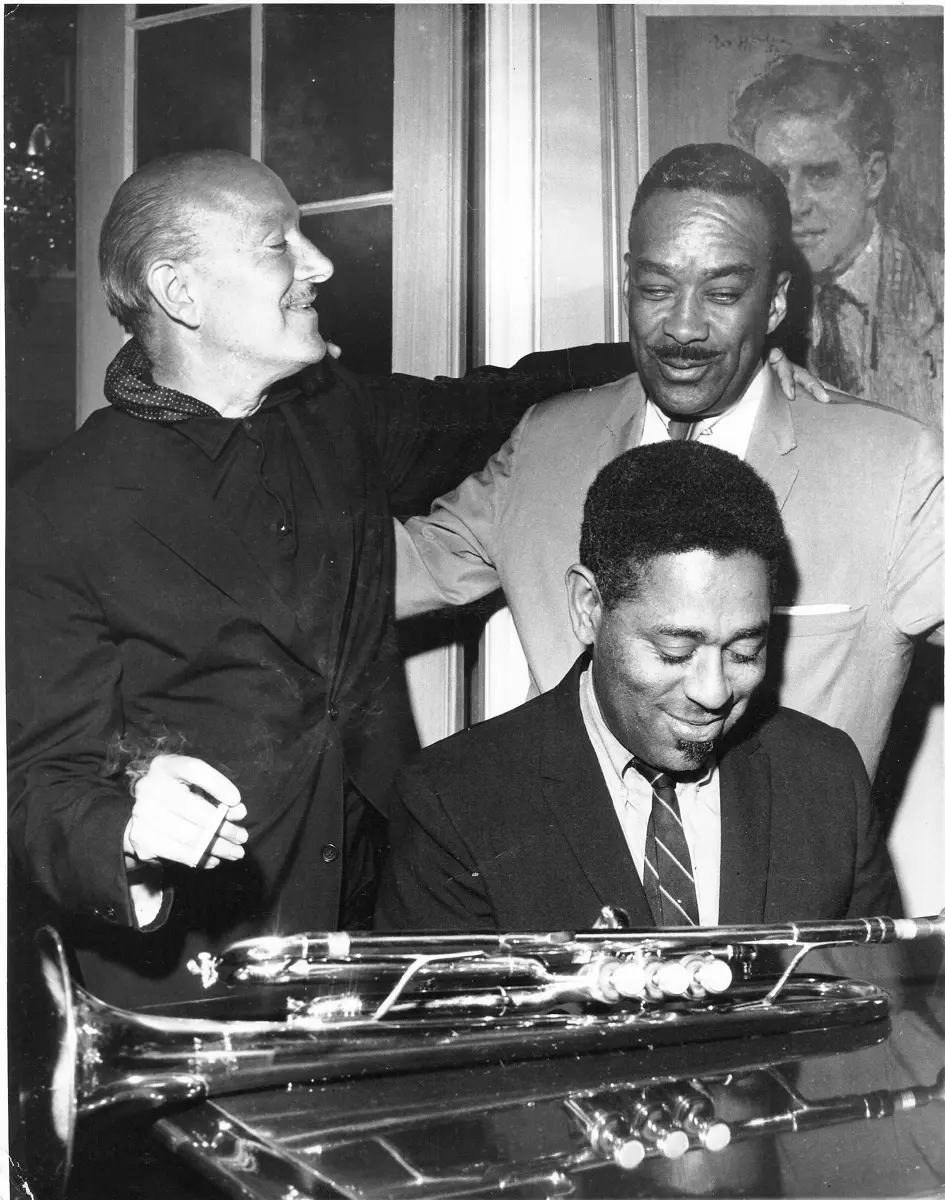
Lawrence ‘Bud’ Freeman, one of the original five musicians from the Austin High School, Chicago, comes to this country so frequently these days that he has become to be looked upon almost as a native Britisher. A happy man, contented with his music, his uncluttered style of playing his tenor appeals to practically all trends of jazz thought. We are happy to have him with us again at this time. – Sinclair Traill
’S Wonderful. Art Tatum. Verve VLP 9110
That was nothing less than a masterpiece! I remember a wonderful story concerning Tatum which occurred whilst I was with Benny Goodman’s band. Tatum was playing downtown at the Three Deuces, and we were playing the Chicago Theatre. I got to the place he was playing one night just as he was coming off stage. ‘This is Bud Freeman,’ I said, as I knew he couldn’t see very well. ‘I almost missed that last set, but what I heard was too wonderful. Would it be an awful imposition, if I asked you to play just one more number for me. I’ll have to leave before you play your next set.’ Well, he went back to the stand and, just for me, he played another forty-five minutes. Now we had never met before that, but somehow we seemed to strike it off, from the word go. As he was playing, the boss of the place came over to me and said ‘Well, who the hell are you anyway?! No one, not even me, and I hired him, can get that man on the stage between sets, and you come along and get him to play like this.’ So I explained that it was something between musicians. Tatum instinctively knew I loved him, and so he needed no persuasion to play for me. And that actually was my introduction to Art Tatum.
In our time he was undoubtedly the greatest pianist – his talent was unbounded, unlimited. There have been so many great pianists who I have listened to and loved – James P. Johnson, Fats Waller, Earl Hines, yes, and even up to Bud Powell, but Tatum just answered that question of what the ultimate jazz pianist should play like.
Benny Carter played very nicely on that record. I first met Benny many years ago in New York City. Mezzrow was rehearsing that mixed band he ledfor a time – it was the first of its kind ever to be formed. Benny came down and played with the band and lent Mezz many of the arrangements they played. I always listened to Benny any chance I got and I say this with all respect to Charlie Parker, who undoubtedly had a wonderful talent, but in my opinion the great alto players were Benny Carter and Johnny Hodges, and I think history will prove this to be a valid statement. Both of them have this marvellous sense of melodic line, allied to a wonderful sound and ability to improvise with the greatest skill.
To get back to Charlie Parker, and again I say this with all respect, he had a marvellous amount of talent, but I feel that his health precluded him extending that talent to its utmost. He was a magnificent musician, but to me he never quite came to full fruition – he died too young. Carter and Hodges had those many more years to bring their talent to complete flower, and I think they benefited thereby. I know some people are going to say, well what does time matter, when people like Parker can play so much in so short a time. I agree with them some of the way, but would like to point out that very important thing, consistency. Jazz has always thrown up young musicians who have been good for a few months, and then suddenly they are gone. Lack of consistency – the consistency to play good which both Carter and Hodges have had for a long time. It was unfortunate for Parker that he was copied by all the idiots. Those people who didn’t have a hundredth of his talent tried to copy him and made a mess of that particular style of playing. Parker I can always listen to, but his imitators never!
Tête à Tête. Clark Terry-Bob Brookmeyer. Fontana TL 5265
I can tell you a very interesting thing about Clark Terry. I have played a few dates with him and we have made some records. One in particular, which is not out yet, by a quintet I think and hope will be successful. The man who paid for the record date has sold it to one of the big companies, but I don’t know which one as yet. It happened this way. I got a call from a man one day asking me if I would like to do a score for a football documentary – to be called The Making Of A Pro. It was a kind of a publicity story for the New York Giants football team. I and Bob Haggart, the great bass player, wrote the score, and we did it with a quintet. I had Clark Terry and myself on horns, Bob on bass, Mousey Alexander on drums, and Dick Hyman on piano. The music got an award from ASCAP. Clark is a real masterful trumpet player, whose playing I love. We are going to get together again soon and do something for Harry Lim. I hope we shall use the same group.
Bob Brookmeyer here also shows some talent. He always plays with Clark when he can, for I know he feels that their styles blend perfectly – and I must go along with that. It is so difficult these days trying to make a living playing the kind of music one really wants to play, that the success these two have had is really phenomenal. Brook and Clark have been lucky to have been able to play these few club dates, but they should stay together if possible. They are both very talented. I don’t think there is anyone playing better horn than Clark today (tho’ I would bracket Ruby Braff in that statement). In that football thing I spoke of there was a tune by Bob Haggart and myself called What Else Is New? It was a feature for Clark. Well, he did the tune again with Skitch Henderson’s big band, and I am happy to say it is a big hit. Happy for Clark, and of course because it will mean a nice fat royalty cheque for Bob and me from ASCAP.
The pianist there, Roger Kellaway, sounds quite a man. He wants to go back to the style of the thirties, which is alright with me. He plays the kind of piano I really admire, and I think this trend is a very healthy thing for jazz – this trend back to the real jazz.
Of Bobby Hutcherson: ‘I can’t really believe these people think that is music, but I find it difficult to believe these people believe in anything. Truly there is little talent there, and it sounds just sick’
Catta. Bobby Hutcherson – Dialogue. Blue Note 4198
Well, really I would rather not talk about that! I don’t want to talk about it because I like to think there is room for everything. If anyone wants to play this way, let ’em – let ’em play and think any way they want to. I can’t really believe these people think that is music, but I find it difficult to believe these people believe in anything. Truly there is little talent there, and it sounds just sick. It is all right to experiment – Clark and Brook on the last record you played me, they are always experimenting, but they experiment musically and know just what they are doing. Really it is all a matter of talent. You go into a bar late at night and there are some people drunkenly singing. Now they may hit a good chord, one out of a thousand, and so the other drunken listeners say, ‘Oh, boy – listen, they can sing great!’ But the next morning when everyone is sober again, it is found the singers just didn’t have the talent. And this is exactly how it is in music. When a man has dedicated most of his years to playing he had damned well better be good, or he will get pushed out, or even give it up himself. I have heard many of them say ‘I got out of the business because of this or that’. But it wasn’t true, an artist knows when he has something to give, and he then sticks with it however rough it may get. When they say ‘I got out of jazz because it hasn’t any future, or there isn’t any money in it’ – well, that is a lot of bunk. It was them that hadn’t got it.
To get back to this record, one can’t answer for all the things that go on, but I feel you can’t really fool the listener. An artist projects his talent and I can’t believe there is any talent here. I have been playing the kind of music I believe in for 43 years and it has become very dear to me. Lots of time I have been asked why I hadn’t left jazz, for I have had opportunities to make more money in other fields but this is the thing – it is a thing which is me, my horn is me!
This music makes me think of that day when I will be playing a concert at the age of 90, and I have to be helped onto the stand and someone even holds my horn to my lips, for I am that feeble. And the next day the critics said ‘Oh, did you hear that wonderful one note that old man Freeman played last night?’ This music is like that, one listens hopefully for the one good note. Perhaps you played me the wrong track. Opinion is often not a very reliable thing, but I think there is musical fact – I think it was a fact that Louis Armstrong, Bix and King Oliver were great players. I am sure it is another fact that Art Tatum was a great pianist; so was Waller and James P. I am sure Jimmy Noone was a beautiful clarinettist; that Dave Tough was the greatest drummer of all, and that Sid Catlett was another. These are musical facts, from which we build our opinions. Not self-opinions, but musical facts. So when we listen to these experimental things, I don’t think we should become angry and just dismiss them out of hand, I think we should try and remember that not everyone can be talented.
‘There has never been any more relaxed musicians than Bobby and Teagarden and this is them at their best. Neither of these two were ever intimidated into playing any “new” or “angry” styles’
Mama’s Gone, Goodbye. Bobby Hackett-Jack Teagarden. World Record Club T 463
Bobby and Jack are two of my greatest idols, and I think the thing I like most about this album is that it is all so effortless. No one tries to break any world’s record, it is just an example of two artists playing the way that comes naturally to them. That A&R man spectre is way in the background. No one told them to trot out any ‘soul’ music, or any other kind of gimmick music – this is jazz the way they wanted to play it. There has never been any more relaxed musicians than Bobby and Teagarden and this is them at their best. Neither of these two were ever intimidated into playing any ‘new’ or ‘angry’ styles; this is the kind of music they believed in, a kind of music that I think was really a part of them, as much as a leg or an arm. I made an album with Jack and Bobby, just before Jack died; I don’t think it has ever been released yet. It included, I remember, a wonderful version of Moon River which Jack was able to make into a completely personal tune of his own.
I remember the first time I heard Jack. I was at that time playing in Ben Pollack’s band in New York City, in 1928. In that band we had Benny Goodman, Vic Briedis, a wonderful pianist, Harry Goodman, Benny’s brother, Dick ‘Icky’ Morgan, (a crazy, really funny man who invented a language of his own called icky – he got it from an old film called The Lost World in which they featured an ichthyosaurus who made queer noises), Glenn Miller on trombone and I was on tenor. The band played at a rather swanky club where monocles and lorgnettes were quite the thing and a white tie was a necessity – it was called The Silver Slipper. We didn’t get all the chances to play quite the way we wanted to. Most of the arrangements were set arrangements and the boss hated every one of us. He hated jazz and knew that any time he turned his back or went out of the club for any reason, Ben Pollack would turn on the heat.
Well, one day Pee Wee Russell called me up. He was almost speechless with excitement, as he told me that the most fabulous trombone had just arrived in town from Texas, and that his name was Jack Teagarden. This was during prohibition days, and so the next day we journey down to this speakeasy and in walked this man. He was a sight, with high-lace shoes and an old-fashioned Norfolk suit, with his trousers half-way up his legs, and a huge button cap! He had his instrument in an old corduroy bag, no case. But when he took it out and played, with no accompaniment, it was the most fabulous music I had ever heard in my life! Now, I straightaway went back to Pollack and told him what Pee Wee and I had heard. He has just got to be in the band, I told him. ‘You must have him.’ Well, the trombone player we had at that time was Glenn Miller. He heard about me telling Pollack and he quit the band at once. He and I were never friendly after that episode, but Jack came and joined, and in a very short time, he changed the whole style of the band. He got Goodman to play more melody, and he helped us all. It was quite marvellous!
To get back to this album, this is a really fine example of two great people playing the only way they know how – the only way they feel the music. People are always confronting me with this question which is unanswerable ‘What is modern jazz, or progressive jazz?’ Well, I think there really is no such thing as modern jazz, or progressive jazz. Because if one is going to call any particular kind of jazz progressive, it just means that all other kinds of jazz are reactionary, so it’s all kind of stupid! An artist must believe in himself and if he does, then through the years, if he is genuine, what he plays is good for all time. We don’t know what is to come. There is no such thing as a way-out sound, it is either genuine or spurious. Listen to anything played by any of the old masters – Louis, Bechet, Oliver, James P, or any of them, and it is as alive today as when it was first played. And if you want to hear some modern harmony, surely you can’t go further than Debussy and the guys who wrote it down a hundred years before jazz was ever played. So there is nothing really new under the sun – the only thing that matters is that a man plays what he believes. You cannot play way-out unless you genuinely feel that way yourself. I’m interested in this new music. I think it has something, but it is certainly not new harmonically – it has all been done before.
‘I was never influenced by [Hawkins]. My influences had come from Bix, Louis, King Oliver and certainly Jimmy Noone’
I Surrender Dear. Coleman Hawkins – Meditations. Fontana TL 5273
What is there to say about Hawk that hasn’t already been said? This is the kind of music that you will be listening to a hundred years from today – and it will still be modern! The great master of the tenor saxophone. If you want a rating I would have to give this about 16 stars!
It was after the Wolverines broke up, that Husk O’Hare took over the band – he was a kind of an agent. We didn’t get too much work, but Art Kassel, a commercial bandleader, got the job at the Greystone Ballroom in Detroit, and we went along as part of the band. We just played the way we wanted to, as Kassel spent most of his time in the bar, and of course the other band was Fletcher Henderson with Coleman Hawkins – and that was the first time I got to hearing him. That was in the early twenties. It was, of course, the first time I had heard a tenor saxophonist with so much power, authority and so much talent. But interestingly enough, although I loved what I heard, I was never influenced by him. My influences had come from Bix, Louis, King Oliver and certainly Jimmy Noone, and they had come to me or rather I had listened to them, before I ever heard Coleman. So although I thought him quite fabulous, I was never influenced by him in any way. The style that became mine was built up in stages. I would say there isn’t a musician in the world who hasn’t taken something from Hawkins, but then by the same token I have also taken something from Bix, from Louis and from all the other greats. So whatever I heard in those early days rolled up into some kind of ‘Freemanistic’ ball, which I now hope is mine.