
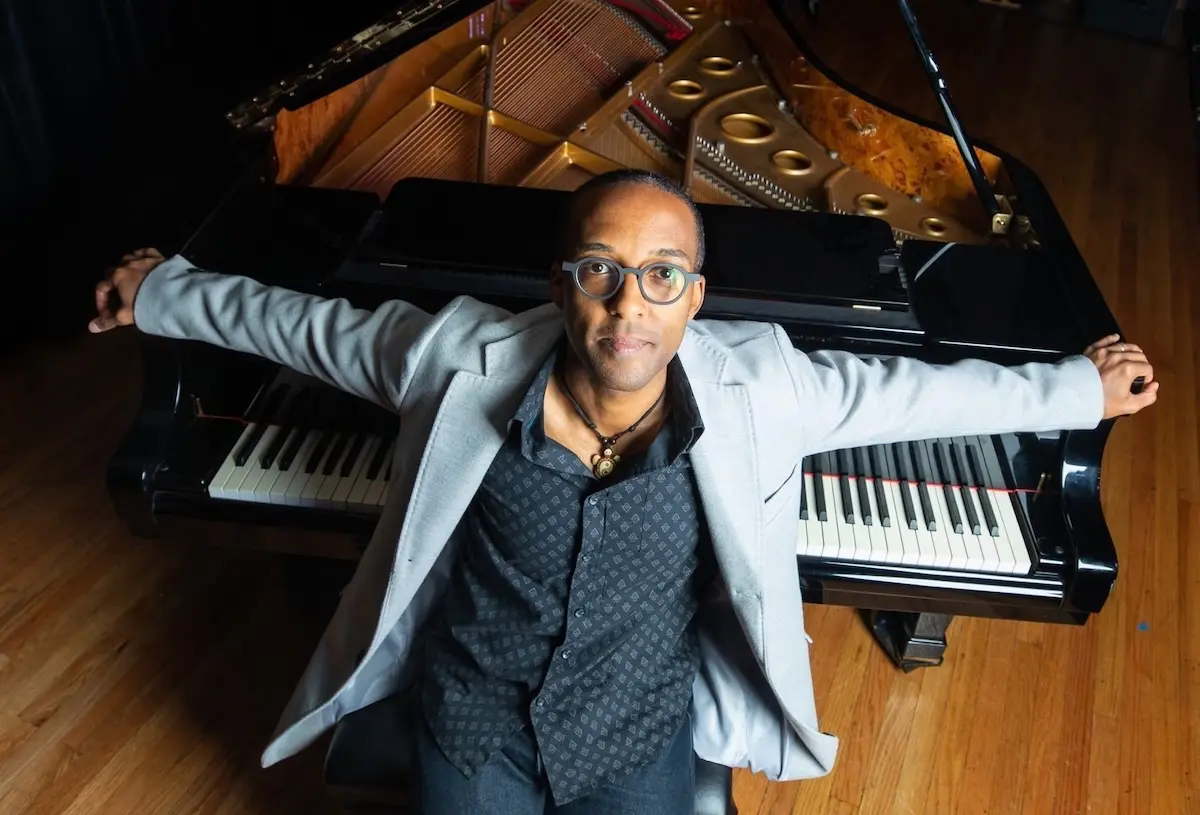
Kevin Harris Project: Vitruvian Echoes
Boston-based composer, pianist and musical educator Kevin Harris fuses art and science in his work. Vitruvian Echoes is inspired by Leonardo Da Vinci’s drawing of Vitruvian Man. This Renaissance artwork shows a standing man, arms and legs spread out with the proportions being equal. Harris uses this as a starting point to pose the question – how can we be balanced as human beings? In musical terms, how can a balance be achieved between freedom and inclusivity, rules, grounding and structure. If that sounds quite a big issue to tackle through music, the good news is that the album combines a sense of exploration and precision with spontaneous improvisation.
Supported by Rufus Reid and Neil Smith, Harris often gently teases out the themes in his compositions, gently stroking the piano keys to almost let the ideas breathe before the trio runs with what emerges. Shui (Water) opens things with some suitably shimmering drumming from Smith before Harris and Reid join the proceedings with equally light and nimble contributions. Despite the serious-sounding nature of Vitruvian echoes as a project, there is a sense of fun to what emerges. Released in May 2026, there is no CD version of the album and as far as I can discover it doesn’t appear on any of the main streaming platforms except for Bandcamp. The full album is available on kevinharrisproject.com which also contains some sample videos of Harris, Reid and Smith performing tracks across the album. These are as informative about the process of making music and the connection between the trio as they are enjoyable to watch in their own right.
Discography
Shui (Water); Mirrors; The Lonely Strength; An Urban Waltz; Hipness; Time; Raven Run (59.02)
Harris (p); Rufus Reid (b); Neil Smith (d). No date or place available.
Roni Ben-Hur: Abriendo Puertas
Born in Israel in 1962 but a long-time US citizen based around New York, Roni Ben-Hur has recorded around 20 albums as either leader or co-leader and is described by critics as a formidable, limber, inventive and consummately lyrical guitarist. Influenced by guitarists such as Wes Montgomery, Joe Pass, Jim Hall and Kenny Burrell, Ben-Hur also claims family links to Tunisia which, he claims, explains his love of African-driven rhythms and Moorish sounds. The album’s opener – Abriendo Puertas (which means opening doors) is a bustling, almost too busy concoction where everyone throws everything into the mix. Only on the quieter follow-up, the gently swaying ballad Mi Mejor Canción, does Ben-Hur’s smooth, easy style emerge.
The album covers the whole spectrum of Cuban-infused music, from pulsating, beat and rhythm-driven songs to gentle ballads, which includes vocals from Osdalgia Lesmes. The musicians also open themselves to blues and other jazz forms, so that the album is rich in textures and shaped by different cultures. Emir Santa Cruz provides some fiery solos on tenor sax to add another dynamic to the mix, and nowhere is this more notable than on the album’s finale El Tiede.
I must admit that some of the music on the album was a bit too frenetic and busy for my taste, but there is no denying the infectious enthusiasm that shines from the performances of everyone involved.
Discography
Abriendo Puertas; Mi Mejor Canción; Dos Gardenias; Gua’One Blues Pal Bobby; Esta Tarde; Lo Que Es Del Cesar; El Tiede (49.16)
Ben-Hur (g); Alejandro Falcon (p); Pedro Pablo Gutierrez (b); Ruy Lopez-Nussa (d); Octavio Rodriguez Rivera (pc); Emir Santa Cruz (ts); Osdalgia Lesmes (v). Havana, November 2025.
Dot Time Records
Luca Crispino: Transitivo
Italian guitarist and composer Luca Crispino is influenced by jazz but also open to many different musical influences and styles. Improvisation and experimentation shape his approach to music, and he has focused on these areas since 2000. Transitivo is the latest album on which this Paduan musician explores the world of border music. Borders, or the liminal space between different types of music, allows the band to explore a variety of sounds, paying attention to the importance of spontaneity and improvisation that has been Crispino’s passion for a quarter of a century.
Basilisco opens the album with mysterious, swirling flute from Stefano Benini and the track develops into a haunting, almost dervish-like song that lures the listener and holds the attention. Cronofrattura serves up bubbling synthesisers to create an entirely different ambience from the opening track, and this sense of difference continues with each of the eight compositions.
Despite the experimental, avant-garde nature of the project, Transitivo offers an intriguing, pleasing listening experience. Inevitably, with use of keyboards, synthesisers and steel guitar, some of the sounds are reminiscent of prog-rock, with shades of Pink Floyd somewhere in the mix. Elsewhere, with its sense of space, unease, pulsing rhythms and slightly other-worldly vibe, the mood took me back to The Police’s final studio album, Synchronicity. A 40-minute journey into the strange, unique world of Crispino’s border music concludes with the suitably mysterious but lovely Ferragut, driven by some exotic-sounding flute from Benini, moody drumming from Luca Pighi and spiky synthesisers and reverb-heavy guitar to really bring out the edginess of the composition and the whole purpose of the album – to explore new frontiers in music. Quirky, hypnotic and very enjoyable.
Discography
Basilisco; Cronofrattura; Dittico Inesplicabile; Verdugo; Argonauta; Pontecorvo; Avamposto; Ferragut (40.00)
Crispino (g, lap steel guitar); Stefano Benini (f, didgeridoo); Enrico Terragnoli (b, syn); Luca Pighi (d). Badia Polensine, Italy, 25 October 2025.
Dodicilune – ED623-0