MISSION POSSIBLE
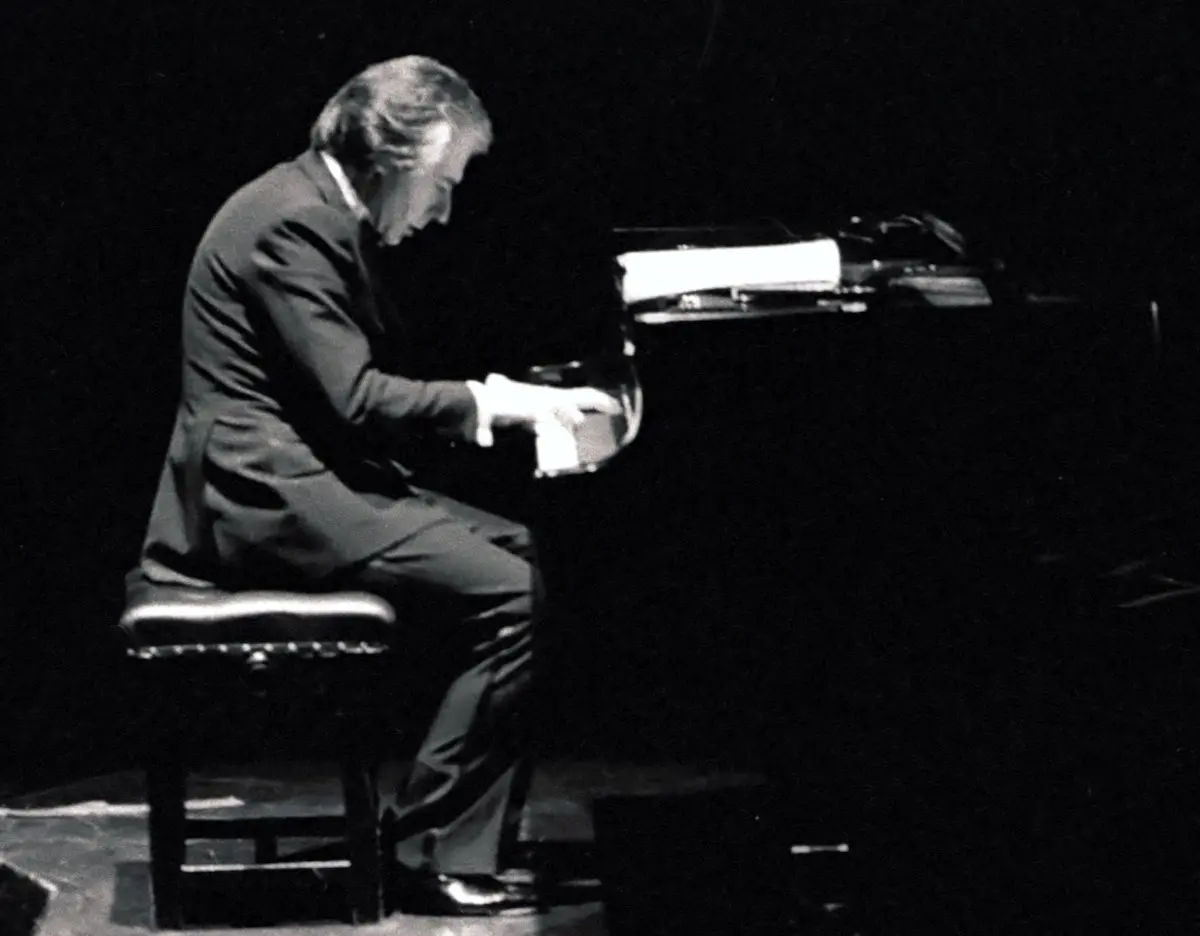
A recent visitor to London was former Dizzy Gillespie sideman and film and TV writing specialist Lalo Schifrin. He had just completed the sound track of the film Voyage Of The Damned, featuring Fay Dunnaway, Orson Wells and James Mason, although he was sorry to be travelling back to the States two days before his former leader opened at Ronnie Scott’s.
In spite of his tremendous success in writing for the visual field he takes his own playing seriously. He still plays straight jazz gigs, and before an important concert or club residency will usually practise diligently for three or four weeks. He has recently received excellent notices for concerts given in New York and is determined never to give up this side of his activities.
Because of his involvement with jazz, it was particularly instructive to talk to him about the art of writing good soundtrack music. He is a man with strong opinions and he believes that a delicate balance must be achieved. The music, while being meaningful in terms of the action, must not be too distracting. He felt that Duke Ellington’s score for Anatomy Of A Murder was ideal and that it would only be the committed jazz fan who would consider the music as a thing apart.
He felt that free jazz could also have a part to play in modern film-making, although he considered that there should be slight changes of emphasis. Schifrin had always worked on a composition after seeing the action. It was conceivable, he thought, that if the free-jazz player and the avant-garde film maker were to come together, it would be better if they had a give and take arrangement. He actually cited Ornette Coleman as a man whose music could have visual art added with creative results. This would reverse the normal process, but bearing in mind that the young American director Conrad Rooks dropped Coleman’s Chappaqua Suite when he finally put together his film Chappaqua, this does make sense. Rooks claimed that the music was too good and would have drawn attention away from his film.
It is possible that readers who know Schifrin from credits on shows like Mission Impossible and Starsky And Hutch, might not remember his excellent playing with Gillespie in this country. This is a contact that he keeps up, however, and they are planning an album together next year. Gillespie seems to have taken a new creative lease of life and Schifrin is determined to use modern techniques in the project. He obviously wants to showcase the trumpeter, but thinks it possible that voices could also be used to good effect. Gillespie has never been afraid to experiment and he expressed enthusiasm for the idea.
ROCK ON
To see Weather Report is an important part of an appreciation of their music. In the tradition of Fletcher Henderson and Chick Webb they have earned a reputation for being better in the flesh than on record, and this is to some extent justified. Musical effects, that on record can sound slightly contrived, fit readily into the stage presentation with its lighting and stagey drama. Finally, however, they must be judged musically with the visual aids accepted for what they are.
Weather Report is better than any rock/jazz group I have ever heard, because it makes a balanced use of rock techniques and has in Zawinul and Shorter jazz soloists of maturity and creative ability. At Hammersmith, Shorter played the acoustic instruments as part of his programme and one soprano solo took us back to the majesty of his early work with Miles Davis. Zawinul is sometimes verbose but he made powerful use of the synthesizer and produced sparkling acoustic piano solos in contrast. The new line-up is good, with drummer Neciouscup Acuña following in the explosive tradition of Eric Gravatt and Fender bassist Jaco Pastorius proving to be one of the most creative young players I have heard for some time. An auxiliary percussionist seems obligatory with the Weathers but unfortunately the chair’s present incumbent, Manolo Badrena, has not learned the lessons of Dom Um Romão and his contribution was intrusive rather than inspiring.
Also on the bill was Shakti, an Indian group fronted by John McLaughlin. This gifted guitarist has often sounded incongruous in the past, particularly when his gentle improvisations found their way into a contemporary Miles Davis set-up. Shakti, however, is a good group for him. Against a background of the inevitable drones, he mixed a contrapuntal brew with violin, tabla and ghatam that was very palatable. He used what sounded like a ‘doctored’ guitar but the crisp lines he played were ideal for this environment. I felt that this set went on too long, if only because of a lengthy percussion duet that closed it. I am aware of my lack of knowledge with regard to the subtleties of Indian music, but a percussion duet is the same in whatever musical context it finds itself. Otherwise this was an intriguing set.
The same could not be said for the opening one. Like most readers I remember Billy Cobham as a stalwart of the Horace Silver Quintet. Unfortunately he now belongs to a different world and one that I would hesitate to call rock/jazz. The jazz content of his present group is virtually nil, and his inaccurate and bombastic drum displays cannot be recommended by any standards. The musical short-comings were maintained by the once talented bassist Alphonso Johnson and the lack of taste was climaxed by George Duke, telling a story about some hip heaven. It was not even slightly funny and if this place exists, it will not feature any of the imitation blues piano that its apologist played.
This concert did highlight several other things that I find disconcerting. It lasted for close on five hours and I think I would have found that daunting even if the music had been all good. More significantly, it seems that rock audiences have the choice of spending well over an hour of that time looking at the fire curtain or struggling to get to an understaffed bar. In the long gaps between sets, while the ‘aids to music’ are set up, the patrons are not allowed to leave the hall if they intend to return. I shall remember my last rock concert with mixed feelings.
A TRYING YEAR
Dizzy Gillespie has had a long and very mixed career. He is without doubt one of the greatest jazz trumpeters, yet he seems to go through periods when he gets bored by it all. Fortunately he is currently going through a spell when he is really involved and he seems to be happy about it. At Ronnie Scott’s club last month he fronted a quartet with guitarist Rodney Jones, bassist Benjamin Brown and the inevitable Mickey Roker on drums. Brown plays Fender and both he and Jones sound as if they have come up through the rock ranks. What they play now certainly is not rock, and with Roker’s impeccable drums as an aid they provide the trumpeter with really tight and inventive support.
Notices from Newport had warned us that Mr. Gillespie was again looming and this proved to be the case. He played a few old favourites and included a lengthy scat vocal, but it was all done with the old enthusiasm. He also included new material and, more significantly, he seems to have rediscovered the ‘slows’. He is approaching them in a different way, however; not blistering into double time, but letting the story unfold in a natural way. His now well-known tribute to Luther King was really moving.
SENT TO COVENTRY
It is a long time since the City of Coventry held its infamous Jazz Symposium and invited JJ worthies Paul Oliver, Sinclair Traill and myself to chat about various styles of jazz. That was a rather memorable weekend and those present regretted that it was not repeated. Coventry has always had a good jazz following and one has only to remember the legend of Dud Clews to see that the flame burns strongly. There is now a Coventry Jazz Society which receives financial assistance from West Midland Arts and which, as part of its operation, presents monthly modern sessions at a local hostelry. John Stevens was there in August with Kenny Wheeler and Ray Warleigh, and they have Barbara Thompson in September and Bob Downes in October. Midland readers can get details from C.J.S.,Bulls Head, Binley Road, Coventry.
STAN DANCE
With compositions like Stan Dance and Truckin’ Down The Sinclair Traill on record, we have had two of our number honoured by musicians. Now Stanley Dance is retiring and Jazz Journal will hardly seem the same. Over the years I have been wooed by his excellent literary style, constantly helped by his insight into the music he loves, amused by his ability in wordy diatribes with opponents and exasperated by his attacks on my own favourites. One thing absolutely certain was that Stanley Dance never wrote for effect, nor did he write to win easy popularity. He represented the establishment view and did it very well. Perhaps after 1200 (his numbering system) we got rather too much of Ellington, Basie and Hines, but there was so much more. I frequently found myself re-examining my opinions after a particularly cold blast from the man. Being involved in new styles of music does mean that you meet the charlatan, and it is of value to be reminded that pretentiousness is always just around the corner.
Here was a man that often pulled me up in my tracks and I was never able to answer two of his questions. He asked ‘Why was the audience for black avant-garde music still predominantly white?’ and why figures like Ornette Coleman and Cecil Taylor get an excellent following, while groups like the Art Ensemble of Chicago do not. He did not always name the groups because he was not interested, but he always delighted in reporting a meagre audience or a walk-out at a free-music concert. The important thing was that Stanley Dance posed questions; he made the reader think and if his own conclusions were not acceptable he did not care.
Jazz has changed tremendously since his first column in 1948, but he has made a considerable impact on our appreciation of it. We should all remember that in coining the term ‘mainstream’ he summed up his whole attitude to the music and presided us with a yardstick. How we used it was up to us. I wish my King Canute (his description) a long and well deserved retirement.
STRUTTIN’
At the time of writing, I am looking forward to a keyboard recital at the Round House by Annette Peacock and Peter Lemer. Lemer is well known in this country and his excellent piano has graced countless sessions, broadcasts and records. Peacock, on the other hand, is known more from her recording but, since she is now residing in this country, she could become an equally big asset to the British scene.
As an instrumentalist she is very talented, and she is also something of an innovator. Beginning in 1968 at the Village Vanguard and later at New York’s Town Hall, she featured the synthesizer vocally with an entire band of treated instruments. She claims that these marked the first public performances using the synthesizer with vocal treatment. She also made quite a name as a sideman and was in the Albert Ayler group that came to Europe in 1963 with Don Cherry, Sonny Murray and her husband Gary. She was on tour here four times between 1966 and 1970 with Paul Bley and Barry Altschul, and was at the 1971 Montreux Jazz Festival with Bley and Han Bennink.
Her composing skills have found many outlets and her work is represented on 42 internationally issued records. She was featured composer for the N.D.R. Orchestra Workshop in Hamburg in 1965, with Mike Mantler and Carla Bley, and has written purely pop things for David Bowie, Al Kooper and Mick Ronson. Next month, Avant Courier returns for a look at Gato Barbieri but I hope to report on the Annette Peacock/Peter Lemer concert in the following Arena.