
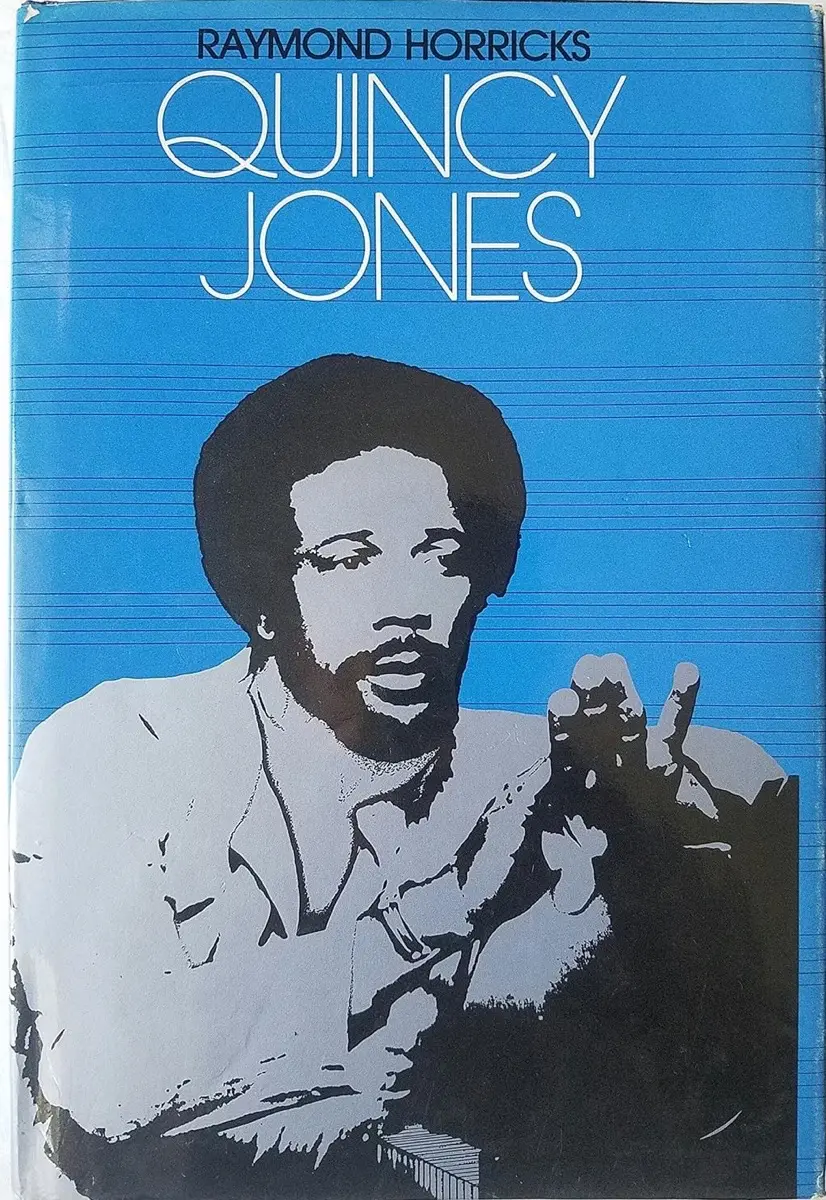
Quincy Jones is the kind of guy who will have caused a lot of pain to those who view jazz from the gloom of the Dark Ages, and it’s not without good reason that Ray Horricks, in his third book for Spellmount (the others featured Gillespie and Gil Evans) refers to him as a Renaissance Man.
Jones spent much of his early life in Seattle, and it was there that he was captivated by the music of another Seattle settler, Ray Charles, and set on the path of righteousness. After absorbing the usual bop influences, the fledgling trumpeter (a Clark Terry disciple and finally virtuoso manqué) worked with Jay McShann and Lionel Hampton. It was while with Hampton that Jones realised his shortcomings as a trumpet player and adopted a new instrument – the whole orchestra. Subsequently he arranged for Dizzy (the book includes a substantial interview with Quince about Gillespie’s 1956 State Dept tour of the Middle East), Count Basie and Frank Sinatra as well as scores of other major jazz and pop artists, the process culminating in the brilliantly arranged and produced Michael Jackson album. Thriller. Along the way, Quincy became a prolific TV and film scorer and the most famous black musician in Hollywood history.
If Quincy’s musical conduct appears somewhat mercenary when viewed from the narrow confines of jazz proper, he has always found it difficult to stray far or long from his own personal vision of music. The unifying element in all his work is the idea of ‘soul’, in particular, it would seem, the kind of soul epitomised by Ray Charles. Though he spent time in Paris in the fifties studying with Boulanger and Messiaen, and had huge respect for them both, he has always adhered to the idea that Afro-American music should grow ‘naturally’, and not by artificial grafting from European concert music. In essence, he propounds the perhaps rather insular virtues of black American tradition; indeed, one of his long term but as yet unfinished projects is The Evolution Of Black Music, a history on film and record.
In the short space of a hundred pages or so, Ray Horricks presents a comprehensive review of Q’s remarkable career – a career made all the more remarkable by the nightmare experience of cerebral haemorrage and extensive brain surgery in 1974. The odds against survival were massive, but as Quincy says, ‘I just wasn’t ready to go . . .’ And that from a man who had already done enough work to fill a dozen ordinary lives. He reckons to have been directly involved with around a thousand recordings.
The book is completed by a selected discography from Tony Middleton and contains a number of black and white photographs.
Quincy Jones, by Raymond Horricks; published by Spellmount Ltd. 127pp at £9.95.