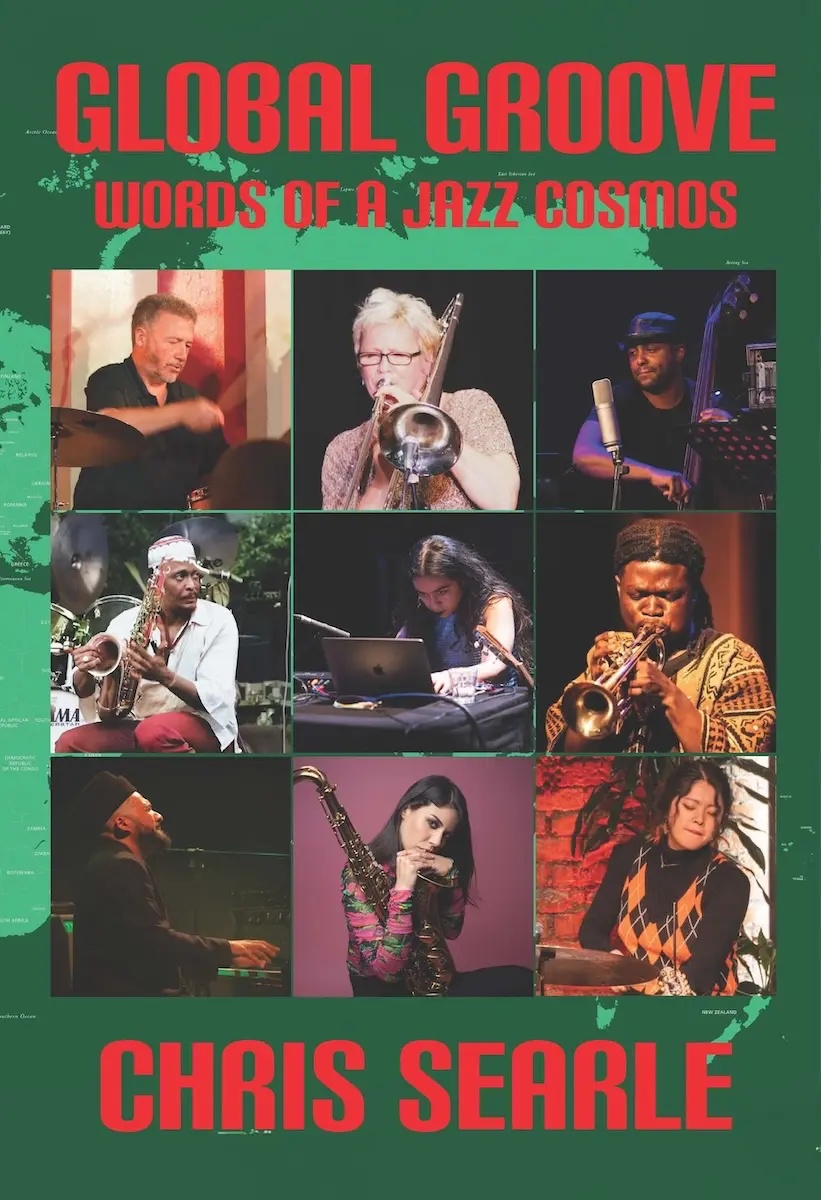
As a companion to Chris Searle’s impressive new book chronicling the international growth and technicolour splendour of jazz, one other volume suggests itself: Visions Of Jazz: The First Century (OUP 1998), by the American critic Gary Giddins. The final sentence of Giddins’ book declares that “jazz is everywhere”, which provides an appropriate lift-off for Searle’s.
Both books are a smidgen short of a brick’s weight and cover seriously ongoing developments. Giddins offers a retrospective historical survey without much, if any, moral insistence save what is obvious and indisputable about the surroundings in which jazz was born and grew up; Searle, most of whose writing on the subject has been for the socialist newspaper Morning Star, suggests an abundance of it. In fact, he lists its manifestations as the expression of “brilliant sonic creations of internationalism, racial and political justice, women’s equality, a rejection of authoritarianism, and a love of peace between the world’s peoples”. Of course, Giddins looks at 100 years of the music, Searle just a quarter of a century – or 30 years of writing about its new millennium and a sliver of the previous one.
Writers at the Morning Star, we assume, aren’t required to do much with cards and tables, such as placing the former on the latter. We know where they’re coming from, as it were. For Searle, the music appears to be almost a political act. Global Groove garners in excess of 300 essays, reviews and interviews about, of and with jazz musicians from over 100 countries. He’s looking at a universe of global reach. There are musicians reviewed here of whom seasoned jazz followers may not have heard. Each one’s national origins are given, from Moroccan guembri virtuoso Majid Bekkas (the guembri is a bass-plucked lute) to Trinidadian steel-pan specialist Rudy Smith.
I’m sure he wouldn’t mind my repeating what I said about his previous book, Talking The Groove – that it was bereft of negativity, which might seem a virtue rather than a justifiable source of complaint. That’s to say, its similar collection of writings eschewed the possibility that jazz as a set of sounds presented to paying audiences, like any other music, might have faults associated with delivery and intent. I say that again despite the author’s kindness in quoting from my review in his promotional epigraphs. Maybe it’s my bad luck to have attended gigs and listened to records about which expectations were unfulfilled or dismantled by poor or indifferent playing, or whatever, and which it was my duty to communicate, albeit as an opinion.
I share Searle’s view that jazz in the century following Giddins’ 20th has become teeming, international and multicultural but would have to question whether or not every gig or recording presented jazz self-evidently as “always remaining a campaigning and evolving music, with its aims rooted in a quest for freedom, popular justice, and astonishing boundary-breaking artistry”. Evolving and sometimes breathtaking, yes, with the caveat that evolution is not always progress; but I once spent a gig interval trying to get Martin Drew to talk about something other than sticks, brushes, Oscar Peterson and some pub landlord who’d devised a way of illegally de-fizzing keg lager to flog it as what today would be called “artisanal” ale. Often, the society inhabited by jazz musicians can be stultifyingly demotic as well as politically fraternal – and sometimes both on an 80-mile drive home after a late gig. There’s more of the ideal than the featureless mundane in Searle’s writing, and that’s observation rather than criticism; we obviously look at the subject from different angles or agree that there are different ways of looking at it.
More than anything else, the book is prodigious in its reach, despite most of the gigs reviewed having taken place in London, especially at Dalston’s Café Oto, the Vortex, Pizza Express and Ronnie’s: the capital as magnet. If you’re in Chesterfield, Carmarthen or Lerwick, the events he notices might seem like the goings-on of another country. But he sometimes gets about, in 2017 recalling a 1961 appearance by Art Blakey’s Jazz Messengers in Manchester – the Timmons, Shorter, Morgan, Merritt Messengers; and managing a trip to Canada in 2005 for a concert featuring, among others, Michael Brecker, Roy Hargrove, and – critical alert! – a disappointing Herbie Hancock “twiddling buttons and adjusting electrical devices”.
Maybe to support his definitions, Searle seeks out those who best illustrate it, such as Peruvian trumpeter-composer Gabriel Alegría. In 2025, Searle reviewed Alegría’s El Muki album, on which Alegría’s sextet celebrates the mythical protector of the Andes miners. He concluded in typical contextual fashion that “The planet, its nature, its earth, rock and minerals, its art and its endless sounds: they all arise full of flesh and music from this empowering record.” Victims of police violence in America are commemorated on the Robert Glasper album I’m Dying Of Thirst, reviewed by Searle in 2017. One assumes that, in the reviewer’s opinion at least, any misgivings about the actual music would not have undermined the validity of the inspiration behind it. For some, that would be a moot point. But even if he doesn’t choose blind, there’s plenty of what one might call neutral or unconditional enjoyment and praise, for the unfamiliar as well as the famous: Monty Alexander, Jacqui Dankworth, Max Roach, Hiromi, Stuff Smith, Maria Schneider, Ellington, Ray Brown, Norma Winstone, Evan Parker, Annie Whitehead, Ginger Baker and scores of others. The appreciation of Humphrey Lyttelton and the final accolade for Louis Armstrong after 490 pages of commentary on musicians that many Armstrong-lovers possibly would not have known are particularly gratifying, and says much for his catholic taste and his sense of historical continuity.
While the churlish might regard gig reviews as of the moment and a bulging trawl of them threatening surfeit (interviews and essays less so), Searle’s endowment of what one might call special societal interest means that his book amounts to an illustration of how much many of us may be missing; how much of what’s missed incorporates extra-musical considerations that are more than just incidental background; and how jazz’s vitality and relevance can be savoured here in Britain, not least in the pages of this magazine. Through the enthusiasm and advocacy of Searle and others, the country is raised in stature as a place where the importance of jazz can be appreciated and evaluated.
Global Groove: Words Of A Jazz Cosmos, by Chris Searle. Jazz In Britain, 492 pp, pb, £15. ISBN 978-1-0683644-2-6