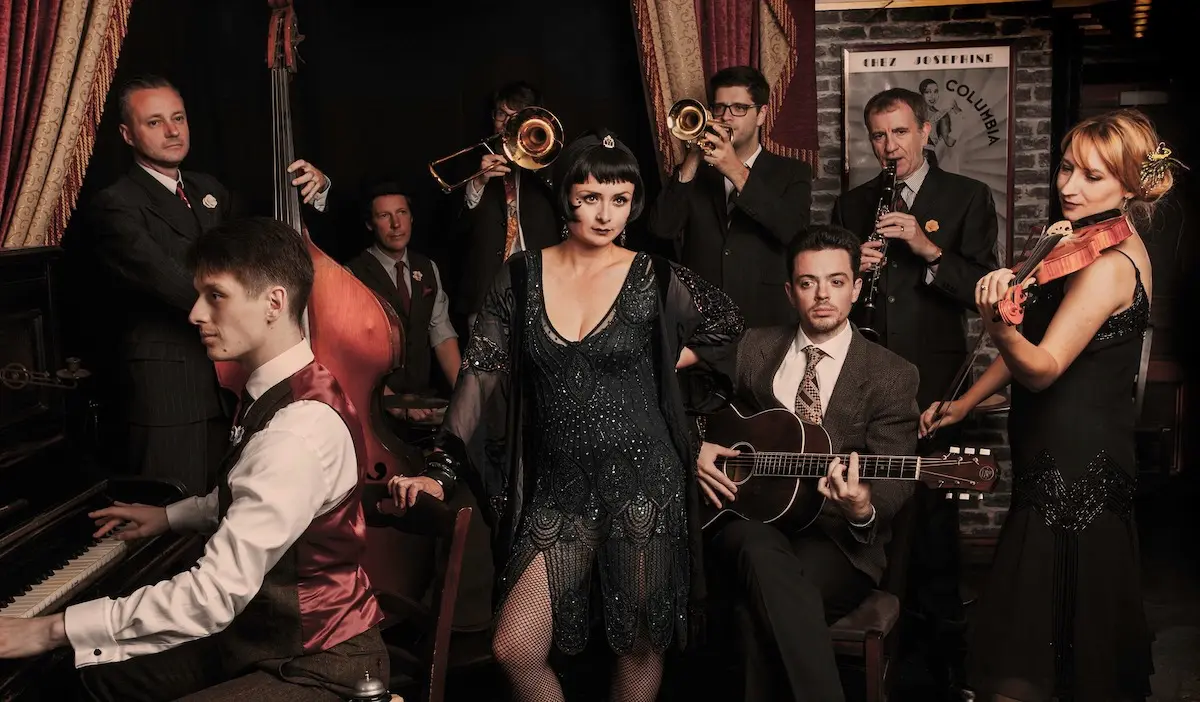
House Of The Black Gardenia: Mazurka In Jazz
House of the Black Gardenia is a nonet that delivers hot vintage swing with a contemporary edge. Its founder members, double bassist Neil Hopper and vocalist Elise Rana Hopper, used to run popular swing-dance nights in Newcastle. They became so immersed in 1920s & 30s music that in 2014 the pair decided to form their own band. Initially they thought it might be something like Tuba Skinny but things didn’t turn out that way. Neil says it was difficult finding the right musicians so they “mainly just nicked people out of the Strictly Smokin’ Big Band and others in the North East”. The selection might sound a bit haphazard but don’t be misled, these talented artists more than fit the bill.
The band’s first album, The New Lowdown, was released in 2020. Now, six years later they’ve just issued Mazurka In Jazz, a mix of jazz roots, big-band swing and R&B – and it’s superb. Seven of the album’s 10 songs are composed by the Hoppers. One of them, Should We Dance?, is from the band’s guitarist and banjoist Michael Littlefield and two are rearrangements of covers – Jelly Roll Morton’s Why? and Walter Donaldson’s You’re Driving Me Crazy. The latter is augmented by two new verses from Elise Hopper that give the female point of view.
Look out for the macabre and mischievous in the songs. The album is accompanied by an eight-page booklet detailing all the lyrics together with band photos. Have a listen to one of the tracks, Suit Of Roses. (Click on the first video that appears – the vocal comes in at 1.18.)
Discography
Queen Witch; Super Hero; Should We Dance?; Double Rations; Why?; Ice Cream For Breakfast; Driving Me Crazy; Sorry You’re Gone; Suit Of Roses; Lowdown (44.38)
Elise Rana Hopper (v, pc, wb); Pete Tanton (t); Keith Robinson (as, ts, cl); David Gray (tb); Katja Roberts (vn); Elliott Rush (p, v); Michael Littlefield (g, bj, v); Neil Hopper (b, sous); Kit Haigh (d, pc, v). Thropton & Gilsland, Northumberland, 2025
HOTBG 002
Various: Cuba – Cha Cha Chá 1950-1962
This comprehensive double-CD set from Frémeaux & Associés presents 44 tracks that chart the cha cha’s evolution and its subsequent embrace by Cuba, the United States, Europe, South America and the Caribbean.
CD1 (66.20) covers the transition of Cuban music from danzón, bolero and mambo to cha cha chá with recordings by artists such as Pérez Prado, Benny Moré, Celia Cruz and Orquesta América. It goes on to review what became known as the golden age of cha chá with recordings by the likes of Carlos Argentino, La Sonora Matancera, René Touzet, Ernesto Duarte and Cuarteto Carlos Faxas amongst others.
CD2 (66.29) provides examples of how the composers of cha chá lured the American market to the genre by naming songs such as Cha Chá Rock by Mongo Santamaria, The Hollywood Cha Chá (Sexteto La Plata) and Shoobie Doo Cha Chá (Luis Barreto). It includes Oye Cómo Va, written by Tito Puente in 1962, which achieved wide popularity when covered by Santana in 1970 and also Chanchullo, the song that first inspired the piece. Other performers on CD2 include Celio González, Cachao, El Conjunto Casino and Orquesta Aragon. This vibrant set comes with a 16-page booklet in French and English with informative notes by Bruno Blum.
Discography
Full tracklist and album details can be found here.
Frémeaux & Associés FA5925
Sarah L King: The Light Ahead
Sarah King grew up in a musical family – her father was a jazz trumpeter and her grandmother a pianist and orchestral conductor. Even so, King’s own entry into music came relatively late in life. After a career in film and television scriptwriting, she joined a soul and gospel choir eight years ago and with encouragement from the choir leader started to write songs.
The Light Ahead is King’s third recording, following a debut album, Fire Horse, in 2024 and an EP of standards in 2020. It mixes elements of 1980s neo-soul, funk, jazz fusion and disco and as with Fire Horse, combines four covers with eight of her own compositions. The title reflects the message of optimism in King’s lyrics, promoting the idea of hope in difficult times. She says the new release is more celebratory than her debut album. The four covers this time are Stevie Wonder’s Overjoyed, Nicola Conte’s Like Leaves in the Wind, Clifton Davis’s Never Can Say Goodbye (you might recall Gloria Gaynor’s 1974 version) and Barry Mann & Cynthia Weil’s Just A Little Lovin’.
King is backed by the core trio of Jim Watson on piano and keyboards, Laurence Cottle electric bass and Jamie Murray on drums. Trumpeter James McMillan, trombonist Chris Traves and guitarist Tommy Emmerton make guest appearances. Claire Martin, who produced the album, provides additional vocals along with the London-born, Marvin Gaye-inspired Marley J Wills. All involved deliver a smooth and consummately professional performance but it would be something of a stretch to call it jazz. For a taste try one of King’s compositions Ain’t Gonna Rain.
Discography
The Heron; Inner Child; April; Get My Fingers Burnt; Overjoyed; Ain’t Gonna Rain; We’ve Gotta Find A Way; Never Can Say Goodbye; My Pointless Plan; Let Me Be The One You Love; Just A Little Lovin’; Like Leaves In The Wind (48.15)
King (v); Jim Watson (p, kyb); Laurence Cottle (elb); Jamie Murray (d); James McMillan (t, flh); Tommy Emmerton (elg); Chris Traves (tb); Claire Martin, Marley J Wills (additional v). 2025.
Peccadillo PD00151922