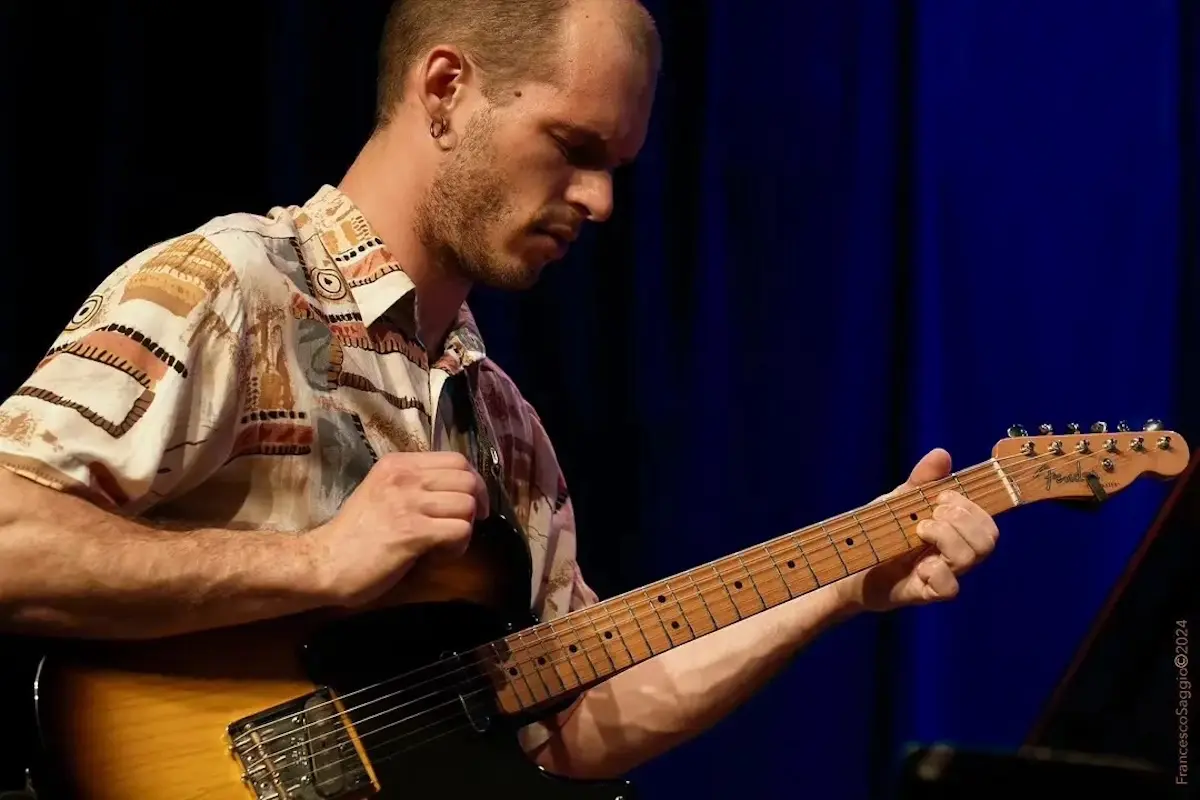
Stefano Boggiani: Andvake
The chart timings on this bustling album by the quintet of Oslo-based Italian guitarist Stefano Boggiani, with its two longest at the end, suggest a movement towards a double summation. And what a terrific build-up the five preceding tracks create. Boggiani, trumpeter Øyvind Mathisen, and saxophonist Oskar Lindberget are matched by the ever-foraging Erlend Olderskog Albertsen on bass and drummer Markus Kristiansen in a sustained and agitated collectivity that makes the band sound numerically greater than five.
The album’s title is an ancient polysemous Norse word whose meanings range from insomnia to its opposite, and especially wakefulness characterised, according to Boggiani, “by extreme attention and vigilance”. This band doesn’t sleep, though the leader’s profile is uncoerced. Even when subdued on Moderato, there’s a feeling of musicians considering their options, which, based on the opening charts, will involve a high level of perturbation. Boggiani’s guitar tops and tails the musing.
Tempos reflect this sense of communion, now settled, now racing away (Hi Reaction). Sun Eats Mouth has guitar, sax and trumpet leading a triple charge, repeated on Hourglass after what begins as a procession. Noisy and assertive polyphony rends the air on the spacious Dead Ends. The feeling everywhere is febrile and often unsettling, and reflects a contemporary mindset.
But the two final tracks are something else. Without A Net entails some decision to undertake a more considered musical journey after a central episode of meditative trumpet and sax, with helpful arco bass and percussive commentary. The final crescendo is abruptly truncated. Ritual is just that, a hypnotic imposition of calm, such as it is, with the principals playing beside the disquieting murmurs of arrhythmic percussion and skittering bass. Albertsen and Kristiansen each doubles percussion, so it’s all hands on a more-or-less level deck.
Discography
Sun Eats Mouth; Hourglass; Hi Reaction; Moderato; Dead Ends; Without A Net; Ritual (35.37)
Boggiani (g); Øyvind Mathisen (t); Oskar Lindberget (as, ss); Erlend Olderskog Albertsen (b, pc); Markus Kristiansen (d, pc). Oslo, March-April 2025.
Losen Records LOS 328-2
Carolyn Trowbridge: Found Memories
Texan vibraphonist Carolyn Trowbridge has much fun with sound structures on her debut album as the leader of a regular quartet augmented on various tracks by four guests. Despite one of them being a tenor saxophonist (Jason Frey), the prevailing sonority is dictated by her vibes, the flautist Alex Coke, the harpist Elaine Barber and the vocalist Caitlin Palmer.
It often makes for an atmosphere bordering on the ethereal, kept earthbound by a tripping rhythmic dynamo. Trowbridge’s compositions don’t so much swing as dance, where dancing is anything but flash-act, four-to-the-bar boisterous. In fact, the motion verges on the dainty and measured. Ghostliness in Chopin’s Séance is underpinned by an ostinato tread throughout, and Physalia’s Journey is a determined voyage into space with interstellar signals sent back to ground control. Fascinating.
Trowbridge’s odd chart titles are attractions in themselves, Duchess Of Sheba introducing a touch of Eastern exoticism, its air of mystery coupled with accelerated motion suggesting a cinematic quality. Grackle Versus Tacotarian has one wondering where the title comes from while flurried solos, notably from Coke, jolt the listener into appreciating sounds that may or may not offer clues to its origins. The Old Woman Who Never Grew Older has a hymn-like, though non-fervent, quality, in contrast, say, to the idiosyncratic Turtle Heart, which incorporates a lot of what throughout the album might be described as easy-going empyrean.
Discography
Thank You For The Memories, Thank You For The Laughs; Duchess Of Sheba; Chopin’s Séance; Grackle Versus Tacotarian; The Lonely Frost Flower; Tookey’s Engine; Turtle Heart; The Old Woman Who Never Grew Older; Physalia’s Journey; Onward (42.51)
Trowbridge (vib, pc); Alex Coke (f); Jason Frey (ts); Bryan Sunderman (g); Mario Castellanos( b); Elaine Barber (hp); Nick Tozzo (d, pc). Texas, August 2023.
Carolyn Trowbridge Music
Johan Tobias Bergstrøm: Stella
Scandinavian takes on jazz sometimes come with heavy input from other genres. Norwegian guitarist Johan Tobias Bergstrøm’s second album on the Losen label reinforces that impression. His first was Nova, in 2024 – a project, in his own words, laden with minor keys and melancholy. This one, with its 10 tracks named after garden flowers, is intended to be brighter and more uplifting. It’s certainly more eclectic.
Stella’s “drone” of creativity doesn’t hover over a cultivated plot and move slowly from one bloom to another in order to dwell on floral allure; rather, it travels farther afield geographically, taking in all sorts and shades, including dance-inflected folk music – Norwegian, African and Irish – echoes of South America (the samba of Azalea), country & western (aided by Knut Hem’s resonating dobro guitar on Campunala), flamenco (on Rubus), and Mahavishnu flight (shades of Jean-Luc Ponty on Cosmos). It amounts to an indeterminate wardrobe of clothing, sometimes inviting a catch-all label that excludes the word “jazz”.
Bergstrøm locates his roots in the Euro-American tradition of Django Reinhardt; yet, despite the band’s line-up of guitars (Hem on just two tracks), violin, bass and percussion, the connection seems nominal rather than special. Bergstrøm thought some charts needed strengthening with lyrical vocalese, supplied in various permutations by himself and the others, bar Hem. It makes the stylistic outcome even more difficult to pin down, but still easy on the ear.
Discography
Snowdrop; Inirida; Azalea; Campunala; Zinnia; Cosmos; Rubus; Santini; Aster; Poppy (34.02)
Bergstrøm (g, v); Jørgen Krøger Mathisen (vn, v); Håkon Huldt-Nystrøm (b, v); Thomas Antonio Debelian (pc, v); Knut Hem (g). Oslo, August 2025.
Losen Records LOS 323-2