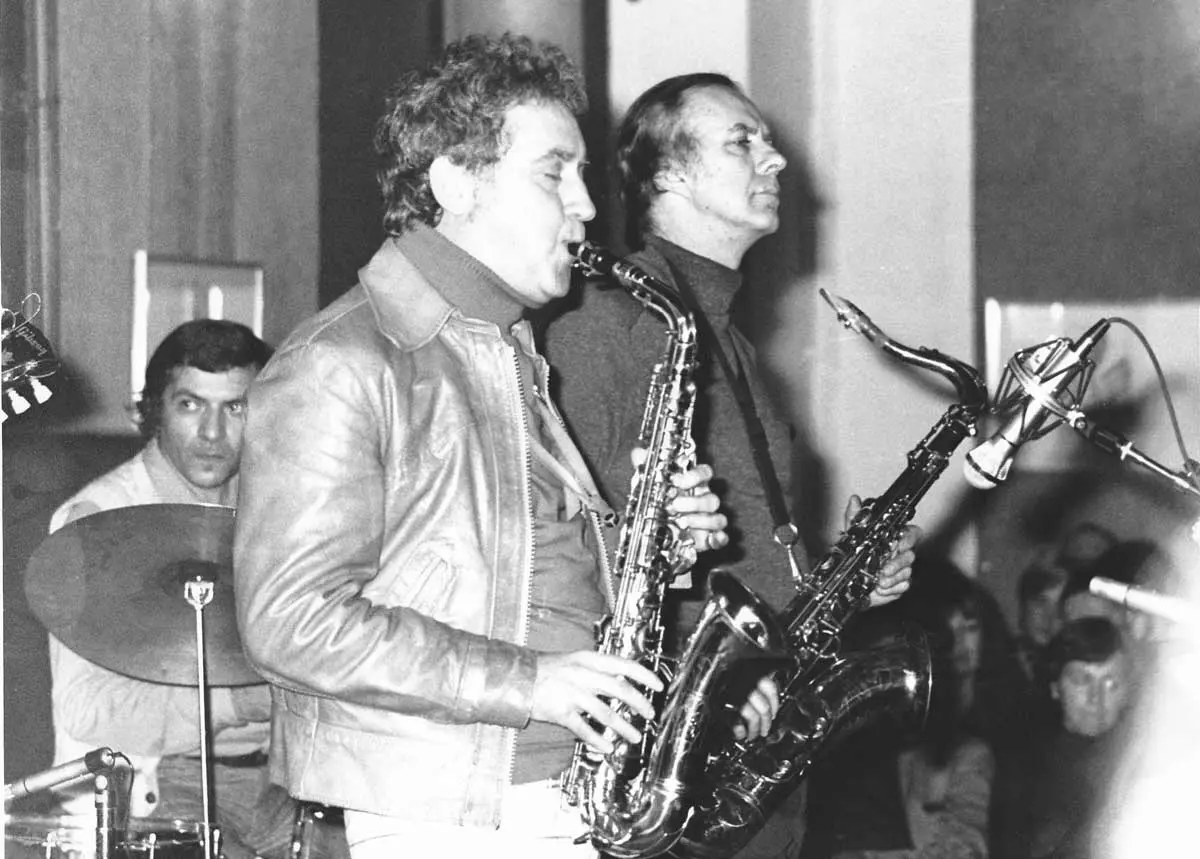
Imagine you’re an alto saxophone player who found something completely different to say on the instrument, and a uniquely personal way of saying it. All this at a time when all your contemporaries were under the spell of one man. Imagine, too, that, notwithstanding this exceptional originality, you had been forced to scratch for work, often having to leave the jazz scene for years at a time, because of neglect by the promoters, the entrepreneurs and the listeners. You would feel justified, I’m sure, in deploying anger as a primary emotional colour in your work. You might also have felt justified in switching to a style that was financially more rewarding.
Lee Konitz is such a biotype. Yet his work remains untainted by either Belial or Mammon. Even more important, his lengthy sojourns on the sidelines have also failed to prevent the continued development of his style. And that is all the more astonishing when you consider that many another musician has been satisfied to sit on his laurels, having achieved less than the miracle of creating a wholly original alto saxophone style when that instrument was totally dominated by Charlie Parker. It was therefore with a sense of resigned outrage that I noted Lee’s billing at Ronnie’s was second to Blossom Dearie, even though such a situation was dictated by commercial common sense. After all, if Konitz can shrug off such adversities (‘I’m just glad if someone wants to listen’), then someone’s got to gripe.
For Konitz’s sense of perfection transcends the glossiness of lounge sophistication. It also transcends imperfect contexts, even if it can be ruffled by them. The opening number of his first Friday at Ronnie’s, The Song Is You, saw his serenity rumpled several times by indiscreet or inappropriate accompaniment. Thereafter, pianist Gordon Beck was politely asked to lay out during Lee’s solos. Now, it was not Gordon’s fault – he was deputising for John Taylor at short notice – and, by the end of the second set, was playing much more in harmony with Konitz. Tony Levin’s drums were another matter. It’s now 14 years since Konitz recorded first with Elvin Jones, and he certainly needs stronger rhythmic accompaniment than he did 20 years ago. But although Levin is a fine drummer, he intruded on Konitz’s alchemy. As Lee put it later: ‘Too busy – but I don’t like to say anything.’
Ron Matthewson’s agile bass did inspire the altoist, however, and, over two sets, they achieved some remarkable music. Lee had other problems, too. His hotel forbade his warming up in his room, and Blossom Dearie’s insistence on silence for her pianissimo dissertations offered him no opportunity to warm up in Ronnie’s musicians’ room.
A tentative and discursive beginning was therefore doubly certain. And that made the dizzy melodic heights reached in the second set’s Yesterdays doubly unexpected. It was an extraordinarily intoxicating display of melodic metaphysics that continues to echo within the inner ear. In between, his acute sense of harmonic logic and his rhythmic suppleness more than compensated for occasional directional lapses. A brittle performance of Some Time Ago (on soprano), a wide-ranging exploration of What’s New, and sinewy Cherokee all demonstrated aspects of his ability to entwine with an imaginative bass line in a manner that has grown out of the way his lines always used to weave around accompaniments by such as Tristano or Mosca.
These more subtle reflections of his antecedents were accompanied by a potent demonstration of the manner in which he has developed his style. His lines are more fragmented nowadays, they dart in unexpected directions, and there is more iron in his tone.
Altogether, he gave much of himself that night – as he has continued to do in nearly thirty years in the jazz business. There’s now one thing we can give him – that’s opportunity. He has the necessary ability to continue to lead and to surprise.