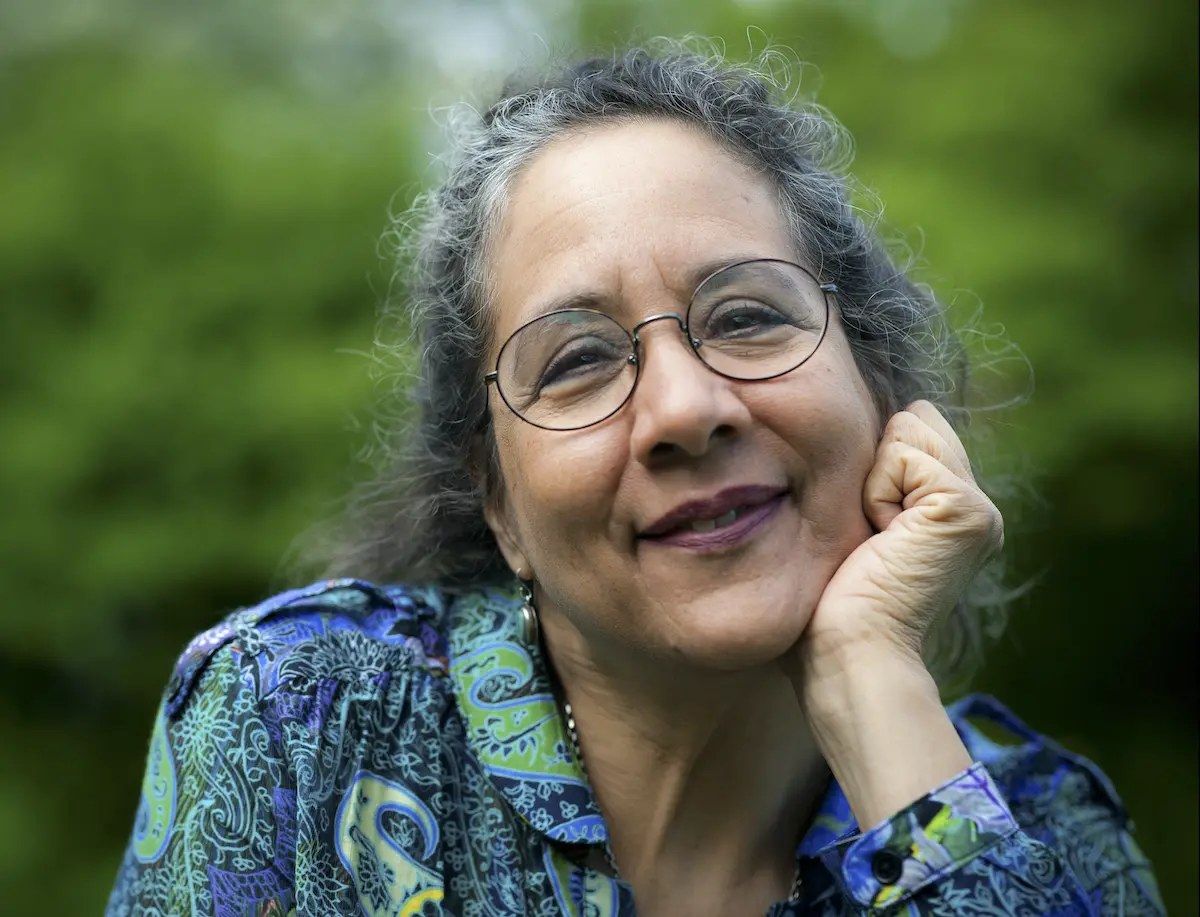
For over five decades the Danish drummer and percussionist, composer, sound-poet, painter and bandleader Marilyn Mazur – who died on 12 December 2025 after a period of illness – was one of the strongest creative spirits in jazz and improvised music. Born in New York in 1955 to Polish and African-American parents, at the age of six Marilyn moved with her family (including her sister Yvonne) to Denmark. While her sister never settled in Copenhagen and later returned to America, Marilyn would not revisit the city of her birth until the 1980s when, following her contributions to the mid-1980s Aura project which Palle Mikkelborg had conceived for Miles Davis, she was invited to join the Davis band. She made two lengthy tours with Miles before joining first Gil Evans and then Wayne Shorter.
The only woman ever to feature in a Davis ensemble, Mazur came to jazz largely self-taught. Early on she had taken lessons in dance and classical piano and would eventually gain a degree in classical percussion studies from the Royal Danish Academy of Music. From 1975 onwards she played percussion in a variety of contexts, including work with Danish drummer Alex Riel in the group Six Winds. Apart from Riel strong early inspiration came from Al Foster and Airto Moreira. The 1980s would see a steady broadening of her capacities and horizons including five recordings with Pierre Dørge’s New Jungle Orchestra.
In 1978 Mazur formed her own first important group, Primi, which soon developed into an all-female theatre band lasting until 1986. In 1989 she created what she called her “dream-visionary band”, the Future Song ensemble. This featured vocalist Aina Kermanis and bassist Klaus Hovman, whom she had met in 1981 and with whom she had a son Fabian who today works in music production. The band made several excellent albums. The recent Future Song Live Reflections documents a terrific range of material from 1990, 2008, and 2015 with a.o. Kermanis, Hans Ulrich (ts), Nils Petter Molvaer (t) and Elvira Plenar (kyb).
The female voice long had a key role in Mazur’s music. Sample the superb Jordsange/Earth Songs from 1989 with Aviaja Lumholt (v), the Ars Nova vocal ensemble and the Copenhagen Art Ensemble, or enjoy Mazur’s latter-day Celestial Circle Quartet on ECM, with Josefin Cronholm (v), John Taylor (p) and Anders Jormin (b).
The chief gig for Marilyn throughout the 1990s and the initial years of the new millenium was her work in the Jan Garbarek Group with Rainer Brüninghaus (p, kyb) and Eberhard Weber (elb). Several recordings were made for ECM: unfortunately, the claim on ECM’s website that Mazur’s first recording with Garbarek for ECM was the 1990 I Took Up The Runes is erroneous. Following her appearance with Garbarek on Niels-Henning Ørsted Pedersen’s Uncharted Land of 1991-2 (recorded for Pladecompagniet) the first ECM record Mazur made with Garbarek was Twelve Moons (1992), followed by Visible World (1995) and the double album Rites (1998). In 2005 she appeared with Garbarek on Eberhard Weber’s Stages Of A Long Journey concert recording and also cut what is arguably her best record as leader on ECM, the Elixir sequence of duets with Garbarek.
Elixir epitomises what Mazur called “the search for an urkraft” (primal force) in her music and this is the chief point to note about the poetics of her work – the increasing exploration of the mytho-poetic realm. Garbarek once described her playing as being like the wind blowing through the trees. It’s an apt image – provided one remembers that the wind can both caress and fell trees. Employing an extraordinary range of percussion including a log-drum (which she could tune with magnets), gongs, marimba and all kinds of cymbals and bells, Mazur commanded a formidable range of sonic and rhythmic power and poetry, timbre, touch and dynamics.
In the last decade of her life she employed this range in three distinctive groups: the all-female Shamania, which recorded two albums (the eponymous debut from 2017 which won the German Jazz Critics Prize and the follow-up Rerooting), the 13-piece Maluba Orchestra founded in 2013 and featuring Danish saxophonist Fredrik Lundin, and Now. This last, established in 2023, featured a.o. Ania Rybacka (v), Kasper Tranberg (t), long-term collaborator Makiko Hirabayashi (p, kyb), Samuel Hällkvist (elg) and Klaus Hovman (b). Fittingly, Marilyn’s last recording for ECM, the 2023 Strands, found her in the company of Jakob Bro (elg) and Palle Mikkelborg (t, flh). Mikkelborg was a life-long inspiration for Mazur and one cannot help but feel a piquant sense of a life coming full circle here.
A vivacious, most intelligent and open-hearted musician, Marilyn Mazur was nothing less indeed than a primal force on the Danish and international scene. She received many honours, including the Ben Webster Prize in 1983, the Jazzpar Prize in 2001, and the Danish Django d’Or (Legend) Award in 2006. A six-time Downbeat Poll Winner, her discography runs to over 100 items: around a fifth feature her as leader, while the range of her guest spots attests to the extraordinary depth and breadth of her musicality. They include contributions to discs by Jon Balke, Ketil Bjørnstad, Carsten Dahl, Gil Evans, Yelena Eckemoff, Peter Kowald, Charlie Mariano, Lars Danielsson, Eje Thelin, Agnes Buen Garnas, Hans Ulrich and Dhafer Youssef.
For further insight into Marilyn Mazur and her world, see the extensive interview Marilyn Mazur: The Music Is The Ritual by Anil Prasad, published by innerviews in 2023 and available on You Tube.