Zakir Hussain: Making Music
At the risk of being ostracised by the JJ community I confess that, when contemplating what to take to that fabled desert island if I were only allowed discs from one genre of music, jazz could well be set aside in favour of Indian (Hindustani and Carnatic) classical music. It certainly wouldn’t be an easy decision. Improvisation is central to both traditions, of course, although the rules on what you can do with a rag are rather stricter, as minimalist maestro Philip Glass found out when he worked with Ravi Shankar.
The earliest attempts to mix jazz with Indian music that I encountered were by the Joe Harriott band Indo Jazz Fusions in the mid-60s. Later came various incarnations of McLaughlin’s Mahavishnu Orchestra, which, despite its technical brilliance and McLaughlin’s obvious sincerity, never quite did it for me (though I did buy one of their albums). Comparatively, Making Music is largely low-key – eight mostly delicate and enchanting compositions by Hussain and McLaughlin. Anisa, which opens side 2, is the only somewhat rumbustious piece.
I would have liked to hear more of the great Chaurasia (one of my all-time favourite musicians) but you can’t have everything. This is quintessential high-quality ECM music, beautifully conceived, executed and recorded.
Discography
Making Music; Zakir; Water Girl; Toni; Anisa; Sunjog; You And Me; Sabah (48.45)
Hussain (tab, pc, v); Hariprasad Chaurasia (f); John McLaughlin (g); Jan Garbarek (ts, ss). Rainbow Studios, Oslo, December 1986.
ECM 1349 (Luminessence Series, LP)
Yusef Lateef: Blues In Space
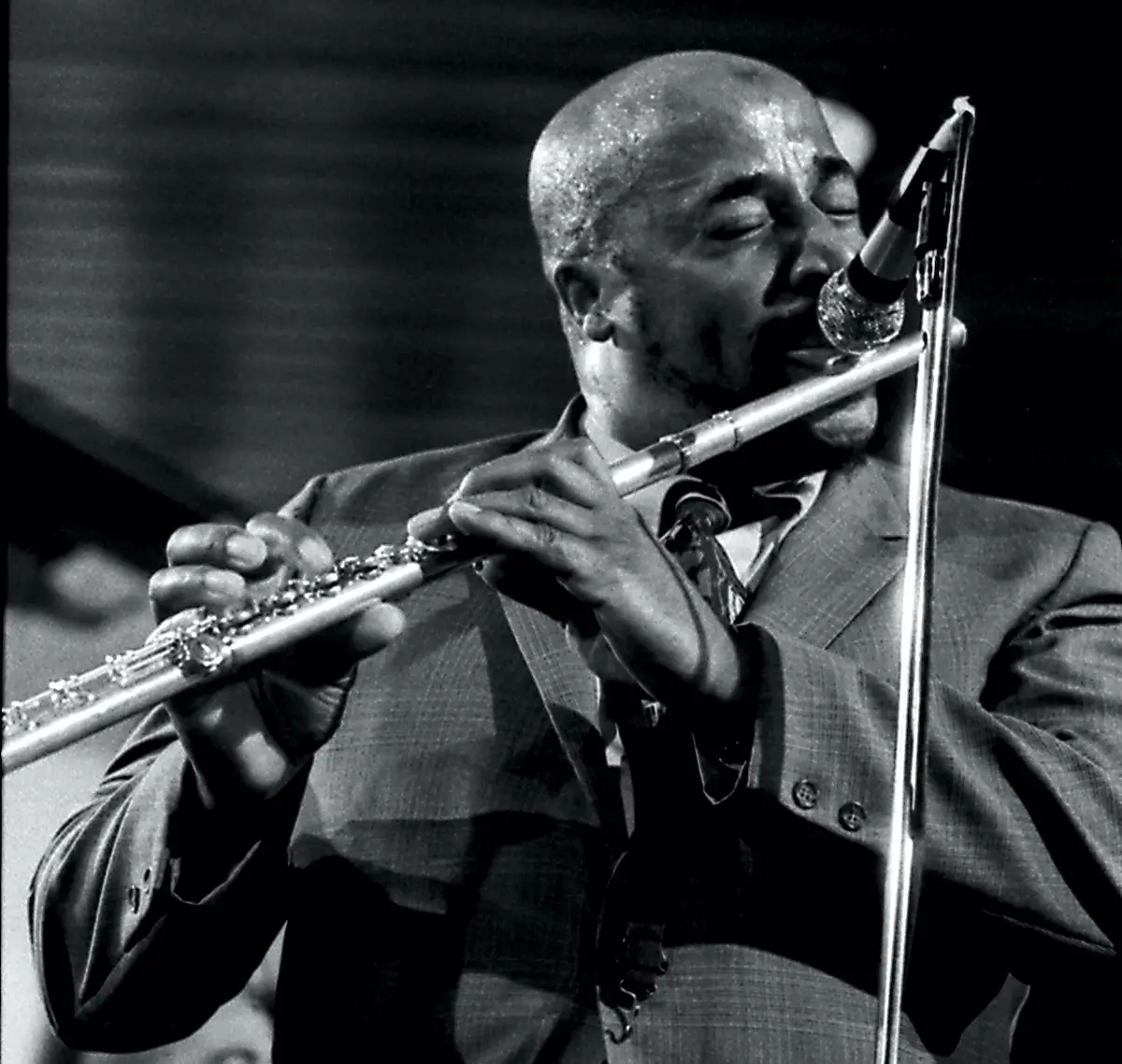
This album is a good companion to Making Music, insofar as Lateef (né William Evans) was fascinated by Eastern music, though Middle Eastern as much as that of the sub-continent, which appealed more to his good friend John Coltrane. (Incidentally, bassist Ernie Farrow was the brother of Coltrane’s future second wife, Alice.)
Blues In Space is effectively a reissue of Jazz Mood, Lateef’s first album as leader, but retitled and with two bonus tracks, Beauregard and Space. The trombone-led theme statement of Metaphor is somewhat dreary but then Lateef’s flute solo livens things up and there are some nice solos, with Lawson’s opening wittily with a quote from It Ain’t Necessarily So. From Yusef’s Mood onwards the band gets stuck in, led by some splendid wailing tenor, including bluesy solos on The Beginning (which also has a fine, thoughtful solo by Fuller) and the title track, where Lawson makes a particularly good contribution. On Morning, perhaps the highlight of the session, Lateef plays an especially haunting tenor solo over insistent bass and percussion.
The original sleeve-notes described the album as “provoking” but today it just comes across as a session of first-class hard bop with a few beguiling, “exotic” decorations. It was recorded by Rudy Van Gelder so the sound is, of course, excellent.
Discography
Metaphor; Yusef’s Mood; The Beginning; Beauregard; Morning; Blues In Space; Space (48.34)
Lateef (f, ts, argol, scraped gourd); Curtis Fuller (tb); Hugh Lawson (p); Farrow (b); Louis Hayes (d). Englewood Cliffs, New Jersey, 9 April 1957. Beauregard and Space are bonus tracks, added to the original Jazz Mood lineup, recorded NJ, 5 April 1957.
(Wax Time 772373 – LP)