
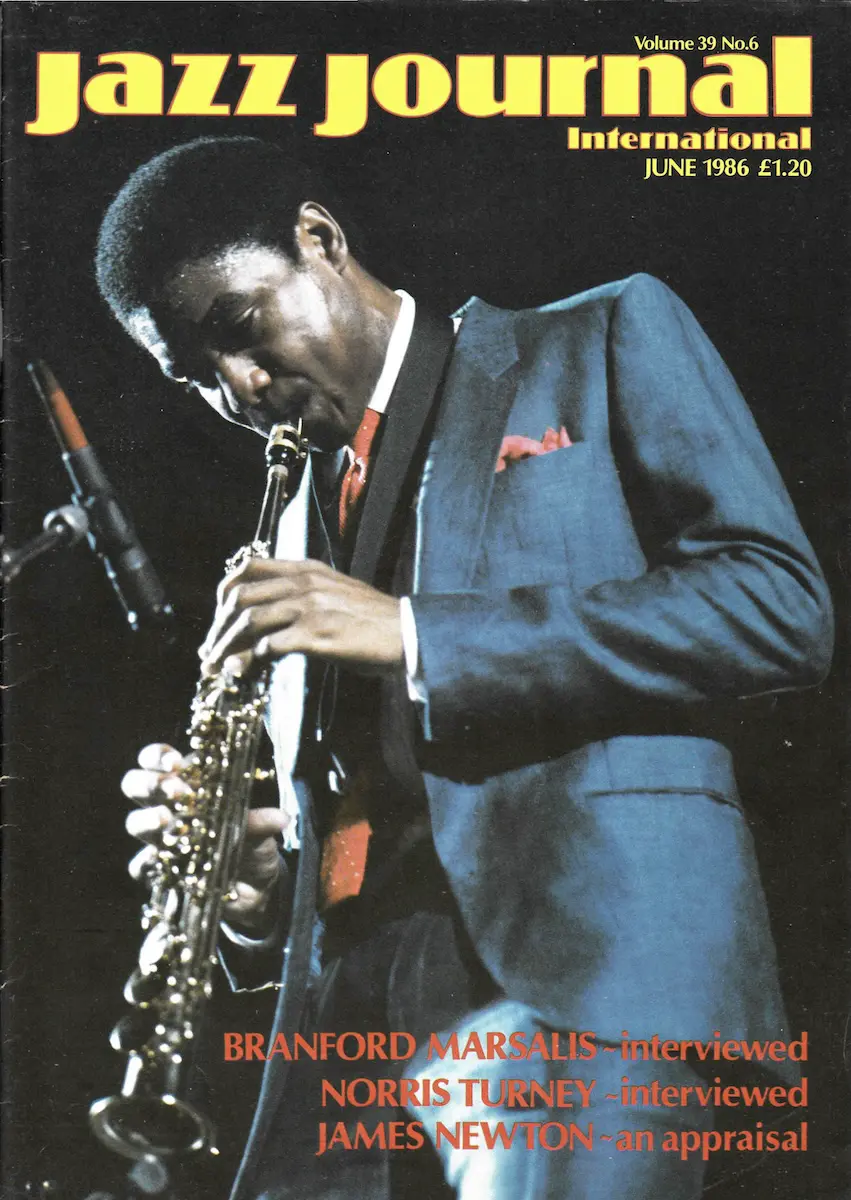
The younger scions, the ‘lion scions’, of the Marsalis family have not found themselves lacking in either limelight or controversy of late, and the tradition was extended last year when Branford, the eldest young Marsalis, caused at least a minor rift with brother Wynton and ruffled a few establishment feathers by joining a rock band. Sting of Police fame had also selected three other well-known jazz alumni for his new venture – Darryl Jones (ex-Miles Davis), Omar Hakim (ex-Weather Report) and Kenny Kirkland (ex-Wynton Marsalis) and the five went on to record a five-million-seller album and do a world tour.
Wynton (often misconceived of as older but in fact younger than Branford) has a reputation for plain-speaking and it’s a trait that runs in the family. However, where Wynton might be an outspoken purist, Branford is an outspoken eclectic. He speaks out for jazz – the fact that he was fired from the Lionel Hampton band after two days has not diminished his cherished ambition to be a respected jazz player – but he also makes no secret of his passion for many other kinds of music, especially rock music and his growing fondness for the classics. He is also an accomplished if ironic exponent of rap, that Harlem-born street music endorsed by none other than master percussionist Max Roach as one of the most important recent extensions of Afro-American culture. During Sting’s Royal Albert Hall concerts, Branford’s perfectly executed parody of that form was a welcome and surprising diversion.
Backstage at the RAH, Branford spoke volubly and vehemently and more than once I was reminded of Miles Davis, whose pronouncements have often appeared more emotional than reasoned and often self-contradictory. Branford’s commentary was a stimulating mixture of highly personal opinion, slick aphorism and transparent inconsistency, all of which coloured the picture of a man who is accountable only to his own complex logic.
These necessarily edited highlights begin with Branford’s response to the suggestion that playing with a rock band might damage his reputation in the jazz world.
‘No, it’s no risk to my reputation because I don’t have a reputation, nor do I value the opinions of others where my reputation is concerned. If you really want to take a reputation risk, you have to be a 22-year-old guy, sitting there with a suit and tie on saying “I’m tired of hearing all this stuff about pop music. Jazz is the thing, it’s hipper than classical music, and I’m gonna go out and play classical music just to show you.” That’s risk: People firing salvos at you all the time, saying “You arrogant son of a bitch.”
‘People know that I don’t care what they think anyway. It’s futile for them to try and tell me what their opinion is. I’ll just say “That’s nice, I’m glad you think that”. To me, opinions are like backsides – everybody’s got one. And I don’t value anyone’s more than I do my own.’
So what then is the attraction of playing with Sting? If there’s no risk, where’s the interest?
‘It was a musical challenge for me to play in an idiom I’d never played in before. I’d played r’n’b in high school, but not as part of my professional career, on record and in front of thousands of people. I’d been playing jazz for a long time and I would have to learn a new sound on my horn, a new concept to fit this music. It was something different, but it wasn’t a risk because I never once thought I would fail. Playing a classical record was more of a risk.
‘Sting pulled me into this, not the idea of big rock dollars or sex symbols or any of that stuff. I dug his music from the beginning. I loved the Police, I got all their records’
‘I also play with Sting because I like what he does. Sting pulled me into this, not the idea of big rock dollars or sex symbols or any of that stuff. I dug his music from the beginning. I loved the Police, I got all their records. It was an interesting concept. I also liked the idea of playing with Omar and Darryl on an extended basis. And the offer came at the time when I needed something different. I just needed a change.’
Do you find you’ve had to remodel your playing to fit the band?
‘The phrasing’s different, the technique is different, the timing is different. You’ve got to play not jazz licks, and there are places where you should and shouldn’t play. In a lot of rock bands, guys don’t think about that aspect; everybody just plays through the gig with no taste and no discretion. But from playing with Wynton, I know how to use the jazz approach. Sting is the lead trumpet player and I’m complementing him, not just showing what I can do.’
Because Sting’s band was manned by musicians with reputations as jazz players, the British popular and pop music press often labelled it a jazz band. Branford was deeply riled by this misapprehension.
‘The British pop press is probably the most illogical and misinformed press I’ve ever read. I’m astounded by the misinformation and the ridiculous ideas they have. Nobody really wants to accept that this isn’t a jazz band. This is a pop band, but they’re all trying to say it’s a jazz band. We ain’t playing jazz, nowhere on stage. I play jazz for a living, and I know what it’s supposed to sound like. They don’t know: they don’t even have the records.’
‘No, he doesn’t. Some of those are jazz licks, but the way he’s playing the piano ain’t the way he would play if he was with Wynton. It ain’t even similar, he wouldn’t do it that way – the direct drive, when he shifts into gear with a barrage of eighth notes without breaking up the rhythm. The press here, across the world and particularly in parts of the US just don’t want to admit that there’s some black guys on stage playing rock ‘n’ roll as good as or better than their heroes. Why else are they all calling it a jazz band? They say we’re not pop musicians, but Darryl plays an electric bass and Omar’s been playing with Weather Report, David Bowie and Dire Straits. When I heard what that lady (Paula Yates) said when she introduced the band on The Tube, my jaw almost hit the floor. She said: “Sting, the man who puts jazz into perspective.” I’m glad I didn’t hear that before I started playing, because then I would have had a real mean vibe for the rest of the show.’
‘There’s only one guy I ever listened to completely and that was Wayne Shorter. I wanted to sound like his twin, to sound exactly like him’
We might deduce that jazz is close to Branford’s heart, and he’s sensitive to any misappropriation of the term. So who for him had represented the quintessence of jazz? On whose style had he modelled his own playing?
‘There’s only one guy I ever listened to completely and that was Wayne Shorter. I wanted to sound like his twin, to sound exactly like him. I’ve given up on that pursuit now because I understand conceptually what he was trying to do. That was the only reason I listened to other musicians, not to play the same notes as they played, but to try and understand conceptually why they played the things they played. Once I got an idea of it, by the time we did the second record with Wynton, and after doing it for three years, I understood conceptually the way Wayne was trying to play and it was time for me to learn somebody else’s. It’s a hotch-potch now.’
Isn’t Coltrane in there somewhere?
‘Yeah, Coltrane’s important – the later years. The middle years not so much because I don’t play like that. The thing that I get from Trane is the way he attacks the notes, because some people consider my playing very tentative. But it wasn’t so much tentative, it’s just that I didn’t have any aggression. I became so intellectual about playing that when I didn’t have anything to play I’d stop. The things that I did play were personally introspective and people were left in the cold. I had to learn how to bring people into the music.’
To me, one of Branford’s most uncharacteristic and effective solos is his soprano outing on the title track of Miles Davis’s Decoy album. Was he conscious of any particular influence at that time?
‘No, it was just that Miles was in there – that’s all you need, man. It’s different from doing other record dates. Like, with Wynton, he’s my peer, we’re all around the same age. Then with somebody like Bobby Hutcherson or Billy Hart, I was excited, but with Miles, you just don’t wanna make any mistakes, so you concentrate and do your best. That was one of those days where everything went right.’
Was that Decoy appearance a one-off, or did you get a chance to join the band?
‘Well, the timing was bad – we were just starting to get to some things with Wynton’s band and I didn’t wanna leave. That was the band to join though, for that kind of stuff. Especially now, the band is really great. I dug playing with Scofield, ’cause we weren’t just playing parts. We were bouncing ideas back and forth; I’d play behind him or in front of him and he’d know what I was doing. He didn’t freak out and I dug that. I also dig Bob Berg – he’s happening. I really like the way he plays.’
‘The Beatles had a lot to say musically. It may not be my kind of music, but that doesn’t make it any less important… I love Led Zep – that’s intensity for your ass… I also like Go West – the guy has a marvellous voice and the arrangements are happening. Another of my favourites is Scritti Politti – heavy duty’
Elsewhere, if I read you right, you’ve suggested that what the Beatles and Coltrane had in common was intensity, and that technical complexity is not of itself the main issue.
‘Yeah, there are musicians who can be intense and on that rests the whole success of their music; they have nothing musically at stake. The Beatles had a lot to say musically. It may not be my kind of music, but that doesn’t make it any less important. A lot of guys don’t like Led Zeppelin. I love Led Zep – that’s intensity for your ass. I have all their records and I just went out and bought tapes of Led Zep 2 and 3 ’cause I don’t have them on tape. I also like Go West – the guy has a marvellous voice and the arrangements are happening. Another of my favourites is Scritti Politti – heavy duty. See, most people won’t like them because they deal with intellect. I’m an intellectual or quasi-intellectual, or any way you wanna look at it. I know many people talk about how things move them emotionally, but the only thing that moves me emotionally is when a guy has an emotional approach married to a sound technique and a fantastic rhythmic concept. Then you have a band like Sade’s, where the sax player doesn’t have any technique, bends notes, plays yooooo! and sounds like he should go back to high school. Having said that, when I say I don’t like something, that doesn’t mean I don’t think it’s valid. If somebody else likes it, to me that makes it valid.
‘Most things I hear I don’t like, but that’s just for me, because I’m a stark, raving intellect. There are certain things in a band like Scritti Politti, like the relationship between the melody and harmony and the keyboard and the choice of notes, that is really impressive.’
Branford is now best known for his tenor and soprano work, though he concentrated on alto in the early days. His first professional gig on tenor was with Lionel Hampton. It was hardly an auspicious debut, lasting only two days, but as Branford explains, it was through no fault of his tenor playing.
Playing with Hampton: ‘After one of the gigs, the manager just fired me. He said “I don’t know if this is the kind of band for you and your attitude.” He wanted us to dance and stuff and I thought “I’m not in this band to dance. If I wanted to dance, I’d join the Jackson Five”’
‘It wasn’t much to do with Lionel, it was his manager. He’s one of those guys who thinks New York’s the only city in America. I was 19 and I’d come along to replace a sax player who’d gone missing. He came in and said “Can you read son?” I said that I did all right, to which he replied “Perfectly?” He didn’t know that I’d already done a tour with Art Blakey’s Big Band and been at Berklee. Anyway, there’s nobody who can read that perfectly, especially the guys from that band. So I said “No, I don’t read perfectly”. And he said “Well, son, this is the Lionel Hampton Organisation.” I said “Look man, I’m not gonna tell you how to manage, so I don’t expect you to come and tell me how to play, all right?” So that was it; he had it in for me from the jump. Later, we were doing this session and he went up to Hamp and said “I wanna hear him play. Give him a solo.” So I went ahead and blew and Hamp liked it, so every time there was a solo he let me play. One time I was playing all night. Eventually some of the guys in the band got resentful. This alto player was showing me how to play the parts and I was real naive. I said “Wait a minute, it doesn’t swing that way. We should play it this way.” This kid who had been in the band two days was telling him how to play. So I made it hard on myself. Then after one of the gigs, the manager just fired me. He said “I don’t know if this is the kind of band for you and your attitude.” He wanted us to dance and stuff and I thought “I’m not in this band to dance. If I wanted to dance, I’d join the Jackson Five.”
‘Hamp’s a fantastic musician and I’d like to play in a small combo with him. But a big band? No. He needs entertainers when he does that sort of thing and I can’t do that. But it was the manager that really fired me and I’ll never forget the words he told me: “You have a bad attitude, son. Guys like you, I’ve seen ’em come and I’ve seen ’em go. Don’t you ever come to New York (though I was already living there at the time) ’cause I’ll make sure you never get another job there.” He didn’t know who my brother was and he didn’t care. He was one of those suckass entertainment lawyer types who hadn’t been around a jazz club in a hundred years. He’s too busy trying to get Hamp to sing on Carol Channing records.’
It was as a result of a young brother Wynton’s ‘incessant pestering’ that Branford quit New Orleans and his plans to be a ‘Quincy Jones type arranger/producer’ and came to New York to play jazz. Like Wynton, he has also recorded classical music, with not entirely happy results.
“I did a dippy classical record in May 1985. It’s a real MoR record. I play soprano saxophone. See, I didn’t really have a tremendous amount of experience in classical music. Whereas when I’m doing a jazz record, I’m with the producer from beginning to end. I engineer it, I mix it, I’ve played and probably selected all the tunes. But this classical project was such a different world for me, I just didn’t know how to do it. I didn’t have the ears for it. So I got this guy and we sifted through the music and picked out some pleasant melodies, but I couldn’t hear the record from beginning to end conceptually. The only thing I could do was hear each piece and its difficulty and where its weakness and strength lay. When the pieces were done and I heard them played back, it might as well have been a K-Tel record. It’s a very light classical record; it’s corny, like a best-loved melodies type of thing. If I’d thought for a second it was gonna sound like that I’d never have done it. It’s not the kind of record you bring to your sax teacher with pride. The pieces were originally for oboes and flutes and soprano voice – a selection of composers. Before the producer suggested it to me I had no intention of doing it, but it seemed like a challenge, right? So let’s do it. I’m gonna do another one, but it definitely won’t be like that. I can hear it now.’
You’ve done jazz, you’ve done rock and now classical music. How do you feel about the way music is categorised?
‘Well I’m not really into definitions, because African tradition isn’t based on literacy. It’s all based on oral tradition, and because black people in America are African descendants, they have a lot of that in them. It’s very difficult to get cats to write down music or ideas. They just say “Man, this is it right here. . .check it out.”’
‘There’s no such thing as black jazz and white jazz. The standard for jazz is set by black Americans, but if white people that wanna play jazz are responsive to and understand the social conditions out of which jazz emanated, then we got no problem’
Does this mean that jazz is in some way a peculiarly black music, or can it be white too?
‘There’s no such thing as black jazz and white jazz. The standard for jazz is set by black Americans, but if white people that wanna play jazz are responsive to and understand the social conditions out of which jazz emanated, then we got no problem. I’m not black because of the colour of my skin. I’m black because of a social attitude that I have from growing up in a specific region at a specific time. It’s all down to social perspective. They did these experiments in the States where they took a white baby and stuck him in a Chinese family and vice-versa, and the kids grew up with the family’s attitudes.’
Do you think the idea of playing with four black American jazz players had some sort of elitist appeal for Sting?
‘Jazz does have an elitist appeal, doesn’t it? There’s a bunch of egotistical, elitist types playing it, to be quite honest. It’s like athletes – egotistical elitists. A guy can play saxophone in any phantasmagorical band that sells three crillion records, or play sax in the Jacksons’ horn section and make tons of money and have women crawlin’ down the hall, but if Sonny Rollins walks in the room, they shit a brick. Jazz musicians are the only kind of people that got that kind of impact. That’s why I wanted to play it!
‘Because of the way my brother talks, some of these rock players, my heroes, don’t believe me when I meet them and tell them that I like their music. They can’t conceive of me playing in a jazz band and liking what they do, and that’s a shame. The trouble is, most people are in awe of jazz musicians. Even the ones like Ringo Starr who spend their time trying to say it ain’t shit. Ringo Starr was in a drum magazine saying jazz sounds like rats running on a tin roof. You don’t have to listen to much jazz to realise that that’s one of the dummest statements ever made.’
Has it been useful to you to have the same name as the new messiah of jazz trumpet?
‘Yeah. That’s how I got my record contract. Record companies don’t know much about what sounds good and what don’t with the exception perhaps of A&M, only because Herb Alpert’s there and he has ears. But generally record companies make corporate decisions which are not based on musical ideas or beliefs. Those days are gone. If I had had an ass named Smith, I wouldn’t be on CBS, let’s be realistic. I wouldn’t be doing a classical record either.
‘The important thing for me is to get the respect of my elders, not even my peers, but my elders. My elders seem to appreciate me and that thrills me beyond belief. People like Miles and Dizzy and the MJQ – I’m doing a video concert as their special guest. I’m also going to be doing a duo tour with Herbie Hancock this summer, then a quartet tour with Herbie, Ron and Tony in Japan, but before all that I’ve got to learn how to play jazz again. I’ve been practising while on this Sting tour, but you can’t practise jazz. It’s like trying to practise pop as a style. You’ve just got to play it. The only thing I can practise is technique.
‘Right now, I can’t play jazz anymore, but two weeks after I’ve started again I’ll be able to play it. At the moment the phrasing’s not there, the confidence isn’t there, the technique isn’t there. But I can get it back so I’m not worried about it.’
Selected discography
Branford Marsalis – Scenes In The City (CBS38951)
Wynton Marsalis – Think Of One (CBS 25354)
Wynton Marsalis – Hot House Flowers (CBS 26145)
Wynton Marsalis – Black Codes (From The Underground) (CBS 26686)
Miles Davis – Decoy (CBS 25951)
Ray Drummond – Susanita (Nilva NQ3409)
Billy Hart – Oshumare (Gramavision 18-8502-1)
Sting – The Dream Of The Blue Turtles (A&M Dream 1)