
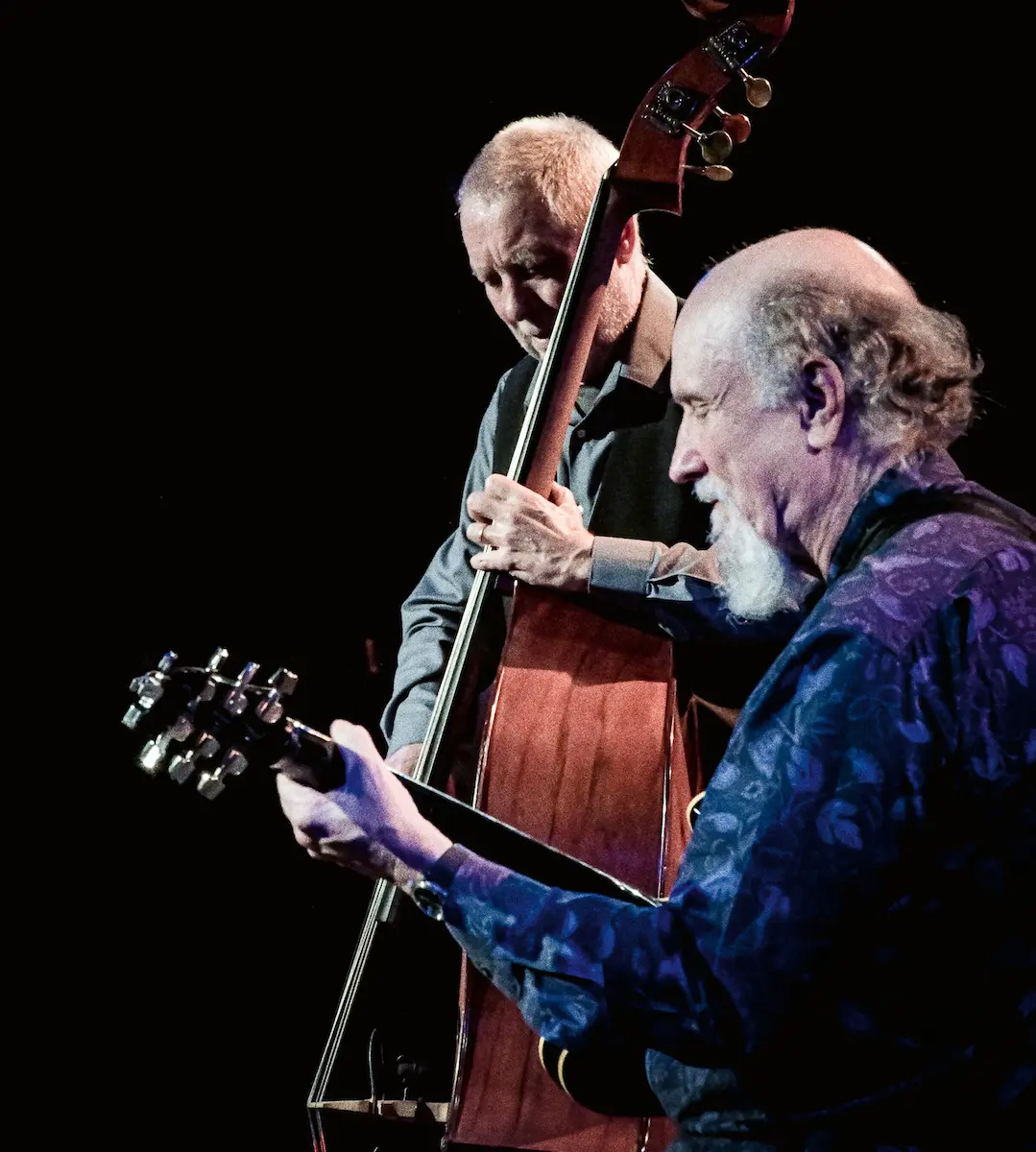
John Scofield and Dave Holland: Memories Of Home
Dave Holland’s composition Mr. B, dedicated to Ray Brown, is a salute from one kind of jazz bassist to another; certainly Brown’s style would have had to change significantly to resemble the bass-playing in the kind of guitar and bass duo illustrated on this album by Holland and guitarist John Scofield. Both guitar and bass have undergone historic transformations, from timekeeper to timekeeper capable of solo interventions to timekeeper as part of a collective unity to exclusive soloist. But the procession shouldn’t be insisted upon too rigidly, as Holland and Scofield demonstrate.
Mr. B is one of four Holland charts – the other five are by Scofield – and the sentiments old and new are at least partly nostalgic, both musicians having been associated together with Miles Davis and Herbie Hancock. As Scofield notes, the two enjoy decades of common musical experiences. The opening Icons At The Fair was Hancock’s contrafact of Scarborough Fair on his 35th album, The New Standard, issued in 1996. Holland and Scofield further modify the tune, their adjustments here attributed to the guitarist.
Scofield’s Meant To Be is from his 34-year-old studio album of the same name (a homage to Ornette Coleman), on which the bass player was Marc Johnson. Performed as a duet, it’s typical of how Scofield can hold back to maintain even-handedness. More recollections follow in Scofield’s Memorette, from 2007, with Holland paying Steve Swallow’s original bass lines a reinterpretative tribute; and Memories Of Home, a Holland bluegrass chart from the mid-1970s with a clever role switch as the bassist opts for jazz contours against the guitarist’s mild Appalachian mimicry.
Discography
Icons At The Fair; Meant To Be; Mine Are Blues; Memorette; Mr B; Not For Nothin’; Easy For You; You I Love; Memories Of Home (54.56)
Scofield (g); Holland (b). New York, August 2024.
ECM 2860
Wink Winkelmann: Be It Known
For a musician who has spent 15 years studying medicine and then holding down a practice in dermatological surgery, the Californian bassist and self-taught composer Wink Winkelmann has produced a début album with a quintet as minutely attuned to his creative refinements as he is to its members’ prodigious capabilities. The compositions maintain a balance between length and development, narrative and picturesque, ensemble and solo. As an antidote to length – it’s not that long, with the longest chart stretching to eight minutes and a few others averaging six-and-a-half – there are brevities for respite.
Winkelmann as bass player providing intricate root patterns is as influential as Winkelmann the creator of sonic space, widened primarily by saxophonist Mae.Sun (sic) and guitarist Yunus Iyriboz and never by rote, with drummer Nate Smith and keyboardist Rashon Murph in prominent attendance. On Breathe, the three principals give way to each other as musicians inhabiting the same groove. There’s a modal focus to Intention Span, Mae.Sun’s tenor sax left alone towards the end before a quiet coda. Contrast with that The Id And The Eno, an anthem-like crescendo led by Mae.Sun’s swirling soprano sax above a slow-shifting amalgam of drums, organ, arco bass, and contrapuntal slide guitar. Cute And Clustered is a waltz-like “stop” tune, with wild runs for flute and piping guitar. Showing more originality than eclecticism, the album marks an auspicious entrance.
Discography
Vibe Check; Nine; Cute And Clustered; Q-Trip; Cross Elevation; Waltz Of The Spirits; The Id And The Eno; Breathe; Intention Span; Ocean Riyad; Nino De Abanica; Midnight Station; Dark Castle; Language Of Light (59.51)
Winkelmann (b, p, pc); Mae.Sun (f, ss, ts); Rashon Murph (kyb); Yunus Iyriboz (g, oud); Nate Smith (d). California. No date.
Independent
Bobby Watson: Live – Perpetual Groove
Claudio Sessa’s liner note for this 1983 album by Watson, recorded in Milan with Italian musicians, refers to a crisis in jazz at the time with no “headliners” to indicate where the music was heading; the founders of jazz were dead, and the present was the past repeated, however distinguished the repetitions. Won’t it be ever thus? Sessa claims that in this reference to the orthodoxy of the past, saxophonist Watson’s playing had a “porosity” through which it breathed modernity. His comment is meant as validation.
But in this remastered version of the album, any crisis is illustrated by Watson’s pursuit of grandstanding excess, which left him with no puff to breathe modernity or anything else. Forty-two years later, its horse-race scenarios sound rather dated, particularly in the context of jazz’s intervening tendencies towards corporate ensemble.
Discography
Cherokee; Mr P.C.; Perpetual Groove; Oleo; Blue ‘n’ Boogie (38.46)
Watson (as, ss): Piero Bassini (p); Attilio Zanchi (b); Giampiero Prina (d). Milan, 7-8 December 1983.
Red Records RR123173-2
George Robert Jazz Orchestra/Ivan Lins: Abre Alas
Bob Mintzer makes a virtue of subtlety and discretion in his arrangements for big band and singer on this album of mostly South American charts, seven by Rio vocalist Ivan Lins and two by the band’s director, George Robert. He’s obliged to. All the tunes are easy going, Lins’s vocals sound a lot like whispered confidences, and the only substitutes for lack of incendiary fire are the opportunities for soloists, including guest guitarist Leonardo Amuedo, to light fuses.
Mintzer shows lots of restraint considering the forces at his elbow: a regular 16-piece explosive device that is the big band of renown. Instead of letting rip – Lins doesn’t, so why should he? – Mintzer deploys the ranks to create low-key backgrounds. On Harold Arlen’s Over The Rainbow, this mutates to a brass/sax choir that takes over the head against which Robert effortlessly spins his alto sax solo.
Lins sings and plays keyboard in compositions which often seem to require no orchestra at all. But Mintzer, the exemplary professional, can make even the potential of a band an active part of his resources, notably on the Robert chart, Mi Corazón, whose gliding tempo – there are a few of those – allows him to stay put while the band as a potentially blistering unit lies in wait, its dragon’s breath never to be used. In Começar De Novo, Mathieu Schneider’s flute colours the surrounding textures.
It would be impossible to unleash the Robert orchestra’s might in Lins’ impassive presence without overwhelming him. That he stays pleasantly underwhelmed is to Mintzer’s credit.
Discography
Abre Alas; Saudades De Casa; Madalena; Mi Corazón; Boa Nova; Começar De Novo; Passarella No Ar; Canción De Amor; Velas; Over The Rainbow (53.14)
Robert (as); Lins (v, kyb); Bob Mintzer (arr); Leonardo Amuedo (g); Philippe Demierre, Anders Gustavson (t, flh); René Mosele (tb); Vincent Hirschi (btb); Robert Bonisolo (ts); Stefano Saccon (bar); Olivier Truchot, Emil Spanyi (p); Miles Foxx Hill (b); Cyril Regamey (d); and others. Geneva, 21-22 May 2009.
GPR Recordings GPR 1003