This is one of a series of taped interviews with musicians who are asked to give a snap opinion on a set of records played to them. Although no previous information is given as to what they are going to hear, they are, during the actual playing, handed the appropriate record sleeve. Thus in no way is their judgment influenced by being unaware of what they are hearing. As far as possible the records played to them are currently available items procurable from any record shop. Bob Thiele has been involved in jazz since his early ‘teens’. He formed Signature Records in 1941 and made his first records with Art Hodes’ Blue Three. Bob had been a jazz fan for years before forming his own label, being an ardent collector of Bix, Louis and Duke. Since his first session in 1941 he has personally supervised recordings by almost every major jazz figure. Bob has produced jazz recordings for Decca, Coral, Dot, Roulette. Currently with Impulse, he has developed this label into a company of significant proportions. – Sinclair Traill
Butterfly With Hiccups. Gerry Mulligan. Limelight SLML 4002
Delightful composition of Mulligan’s. He plays piano there, but I often wonder who plays piano best, Mulligan or Brookmeyer – the latter has perhaps more guts in his playing. Art Farmer I always enjoy. He gets a lovely tone from his flugelhorn – there is no one up there with him on that instrument, except, of course, Clark Terry. I like the sound of the flugelhorn and the cornet. Ray Nance is exceptional, and then we go back through Bobby Hackett to the one and only Bix. I think it a pity that more modern musicians don’t play cornet, the bigger more rounded sound is so much prettier. As for this record I find it workmanlike, but it doesn’t thrill me too much – it is to me too much like a relaxed chamber music group. As a musician I think Mulligan is great. He has roughly done for the baritone, what Art Farmer has done for the flugelhorn – if you see what I mean.
‘The thing that amazes me about this kind of music is that much of it was being performed in the twenties – those French films definitely used it, and there were writers composing this type of sound, long before the avant-garde jazz men found it’
Untitled Mixes. Bob James – Explosions. ESP Disk 1009
Well, one has to be in a mood to be able to listen to that kind of music – and if you ask what kind of a mood, then I’m not too sure, but it would certainly be a very personal one. I remember as a kid I used to go and see some avant-garde movies from France that used to be shown down in the Village in New York. I don’t remember anything about the films at all, but I do remember that this is the kind of sound that went with the films. The thing that amazes me about this kind of music is that much of it was being performed in the twenties – those French films definitely used it, and there were writers composing this type of sound, long before the avant-garde jazz men found it. As I listen to this particular record, although there is no mention in the liner, I think that there are some electronic sounds in there, not all made by the musicians. If one takes the time to search and look around at the music, one can find some interesting things. For instance I noticed the bass player on this record, Barre Phillips, he played at Newport this year with Archie Shepp, and the critical comment covering all the avant-garde players was most reasonable to Shepp. And the reason for that was because his music was organised. Each tune had a definite little theme and I think each player knew approximately just how long he was going to play. I enjoyed it.
The first time I heard Coltrane was when I had to record him. I had been away from jazz for about eight or nine years and Coltrane was my first artist when I joined Impulse. I don’t think I tried to understand his music, but I think it just got through to me. And that is how I think one should approach this avant-garde music. The good parts will come through to you if you take the time to listen. I don’t think it is all good, I don’t think it is all even listenable, but if we picked ten or twelve records of this description, then I think I might like parts of two or even three. It is certainly a hell of a way to criticise music, but this particular track didn’t irritate me as much as I thought it would. The musicians are a little different, but they are striving for something, even if some of it is tied in with the angry approach. They still mean it, and some of them are still pretty angry. Approaching it strictly on a musical basis, when we talk about this business of being angry, if one throws a kettle across the room in anger then one must admit that isn’t music. But although I think that much of it is not good, there are spots of good music being played.
Archie Shepp is definitely angry. He believes this music reflects some political beliefs – anger with the white situation as it is in America. Coltrane on the other hand is a mild-mannered individual, a very soft human being who has a kind heart. I remember talking religion with him. I talked about religion because I figured he may have leaned towards some Eastern beliefs because of his interest in Indian music. And all he told me was that he thinks he is a baptist! So here one has two extreme individuals. Shepp and Coltrane. Both are playing the same kind of music, yet all the avant-garde music doesn’t, you see, express anger. I think most of it does, but like Coltrane they are not all angry. Don’t forget that these are not old–time musicians, they are young musicians who are perhaps a little more intellectual than some of the old timers. They’ve had good schooling, gone through college, and so they are very much aware of what the problem is with the ever abiding colour question. So as they happen to be musicians, they express their anger through their music. I don’t think they are trying to communicate with the masses, but that they are in a way playing for themselves, or for the small groups who enjoy their music at the present time. In the old days, musicians, although they played great jazz, were also entertainers. The bands played for dancing, they were part of the entertainment business. But these young, modern musicians are something quite different.
I Ain’t Got Nobody. Earl Hines – The Real Earl Hines. Atlantic ATL 5031
That, of course, is quite fantastic. There were two concerts, and that I think was recorded on the Saturday night, when I was there. It is one of the strangest things to have happened in all jazz, the way we all seemed to have lost track of Earl Hines – and yet like Louis and Hawkins, he is one of the really great musicians. Then suddenly he was back in our midst, playing as well, if not better, than ever. This to me is so important, and not only for us, but also for Hines, for it will make him go on playing even longer. This is, of course, the complete opposite of those angry sounds – this is happy, joyous music, the kind of music I first heard as a boy. This Hines piano is truly one of the magnificent things in jazz – he is the complete master of the instrument, in fact I think probably the only thing he couldn’t do would be to join in on one of those E.S.P. records. But of course they couldn’t play with him anyway, for none of those young avant-garde musicians know any of the old tunes such as this Ain’t Got Nobody – they have never listened to such tunes, and just don’t know the chords. Getting back to this ‘angry music’ again for a moment, it might be more palatable to hear them play some of the standard tunes. But they don’t like to play music of what they think of as the past. They like to think themselves way ahead of the times. In fact Archie Shepp has recorded Duke’s Prelude To A Kiss, which although different, is I think much more understandable than most of the things he does – he just had to stay with those chords and so it becomes a much better introduction to the avant-garde music than anything else he has done.
‘When Duke plays those current pop tunes, it is really a waste of his talents, but the Gershwin, and the Kenton piece here, and even Gordon Jenkins’ Goodbye, are so much more musical, for the songs are better than so much of the current rubbish’
Rhapsody In Blue. Duke Ellington – Will The Big Bands Ever Come Back. Reprise R 6168
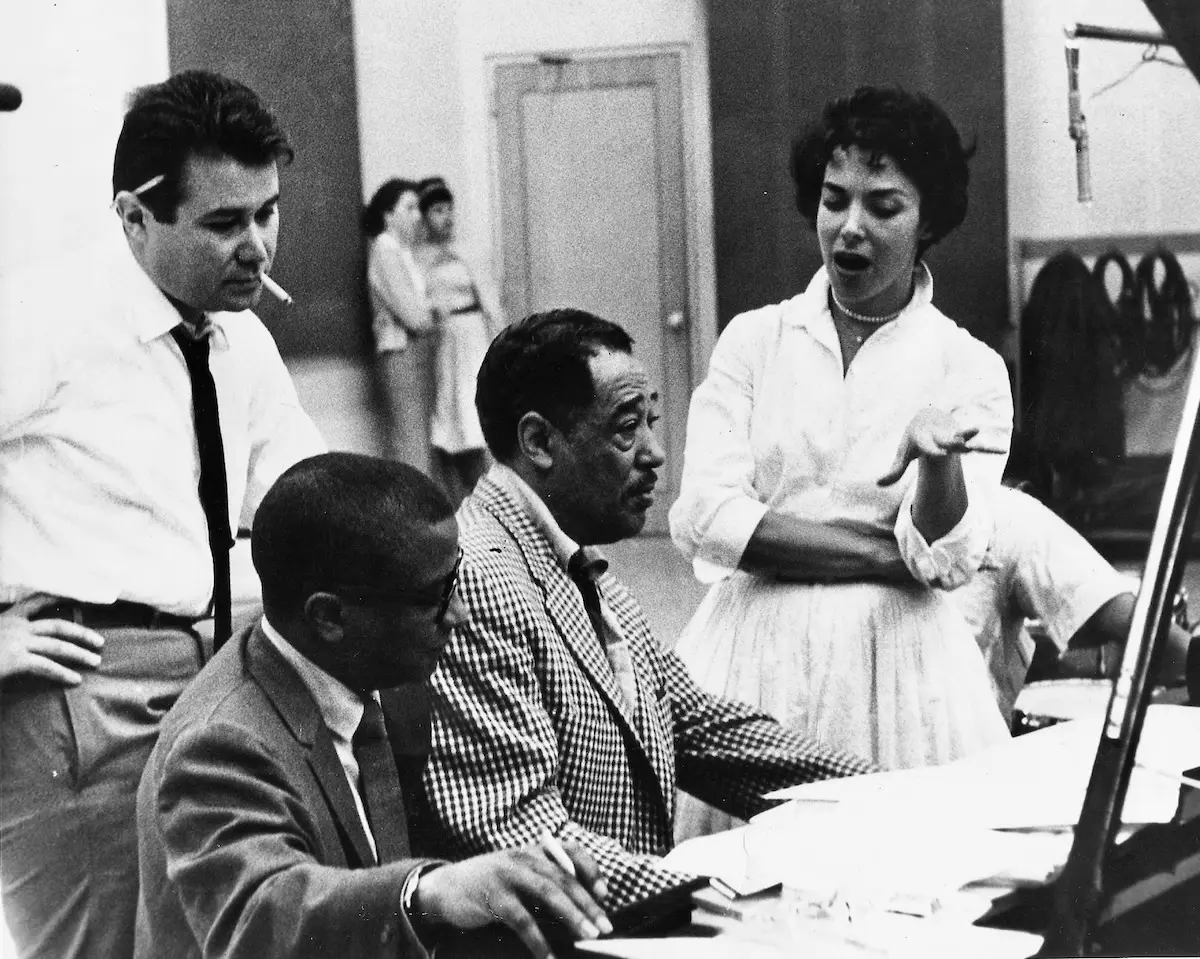
Well, that was a masterpiece by Duke. Really, there is little I can add to what has been said so many times. This to me is the true, real force in jazz. He is a wonderful man, and quite the greatest creator existing in the jazz world today. To be able to take Rhapsody In Blue and to be able to make it sound that way is so wonderful. Paul sounded beautiful, Hodges, of course, and it is splendid just how Jimmy Hamilton fits into the picture. Almost if the piece had been especially written for him. No matter what Duke does it comes out Ellington, and no matter what it was I would be sure to like it. Those two albums I did with Duke for Impulse, the one with Hawkins and the other with Coltrane were full of interest, but I would just love to record the whole band today. One point which may interest you is a visit I had from Johnny Hodges in the office not so long ago. We were talking about the Coltrane recording and he told me that he thought the reading by Coltrane of In A Sentimental Mood was the finest reading he had ever heard – and he added ‘I ought to know for I’ve been playing it for twenty years, but Coltrane’s version is quite beautiful.’ The track, incidentally, was made in one take, which in itself was a funny thing, for Coltrane has never been one to accept a first take. He is a very intense guy and spends so much time on each thing as it is recorded. Many times I have been sure we had a fine take, but Coltrane would always want to do it again, even to coming back another day to make another take. But on that Duke session I was surprised. The very first tune we cut, Duke looked at Coltrane when it was finished and said to me, ‘He’s never going to say it any better than that!’ And so it was left. And the funny thing is that since that date with Duke, Coltrane has come to accept nearly everything he has recorded for us in either one, or at the most two, takes. Somehow he got the message and has become more and more relaxed. As a consequence I think his records have become better and better.
I don’t know, Duke’s feeling towards this avant-garde music, but I know he likes some of it, and particularly some of Coltrane’s music. I know he thinks highly of Elvin Jones and I expect being a very broadminded man, he will look for the good in this ‘new thing’. I must admit that I wasn’t altogether pleased with those other things Duke did for Reprise; his playing of those pop things. But here it is different and for one reason because the tunes are better. When Duke plays those current pop tunes, it is really a waste of his talents, but the Gershwin, and the Kenton piece here, and even Gordon Jenkins’ Goodbye, are so much more musical, for the songs are better than so much of the current rubbish. And, of course, Duke’s interpretations – well, what can one say except it makes me very happy to listen to such a record.
Wrapped Tight. Coleman Hawkins – Wrapped Tight. HMV CLP 1899
It’s nice to hear a record that one has supervised. Coleman is to me another of those few musicians who one can rank with Louis Armstrong, Duke and Hines. I think this is the beginning of a slightly new way of playing for Coleman. I think you are going to be hearing more and more rapid phrases, particularly on the up-tempo things from now on. Hawkins’ breath control is probably not the same as it was when he was a younger man. The time when he used to be able to play those long, long sweeping phrases has gone, so he has now altered his methods somewhat to suit his present physical condition. Of course, it is still pretty exciting the way he plays, his creative energies are as wonderful as ever, but his style of approach has altered now a little. The tenor is a tough instrument, it takes a lot of blowing. Hawkins was particularly pleased with the playing of Barry Harris on that date, incidentally.
Looking back over the years with Hawkins, it occurs to me that he and I must have a good rapport, because it is my opinion that some of the best records he has ever made he has made with me. I am very thankful for that. We get so relaxed at times, that there have been sessions when I wondered if we were ever going to finish the album, but it always has come out right in the end. This album, incidentally, hasn’t yet been issued in the States.
Finally, one last word on Barry Harris. At least two of these tunes hadn’t been seen by Hawkins before he came to the studio, but Harris presented them to him in such a way musically, that Hawkins was able to pick them up without any difficulty at all. Harris was in fact a great help throughout the whole session. One tune on that album And I Still Love You is in part mine. You know, I always go over big with female songwriters, or so they say. But fooling apart, I have written a few songs, and one or two with a girl named Ruth Roberts. This particular tune has some good lyrics by Pauline Rivelli, but you don’t hear them here. If they ever are recorded you will learn something. Sometime in the twenties a mid-west congressman stood up in Congress on Lincoln’s birthday. It was one of the most beautiful things I have ever read, his description of Lincoln. So I read it to Pauline and suggested she wrote a lyric around this speech – and that is what she did. Ruth and I dabbled with the melody and that was that, so to speak.