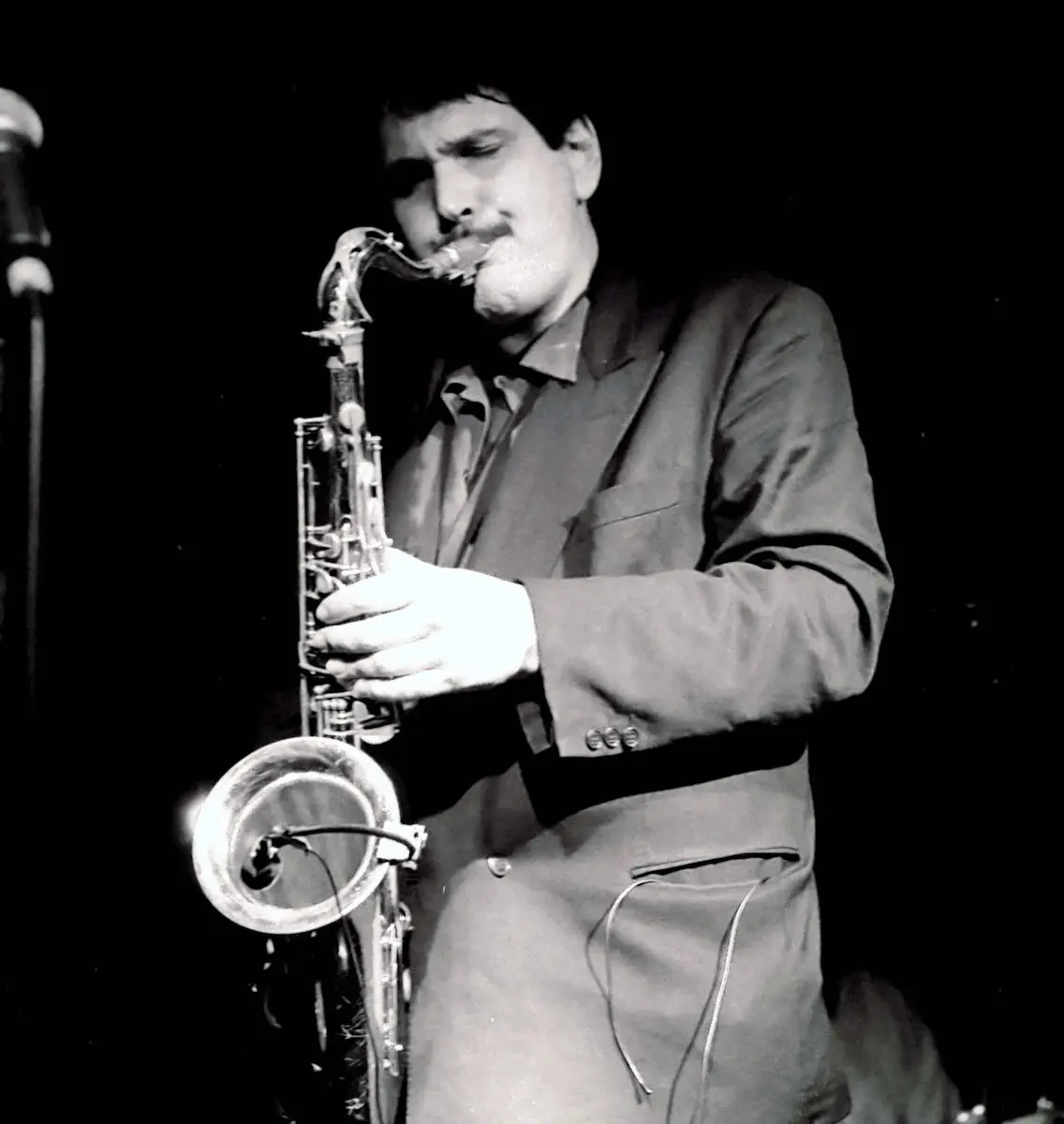
Along with Liebman, Brecker, Berg, Mintzer and others, Steve Grossman is one of the generation of East Coast saxophonists, born in the immediate post-war years, who have consolidated and built on the legacy of Coltrane, Shorter, Rollins and Henderson. Like his peers, he has applied the post-bop vocabulary in rock contexts, famously with Miles Davis, but latterly he has become once again a reliable, thoroughgoing apostle of the hard bop gospel. He talked to Mark Gilbert during a season at Ronnie Scott’s club.
Steve Grossman was born in Brooklyn on January 18, 1951 and took up the alto saxophone in junior school. At 13, together with this trumpet-playing brother Hal (later a teacher at Berklee for 20 years, now an estate agent), he formed an Adderley-style quintet called The Uniques, which played around Pittsburgh. (The family had moved there when Steve’s father, an RCA salesman, had been transferred.) On one Pittsburgh gig, The Uniques opened for Duke Ellington, and an invitation to join the great man followed. Steve declined, but by 16, and back in New York, he was fully professional, notably appearing with drummer Elvin Jones in July 1967. By this time, developments in the music had had a signal effect on Steve’s choice of instrument.
‘I started out listening to Bird and Jackie McLean, just trying to play straightahead. Then I heard Coltrane and that took me for a trip. At first I didn’t know what was happening, but eventually the sound just went through my body.’ Inspired by Coltrane, Steve took up soprano in 1967 and in the following year moved on to tenor. He continued to make connections in New York, playing with such budding talents as Lenny White, Billy Cobham and George Cables in The Jazz Samaritans and jamming at Slugs club on Saturday afternoons with Woody Shaw, Kenny Dorham, Kenny Barron, Gary Bartz and others.
Miles vs. Trane: ‘The rhythm sections – Elvin and McCoy, Tony and Herbie – for me it was obvious which was more what I’d like to hear. I liked Elvin and McCoy more; it was more swinging, just less cerebral’
About the same time, Steve began a course at Juilliard school of music, but this was interrupted by a meeting with Miles Davis at The Village Gate in New York. Interested as ever in young blood, Miles invited Steve to record with him. The result was Great Expectations, the first of Steve’s contributions to some half dozen Miles albums between November 1969 and June 1970. Steve was thrilled to play with one of the legends of modern jazz, and cherishes many of his musical experiences with the band, but his view of Miles’s jazz-rock bands, and of Miles in general, is not without reservations:
‘Well, I liked what the group was doing with (Jack) DeJohnette, and I liked a lot of what Wayne was playing, and Miles, of course. But for the first time in my life I felt at a loss for what to play sometimes. It was a strange feeling. It was maybe too much interference. So I mostly played with the drums, with DeJohnette. They would lay out – Dave (Holland) and Chick (Corea) – and I would just play tenor with the drums. That’s where I felt most comfortable.’
Steve’s fondness for unaccompanied duets with DeJohnette is, of course, a reminder of a similar partnership between Coltrane and Elvin Jones. It also throws light on Grossman’s preferences in a broader sense: ‘After Coltrane died, it was like Miles came back really strongly, but I think Trane put him in the attic for a couple of years. Miles was moving ahead through the sixties, but it was a different thing. The rhythm sections – Elvin and McCoy, Tony and Herbie – for me it was obvious which was more what I’d like to hear. I liked Elvin and McCoy more; it was more swinging, just less cerebral. Coming from straightahead playing, it seemed there was more spirit there, no thinking about it consciously.’
Grossman’s preoccupation with the Coltrane quartet led to other problems with Miles. Although his adoption of the soprano in 1967 had been inspired by Coltrane, his favourite Coltrane sound was the tenor, which he took up in 1968. However, in terms of the Miles gig, his relegation of the soprano and concentration on the tenor was ill-timed: ‘He wanted me to play soprano all the time. He said, you don’t have to bring your tenor. I could see he was very into the sound of soprano and trumpet melodies. But I kept bringing my tenor, kept playing it, and he would splice my tenor solos out of the records. But he liked the tenor and drums.’
Steve’s description of Miles’s working methods at this time confirms the image of a music perpetually in flux: ‘Miles was funny. He would rehearse certain things, just to get the band together and then come in with something different. I notice a lot of the old cats would do that. You know, rehearse one specific thing, and then the day would come around and that specific thing would be gone. It was very spontaneous. He’d change some things right in the middle of the date. Sometimes he would start and then get an idea and then just can it. It was all pretty much Miles directing things, although I heard Dave Holland was suggesting a lot of things to Miles, like playing free. I think anything is free. I like to play something that’s swinging. You can be free on top of that.’
‘When I was with Elvin, a lot of the tunes had a Japanese influence … Elvin’s music was straightahead in that it was swinging, it was just that the harmonies – maybe it was too modal, or the tunes, to me some of them weren’t strong enough’
On leaving Miles, Steve spent some time playing organ combo music with Lonnie Smith and George Benson, but within six months he had renewed his association with Elvin Jones, thus finding the perfect outlet for his passion for tenor and drums. His time with the great drummer was not, however, entirely to his liking: ‘When I was with Elvin, a lot of the tunes had a Japanese influence. I tried to change that, and we rehearsed my tunes which were more straightahead, but it just wasn’t in the air. Elvin’s music was straightahead in that it was swinging, it was just that the harmonies – maybe it was too modal, or the tunes, to me some of them weren’t strong enough.’
Steve had got into Elvin’s band largely through his friend Gene Perla, the band’s bass player. After a few years with Elvin, Perla and Grossman quit to form the fusion-oriented Stone Alliance. Steve was happy with it for a while: ‘For me that group was a chance to play and discover some new material, but they wanted to make a lot of money. They played some rhythms, especially Latin ones, and I just played on top of it. I recorded one album with them, but later Perla and Jan Hammer were on two albums under my name – Some Shapes To Come and Terra Firma. Some of the tunes, that were actually tunes, for me came out best, but they overdubbed a lot – too much percussion.’
After Stone Alliance and his own records on PM (Perla Music Records), Steve had an unsuccessful deal with Atlantic. Only one record, Perspective, came from that contract, with Atlantic effectively paying Steve not to record a second one. Fusion had been the order of the day. Nowadays, Steve is back where his heart belongs, playing strictly out of the straightahead sixties bag. Living in Europe, he made several records in the eighties for the Italian Red Records label. Then in 1991 he signed with the Parisian Dreyfus Jazzline label and has produced two records with top drawer rhythm sections – Do It (with Barry Harris, Art Taylor and Reggie Johnson) and In New York (a live recording with McCoy Tyner, Art Taylor and Avery Sharpe).