Julius Gawlik: It’s All In Your Head
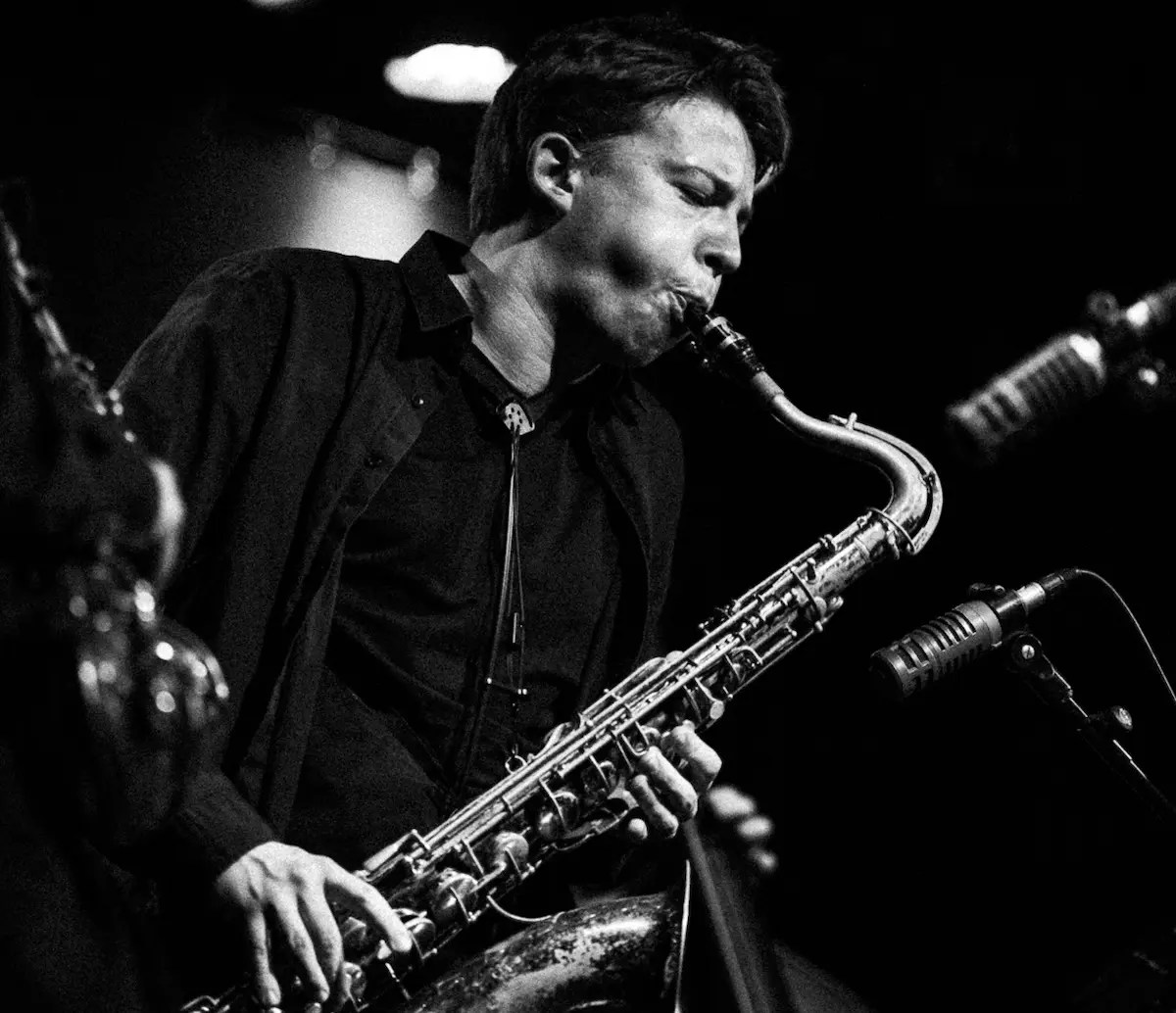
One of the unintended consequences of the rise of jazz education is that as technical proficiency has generally increased it has become harder for artists to stand out. Solid foundations are no longer enough in and of themselves, and those destined for greater things increasingly opt for a hybrid approach which fuses old-fashioned mentorship with a wide range of collaborations and performance opportunities. This has been the path chosen by German saxophonist and clarinetist Julius Gawlik (b. 1997), whose academic distinctions include an Outstanding Soloist Scholarship at Temple University (Philadelphia) and a comparable accolade from the Karl Hofer Gesellschaft in Berlin. Mentors and collaborators have included Jim Black, John Hollenbeck, George Garzone and the Ensemble Modern, and at the age of just 23 he became the youngest ever member of the NDR Bigband, filling the estimable shoes of Christof Lauer.
Yet no selective resumé adequately prepares you for the depth, maturity and sense of adventure displayed on this, Gawlik’s debut as leader. Inspired by the semi-abstract late 60s sound-worlds of Andrew Hill, his dark, angular themes only achieve their potential when subjected to the rigours of performance. He is joined by three well-established collaborators whose paths have often intersected, and the vibraphone of Evi Filippou proves to be a key ingredient, engendering an ever-present sense of harmonic ambiguity. Both Donkin and Black can move from tight groove to open-ended abstraction at the flick of a switch, qualities abundantly in evidence on the shape-shifting opener.
The high-octane free-bop of Fuchs is a real tour de force, Gawlik’s urgency reminding me of Lauer, while Chicago is a veritable kaleidoscope of shifting colours and pulses. The labyrinthine You Wish is more introspective and features Gawlik’s woody clarinet, while the sonic explorations of Glow speak to Ligeti, revealing another facet of his persona. TSCH, meanwhile, encapsulates the full gamut of group’s range, balancing sharp-edged clarity with a fiery collective intensity, and it’s a suitably impressive coda to one of the most remarkable debuts I’ve heard for some time.
Discography
There Are No Ugly Dogs; You Wish; Fuchs; Glow; Chicago; TSCH (37.17)
Gawlik (ts, cl); Evi Filippou (vib); Phil Donkin (b); Jim Black (d). Hansa Studio, Berlin.
Unit Records 5268
Rasmus Oppenhagen Krogh: Pillars
Often compared to his compatriot Jakob Bro, young Danish guitarist Rasmus Oppenhagen Krogh (b. 1994) shares many characteristics in common with his famous peer. Both are extremely thoughtful players, prioritising subtlety and feeling over ostentatious displays of technique, and both follow a path which, to varying degrees, leads towards Bill Frisell. Yet there are also significant points of difference between the two, Krogh generally favouring shorter song-form structures and embracing the sounds of post-rock and electronica, making him more of an Esbjörn Svensson-like figure relative to Bro’s open-ended post-ECM improvisational aesthetic.
Pillars is his fourth album as leader, and the nucleus of this ensemble has been remarkably consistent from album to album. Both Christensen and Høyer are associated with Bro, sharpening the inevitable comparisons, while Greve and Dybbroe are members of acclaimed jazz-electronica outfit Girls In Airports. The perennially brilliant Simon Toldam meanwhile operates as a libero, completely connected to the group but with licence to add colour, texture and harmony, while Rasmus Juncker’s studio savvy mix gives a bold contemporary sheen.
The album’s title refers to the fundamental feelings and connections which define us as people, and the 10 pieces have a through-composed consistency and an emotional gravity befitting such a theme. Krogh’s melodic lines are invariably crisp and memorable, their quality unwavering throughout. The ruminative Sooner Or Later and the emotionally direct title track are as solid an opening as you could wish, Simulacrum introduces a hint of prairie Americana, while The Bell On The Hillside falls into two distinct sections, its hazy theme morphing into a cinematic passage which recalls David Grubbs and Jim O’Rourke’s Gastr del Sol. Greve’s lyrical saxophone imparts fragile optimism to Hope, a feeling echoed on Namesake, where Krogh draws on the rural nostalgia of Frisell, while Toldam’s reflective solo on June introduces an enticing hint of wayward rubato. The extent to which Krogh is growing as a composer is striking, and Pillars is a confident statement from an artist on the move.
Discography
Sooner Or Later; Pillars; Look Ahead; Simulacram; The Bell On The Hillside; Summit; Hope; Branches; Namesake; June (38.42)
Oppenhagen Krogh (g, elg); Lars Greve (ts, ss, fx); Simon Toldam (p, kyb); Anders Christensen (elb); Victor Dybbroe (pc); Jakob Høyer (d). No date. MillFactory Studio B, Copenhagen.
April Records APR 152 LP & CD
Joachim Kühn with Daniel Humair & Jean-François Jenny-Clark: On Tour 1992-1993
I’m usually pretty nonplussed when archive tapes are unearthed several decades after the event, but there are occasions when a release simply demands my attention. The trio of Joachim Kühn, Jean-François Jenny-Clark and Daniel Humair were seminally important to me as a wide-eyed teen discovering contemporary jazz in the late 80s, their exhilarating blend of freedom, sophistication and joie de vivre knocking me sideways. I was delighted in 2014 when ACT Music unearthed an album of previously unreleased material by the trio as part of a repackaged edition of Kühn’s Europeana Suite, and this stunning collection from archivists extraordinaire Frémeaux & Associés feels every bit as significant.
Capturing the trio at their creative peak, the five lengthy workouts were recorded in three separate locations between May 1992 and May 1993 and are beautifully presented in a slip-case which is adorned with one of Humair’s striking abstract geometric paintings. While the recordings lack some of fine detail of Walter Quintus’s productions, they nevertheless compare well to CMP’s contemporaneously released Live, Théâtre De La Ville, Paris, 1989. Save for the modal deconstruction of the Gershwin brothers’ Summertime all of the pieces have appeared in various guises on the trio’s official albums, but they’re approached with such daring high-wire creativity that it’s as if we’re hearing them afresh.
Opening with Coltrane’s modal classic India, the trio briefly pay respect to its majestic theme before launching headlong into 12 and a half minutes of wide-reaching improvisation. Kühn’s Heavy Hanging is next, darker and more reflective, and it’s followed by expansive re-examinations of Guylène and From Time To Time Free. The first features chorus after chorus of cascading piano gymnastics, the trio constantly stretching the tempo, while the latter is a 20-minute tour de force during which, one-by-one, pushes everybody to their limits. Summertime is perhaps more conventional, sticking closer to the Coltrane quartet’s vision, but it’s nevertheless another spirited reminder of why I first fell in love with this trio’s life-affirming music almost 40 years ago.
Discography
India: Heavy Hanging; Guylène; From Time To Time Free; Summertime (71.00)
Kühn (p); Jean-François Jenny-Clark (b); Daniel Humair (d). Mainz, Metz and Chambéry between May 1992 and May 1993.
Frémeaux & Associés FA8621