
Sliders: Sliders
The eponymous debut recording by Bristol-based instrumental quartet Sliders is released on saxophonist, flautist and composer Kevin Figes’ label Pig Records, which he founded in 2010. The group comprises Neil Smith (guitar), Dan Moore (keyboards, synthesizers), Harry Stoneham (electric bass) and Chris Langton (drums). The band reveals that its influences range from Tortoise and Medeski Martin & Wood to Sonic Youth and Can and its sound is a mix of psych, motorik, dance music, jazz and skronk (experimental deliberate dissonance). There’s also a leaning towards improvisation, as clearly signposted on two tracks titled Improv #1 and Improv #2, both containing space-rock elements due in part to Moore’s deployment of a paraphonic synthesizer which unlike a polyphonic synth can play multiple pitches at once. But there are also some carefully crafted pieces such as Rumba For Hulk Hogan, whose haunting opening melody evinces a passing reminiscence of Edwin Astley’s theme tune for the 1960s television show Randall & Hopkirk (Deceased) whilst also sharing an attractive, eerie feel.
The opener, Jumper, is nearer to, say, the instrumental sections of Robert Wyatt’s Matching Mole albums due to the tight bass line, the spacey psych-rock of Moore’s synth and the tintinnabulating Fender Rhodes and especially to Smith’s liquid single guitar notes. Kraut Crouch is the nearest the album comes to pastoral but it’s hardly that at all, just a gentle, memorable tune that develops with subtly pulsating ostinato drum and bass underpinning Smith’s elegant guitar work and Moore’s keyboard extemporisation. The menacingly moody Hip Priest oscillates between angry guitar crescendo and swirling synth but retains throughout a sense of order. Meanwhile, the almost playful start to Zummerzova soon deconstructs both its tune and time signatures. But ultimately, here and elsewhere it’s the essential rhythm section that holds the compositions together, allowing the front-line instruments to dazzle. Operating in waters already chartered by the likes of Acoustic Ladyland, Led Bib and Polar Bear, Sliders is a band to watch since they bring a novel approach to collective semi-improvised music and this opening salvo is replete with compelling, mesmeric gems.
Discography
Jumper; Krut Crouch; Rumba For Hulk Hogan; Improv #2; Hip Priest; Zummerzova; Improv #1 (40.17)
Neil Smith (elg); Dan Moore (kyb, syn); Harry Stoneham (elb); Chris Langton (d). Bristol, spring 2024.
Pig Records Pig 17
Ragawerk: Nila
This is the successor to Ragawerk’s eponymous debut album (L+R/Bellaphon Records, 2022). With a line-up led by Max Clouth on guitar and Martin Standke on drums, electronics and additional keyboards, Ragawerk has picked up where it left off, purveying its idiosyncratic Indian meets Western brand of music. Whilst the instrumentation of this tight ensemble is predominantly Western-based, there are some Indian percussion instruments involved, such as tabla and mridangam.
After studying jazz guitar at the University of Mainz, Frankfurt-born Clouth lived in Mumbai for three years studying music and immersing himself in India’s traditions and its sounds. Standke studied music at Frankfurt University of Music and Performing Arts and later studied jazz percussion at Cologne University of Music.
Clouth has mastered the challenging task of adapting his guitar style to emulate at times a sitar, as heard on the concluding section of Soledad. Few guitarists have managed this feat although one famous exponent was Mumbai-born jazz guitarist Amancio D’Silva; Clouth’s opening silvery guitar notes on the title track bear some comparison to that Indian improviser. On other occasions, such as Shyam and Computerwelt, Clouth sounds positively John McLaughlin-esque in terms of his lightning fluidity. Karela, with its South Asian musical influences, percussion and wordless vocals, fuses Clouth’s electric guitar soloing with an electrocharged version of Shakti. Blue P and its Blue P Reprise outro version contain a probably unintentional snatch of the melody to Irving Berlin’s Puttin’ On The Ritz, the net result of which serves to consolidate an earworm. The intense, thermonuclear bluesiness of Relegadi is worthy of Jeff Beck in its intensity and serves as yet another indelible takeaway from this wholly imaginative offering.
Discography
Niḷa; Shyam; Soledad; Karela; Computerwelt; Blue P; Relagadi; Merkur; Charukeshi; Blue P Reprise (54.03)
Max Clouth (elg); Martin Standke (d, elec, kyb); Vroni Frisch (b); Robert Schippers (kyb); BC Manjunath (mridangam); Peter Hinz (tab); Shruti Ramani, Sophie-Justine Herr (v). Frankfurt, no date.
O-Tone Music OT 074-2
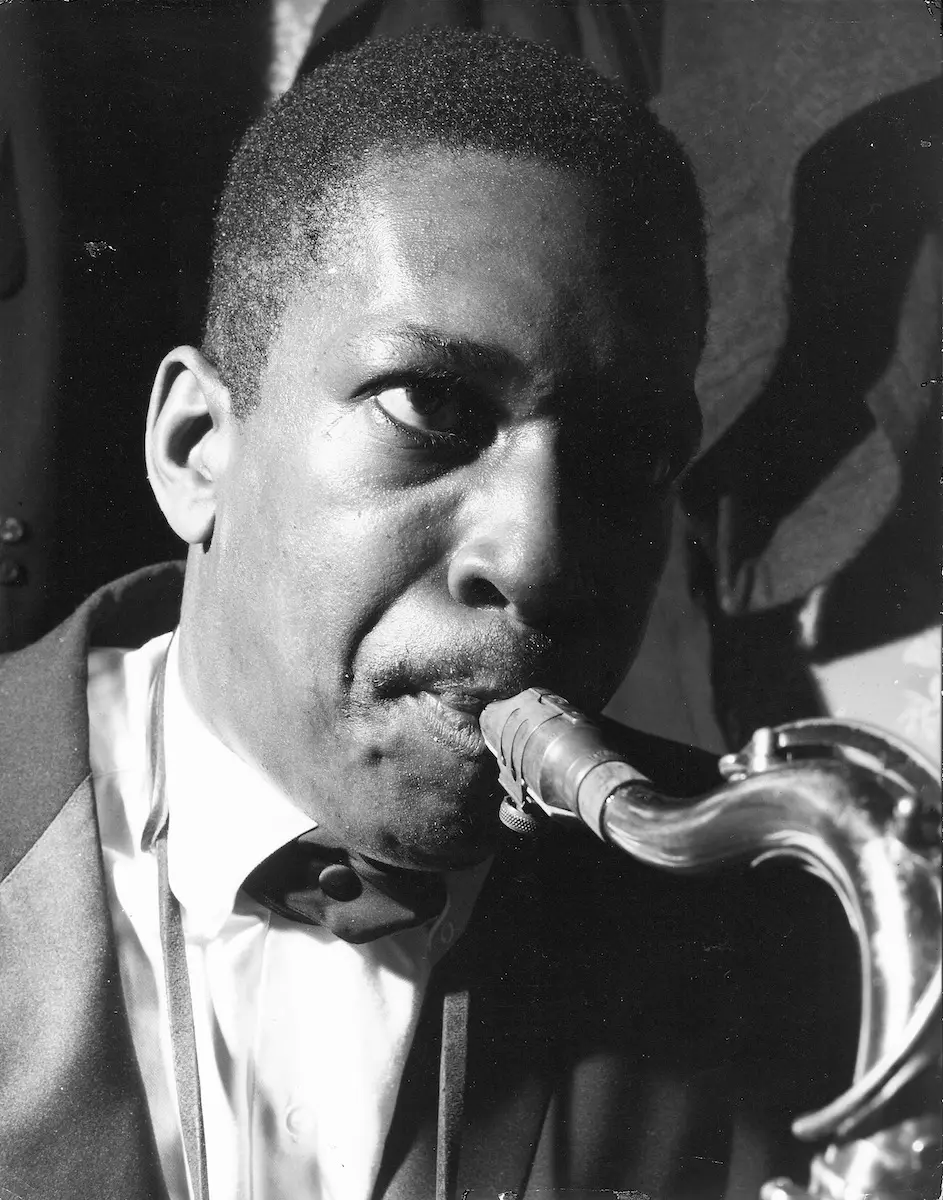
John Coltrane: Essential Coltrane
Out of the say, half dozen musicians who radically changed the course of jazz – and indeed music – John Coltrane probably ranks within the top two places, especially considering Trane’s life was cut short at just 40 years of age whereas Miles Davis – who might, arguably, be regarded as the genre’s greatest innovator – survived him by almost 25 years and therefore managed a much greater output of recordings. But Coltrane’s oeuvre runs deep and this best-of collection doesn’t even include his most commonly cited greatest achievement, A Love Supreme (Impulse!, 1965). Essential Coltrane is released in two formats, LP and CD, but the former only contains eight tracks whereas the CD offers 12 so makes for a much more comprehensive primer. Either format though would hopefully convert any newbie listener.
The opening track on the both vinyl and CD is Blue Train, the title track to the saxophonist’s only outing on Blue Note, which would surely grab the attention of most people on first hearing. Then on both media there are three tracks from Giant Steps (Atlantic, 1960) including, predictably, the serpentine title track, plus Mr P.C. and Naima. Another shared treasure is In A Sentimental Mood from the album Duke Ellington & John Coltrane (Impulse!, 1963), one of the most emotionally charged renditions of that famous ballad ever recorded. Also jointly included is the 14-minute My Favorite Things from the album of the same name (Atlantic, 1961), which became one of Coltrane’s signature tunes.
For a “greatest hits” collection and with a caveat that inclusion of tracks from A Love Supreme would necessarily have lost the essential context of the full album, there are some debatable omissions such as Impressions, After The Rain, Afro Blue and Lonnie’s Lament, to name just a few. The CD’s inclusion of It’s Easy To Remember, Ruby, My Dear, Why Was I Born? and Theme For Ernie, whilst these are unarguably fine tracks, suggests quite arbitrary choices, allowing that collections such as this will inevitably be to an extent subjective: everyone has their favourite Trane tracks. That said, this aggregation probably makes more sense than opting for anything from Coltrane’s later free period, i.e. from Ascension (Impulse!, 1966) onwards, which might necessitate, for novices, a quantum leap in appreciation. However, as a starting point for listening to Coltrane – or even modern jazz as a whole (Ellington, Kenny Burrell, and Thelonious Monk are all incidentally represented here too) – both formats yield excellent sets.
Discography
Blue Train; Giant Steps; Equinox; In A Sentimental Mood; My Favorite Things; Mr. P.C.; It’s Easy To Remember; Ruby, My Dear; Why Was I Born?; Theme For Ernie; My Little Brown Book; Naima (76.29)
Coltrane (ss, ts); Lee Morgan (t); Curtis Fuller (tb); Kenny Burrell (g); Wynton Kelly, Red Garland, Tommy Flanagan, McCoy Tyner, Duke Ellington, Thelonious Monk (p); Jimmy Garrison, Paul Chambers (b); Elvin Jones, Art Taylor, Philly Joe Jones (d) and others. New York, 1957-1962.
New Continent 648082 (CD)